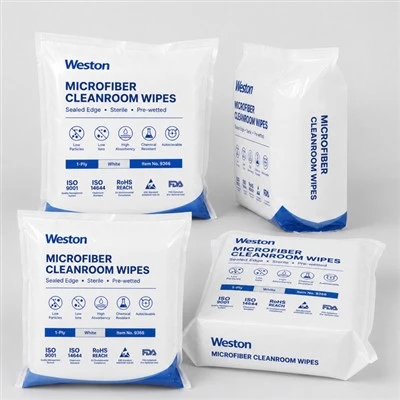
ESD Cleanroom Wipes - Laser-Sealed Edge, 9" × 9"
A conductive-fiber cleanroom wipe that pulls particulate and drains static charge in the same pass, built for use inside ISO Class 4 (Class 10) cleanrooms.

Why this wipe is different
Most cleanroom wipes handle either particle removal or static control well, and compromise on the other. This wipe is woven - not laminated or coated - with conductive filament running through a polyester (or polyester-nylon) base, so the anti-static performance doesn't wash off, wear thin, or fade after repeated handling.
Core Product Features
Conductive grid weave, not a surface coating
Woven from polyester or polyester-nylon filament interlaced with high-performance conductive yarn. Because the conductivity is built into the weave structure itself, it holds up over the life of the wipe instead of degrading after a few uses like sprayed-on anti-static treatments.
01
Surface resistance tuned for ESD-sensitive handling
Surface resistivity of 10⁵–10¹¹ Ω - wipes down microdust while actively pulling static charge away from the component or surface being cleaned, instead of just moving dust around.
02
Fast static dissipation
Static decay time under 1.5 seconds, with triboelectric (friction-generated) voltage kept below 100V. Both values can be tuned to a customer's process requirements.
03
Laser-sealed edges
Edges are laser-cut and sealed rather than pinked or pressed, which stops the fraying and loose-fiber shedding that ordinary cut edges produce - important in any environment where a stray thread is itself a contamination risk.
04
Configurable conductive fiber spacing
Conductive yarn spacing can be adjusted (1cm, 1.5cm, 2cm, or custom) depending on how aggressive the anti-static requirement is for a given line.
05
Product Specifications
|
Attribute |
Value |
Spec Tolerance |
Test Method |
|
Material |
100% Polyester |
- |
- |
|
Size (L × W) |
22.7 × 22.4 cm (≈9" × 9") |
22.8 ± 5% |
IEST-RP-CC004.3 |
|
Thickness |
420 μm |
300–500 μm |
IEST-RP-CC004.3 |
|
Basis weight |
118 g/m² |
120 ± 5% |
IEST-RP-CC004.3 |
|
Sorbency, intrinsic |
2.76 cc/g |
≥ 2.5 cc/g |
IEST-RP-CC004.3 |
|
Sorbency, extrinsic |
346.72 cc/m² |
≥ 260 cc/m² |
IEST-RP-CC004.3 |
|
Sorptive rate |
1 second |
≤ 5 seconds |
IEST-RP-CC004.3 |
|
Particle count (≥0.3μm) |
123 |
≤ 300 (Ea/ft³) |
IEST-RP-CC004.3 |
|
Surface resistance |
10⁵–10¹¹ Ω |
Process-adjustable |
- |
|
Static decay time |
< 1.5 seconds |
Process-adjustable |
- |
|
Triboelectric voltage |
< 100V |
Process-adjustable |
- |
|
Edge finish |
Laser-sealed |
- |
- |
|
Conductive fiber spacing |
1cm / 1.5cm / 2cm (custom available) |
- |
- |
Compliance & Test Report Summary
Every production batch is tested for restricted substances. Below is a summary of results from Test Report No. CANEC25022464207, run to IEC 62321 (equivalent to EN 62321) using ICP-OES/AAS, UV-Vis, and GC-MS. Limits referenced are from RoHS Directive (EU) 2015/863.
|
Test Item |
Limit |
Unit |
MDL |
Result |
|
Lead (Pb) |
1000 |
mg/kg |
2 |
ND |
|
Mercury (Hg) |
1000 |
mg/kg |
2 |
ND |
|
Cadmium (Cd) |
100 |
mg/kg |
2 |
ND |
|
Hexavalent Chromium (Cr(VI)) |
1000 |
mg/kg |
8 |
ND |
|
Sum of Polybrominated Biphenyls (PBB) |
1000 |
mg/kg |
- |
ND |
|
Sum of Polybrominated Diphenyl Ethers (PBDE) |
1000 |
mg/kg |
- |
ND |
|
DEHP |
1000 |
mg/kg |
50 |
ND |
|
BBP |
1000 |
mg/kg |
50 |
ND |
|
DBP |
1000 |
mg/kg |
50 |
ND |
|
DIBP |
1000 |
mg/kg |
50 |
ND |
All individual mono- through deca-brominated biphenyl and diphenyl ether homologues were also tested individually and reported as ND (MDL 25 mg/kg each). Full results available on request.
Additional documentation available:
- RoHS Test Report
- Halogen Content Report
- Silicone Oil Test Report
- Metal Ion Report
- Breaking (Tensile) Strength Report
- Cleanliness / Particle Report (IEST method)
Where This Wipe Is Used
ISO Class 4 (Class 10) cleaning and packaging
Each production batch is checked against the anti-static values above before release, so the wipe's ESD performance is confirmed lot-by-lot rather than assumed from a spec sheet.
Cleanliness verified to IEST protocol
Particle shed and absorbency are measured using IEST-RP-CC004.3 methodology, the same standard referenced in the spec table above - so cleanroom QA teams can cross-check incoming lots against a known test method rather than a proprietary one.
Process-matched conductive spacing
Because conductive fiber spacing is configurable, the same base wipe can be tuned for lines with different static sensitivity - for example, a wider 2cm spacing for general handling areas, and a tighter 1cm spacing for stations handling unpackaged ESD-sensitive components.
Example use case
A semiconductor packaging line handling unshielded components between test and tray-loading steps needed a wipe that wouldn't leave fibers on tray surfaces (laser-sealed edge) and could bring triboelectric charge on the component surface below 100V before the next handling step (met by the <1.5s static decay spec). Batch-level anti-static verification let the line's incoming QC skip a secondary in-house resistance check.
Frequently Asked Questions
Hot Tags: ESD cleanroom wipes, China ESD cleanroom wipes manufacturers, suppliers, factory, cleanroom wipers, Cleanroom Wipes 9x9, ESD Cleanroom Wipes, Heavy Weight Polyester Absorbent Cleanroom Wipes, Microfiber Cleanroom Wipes, Nano Scale Ultra Fine Cleanroom Wipes