


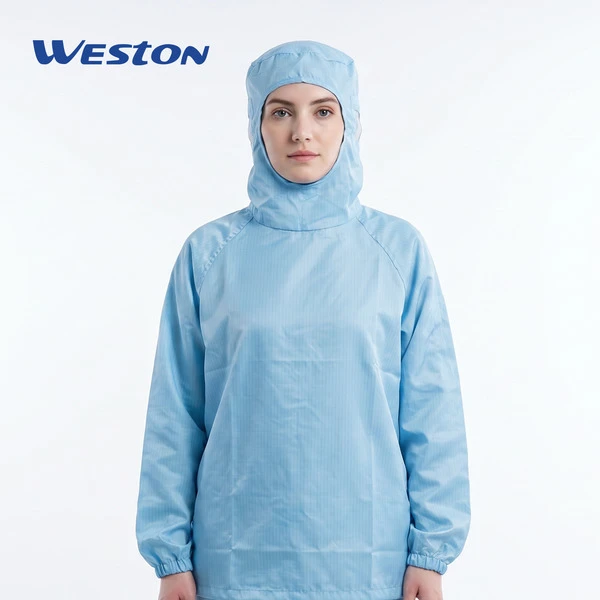
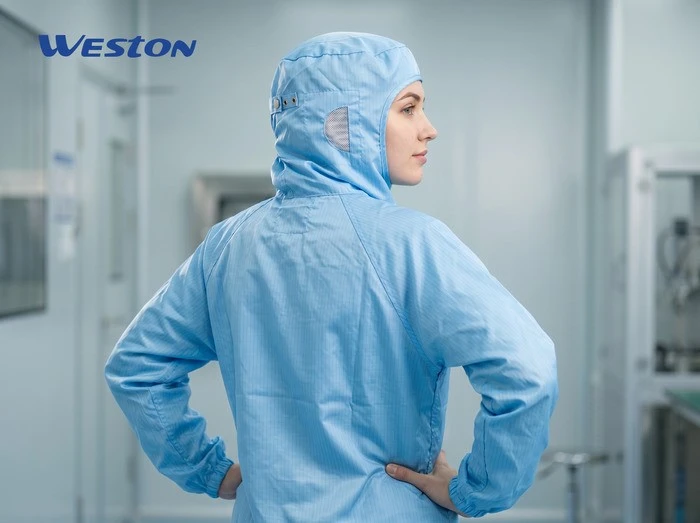
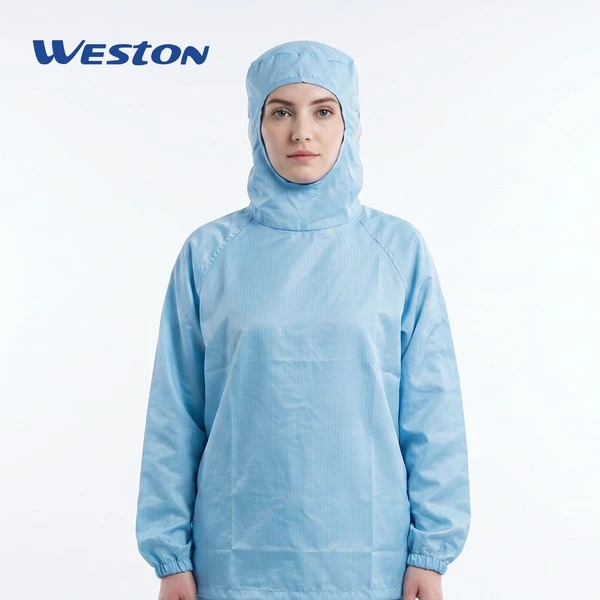
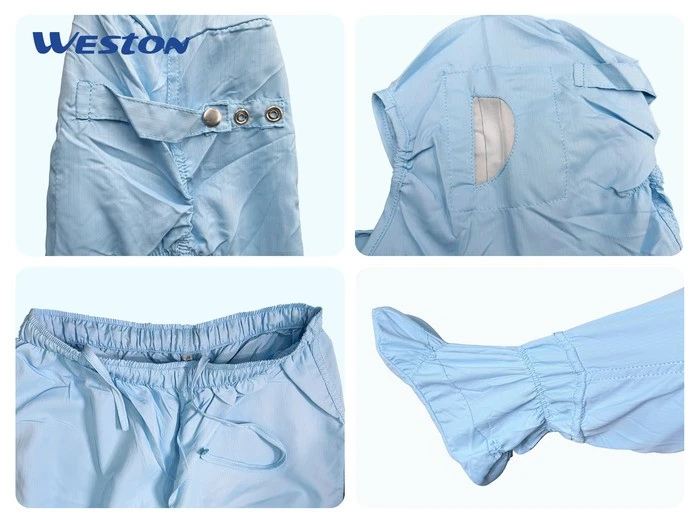


ESD Hooded Cleanroom Separate Suit - WN-213
A two-piece anti-static cleanroom suit engineered for Class 1,000 and above environments, combining full-body contamination control with the mobility a separate-style design delivers.

Why Separate-Style Matters
Most cleanroom suits force a trade-off: full coverage or free movement. The WN-213 rejects that compromise. The hooded jacket and pants operate as independent pieces, so when you crouch at a workbench, reach overhead to adjust equipment, or bend repeatedly during a production run, the suit moves with you - not against you.
Core Product Features
Anti-Static Fabric That Passes Wash Durability Testing
The 100D striped fabric (99% polyester + 1% conductive fiber) meets GB 12014-2019. Surface resistivity stays within 1.0×10⁵–1.0×10¹¹ Ω even after 15 wash cycles - confirmed by third-party lab testing.
01
Hood Integrated into the Jacket
The attached hood shields hair, scalp, and neck from particulate fallout and droplets. No separate hood to track, store, or forget. Combined with the pants, the suit achieves near-complete body coverage with minimal exposed surface area.
02
Separate Two-Piece Construction
The jacket and pants are sized and worn independently. This matters during long shifts: workers can adjust fit at the waist, move more naturally between standing and squatting positions, and replace one component without discarding the entire suit.
03
Air Particle Filtration Verified by Testing
At 0.5 μm particle diameter, filtration efficiency reaches 88.0%. At 1 μm, it reaches 93.4% - both results exceeding the Grade 2 requirement of ≥35% and ≥50% respectively.
04
Available in 7 Colors
White, Blue, Pink, Yellow, Green, Grey, Navy (Cyan). Color-coding by department, role, or zone is straightforward without ordering a custom product.
05
Technical Specifications
|
Parameter |
Detail |
|
Model |
WN-213 |
|
Fabric |
100D Stripe |
|
Material Composition |
99% Polyester + 1% Conductive Fiber |
|
Style |
Separate suit: hooded jacket + pants |
|
Applicable Cleanroom Grade |
Class C / D / 10,000 / 100,000 (ISO equivalent) |
|
Execution Standard |
GB 12014-2019 |
|
Applicable Industries |
Biopharmaceutical, Medical Device, Solar/Photovoltaic |
|
Available Colors |
White, Blue, Pink, Yellow, Green, Grey, Navy |
Test Report Data - Report No. STFWT20253103G
All results below are from third-party laboratory testing. Individual judgment: Pass on all items.
|
# |
Test Item |
Unit |
Requirement |
Result |
|
1 |
Breaking Strength (Warp) |
N |
≥490 |
1200 |
|
1 |
Breaking Strength (Weft) |
N |
≥390 |
770 |
|
2 |
Abrasion Resistance Index |
- |
Grade 2: ≥10 times/mg |
41 times/mg |
|
3 |
Surface Resistivity (pre-wash) |
Ω |
1.0×10⁵ ~ 1.0×10¹¹ |
6.3×10⁸ |
|
3 |
Triboelectric Voltage - Wool (pre-wash) |
V |
Grade 2: ≤1000 |
44 |
|
3 |
Triboelectric Voltage - Cotton (pre-wash) |
V |
Grade 2: ≤1000 |
137 |
|
4 |
After 15 Wash Cycles - Surface Resistivity |
Ω |
1.0×10⁵ ~ 1.0×10¹¹ |
5.9×10⁸ |
|
4 |
After 15 Wash Cycles - Triboelectric Voltage (Wool) |
V |
Grade 2: ≤1000 |
46 |
|
4 |
After 15 Wash Cycles - Triboelectric Voltage (Cotton) |
V |
Grade 2: ≤1000 |
143 |
|
5 |
Air Particle Filtration Efficiency (0.5 μm) |
% |
Grade 2: ≥35 |
88.0 |
|
5 |
Air Particle Filtration Efficiency (1 μm) |
% |
Grade 2: ≥50 |
93.4 |
Breaking strength at 1200 N (warp) is more than double the required minimum. Filtration results at both particle sizes clear the standard by a significant margin.
Where This Suit Is Used
In sterile filling environments operating at ISO Class 7 or 8 (Grade C/D), operators move between equipment positions frequently. The separate design means technicians can crouch to inspect filling nozzles or reach across isolators without the jacket riding up and exposing the waist - a contamination risk point common in one-piece suits. The hood keeps hair fully enclosed during extended shifts under laminar airflow hoods.
A medical device manufacturer sourcing WN-213 suits for their PCB-adjacent device assembly line cited two reasons: the triboelectric voltage results (44 V with wool, 137 V with cotton, both well under the 1000 V ceiling) and the wash durability data. Their cleanroom laundry cycle runs every 48 hours; suits that degrade in anti-static performance after repeated washing are a compliance liability. After 15 washes, the WN-213's surface resistivity (5.9×10⁸ Ω) remained squarely within spec.
Photovoltaic manufacturing lines handle materials sensitive to both particulate contamination and electrostatic discharge. The WN-213's 88.0% filtration efficiency at 0.5 μm addresses the particulate side; the conductive fiber construction handles ESD. Workers on cell stringing and module lamination lines benefit from the flexibility the two-piece design provides during repetitive, precision hand tasks.
Frequently Asked Questions
Hot Tags: ESD hooded cleanroom separate suit, China ESD hooded cleanroom separate suit manufacturers, suppliers, factory, Cleanroom Bouffant Cap, cleanroom coverall, Disposable Protective Cap, ESD Cleanroom Smock, ESD Hooded Cleanroom Separate Suit, PP Cleanroom Garment With Hook Loop Fastener


