


Microfiber Cleanroom Swabs | 100 mm PP Handle | Westonwiper
Precision Cleaning Starts at the Contact Surface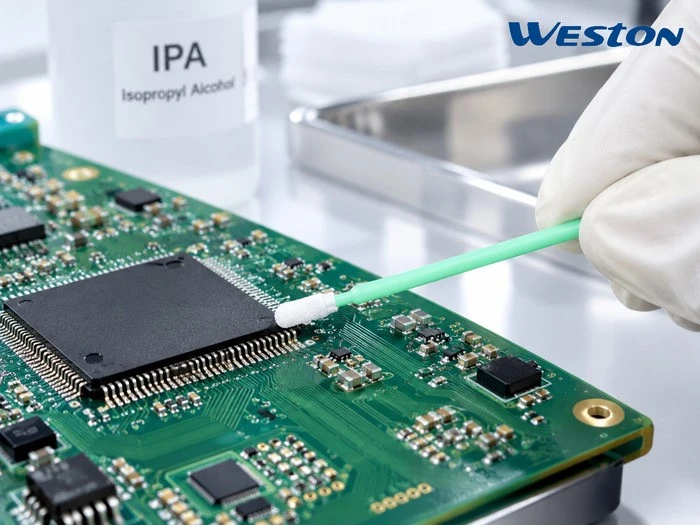
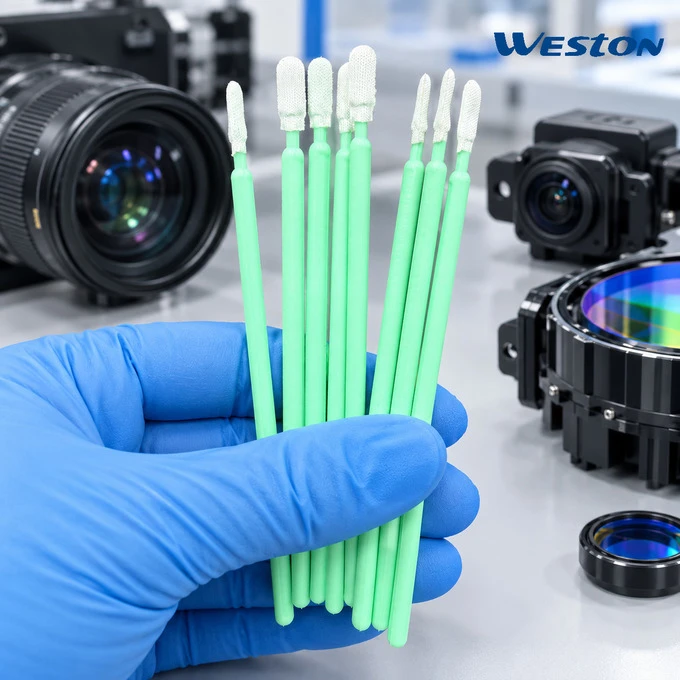
Small cleaning areas need a tool that is easy to position and gentle at the point of contact. Westonwiper microfiber cleanroom swabs combine a flat woven microfiber head with a rigid polypropylene handle for controlled, localised wiping.
Made with quality raw materials and cleanroom-laundered before use, these swabs are designed for precision-cleaning tasks, including carefully controlled printhead maintenance. The soft fabric provides a gentle contact surface, while the firm handle helps operators guide each wipe.
The standard configuration measures 100 mm overall, with a 4 mm handle diameter and a nominal 4.3 mm head diameter. Blue and green options are available.
Core Product Features
|
Soft woven microfiber head |
The fabric head provides gentle wiping contact for delicate cleaning areas. For printhead maintenance, use light pressure and follow the equipment manufacturer's cleaning instructions. |
|
Heat-bonded head attachment |
Thermal bonding secures the microfiber head to the PP handle. This construction helps reduce the risk of head separation associated with solvent attack on adhesive joints. |
|
Rigid polypropylene handle |
The firm 4 mm shaft supports steady positioning during localised cleaning, particularly where a folded wipe is difficult to control. |
|
Flat head for targeted wiping |
The compact profile helps operators clean defined areas without unnecessarily contacting surrounding surfaces. |
|
Cleanroom-laundered construction |
The swabs undergo cleanroom laundering as part of production. Blue and green options allow visual separation between designated cleaning tasks. |
Product Specifications
|
Parameter |
Specification |
|
Product name |
Microfiber Cleanroom Swabs |
|
Brand |
Westonwiper |
|
Head material |
Woven microfiber fabric |
|
Head profile |
Flat |
|
Nominal head diameter |
Ø4.3 mm |
|
Handle material |
Polypropylene (PP) |
|
Handle diameter |
Ø4 mm |
|
Overall length |
100 mm |
|
Head attachment |
Thermal bonding |
|
Cleaning process |
Cleanroom laundering |
|
Standard colour options |
Blue and green |
Material Testing: SGS RoHS Restricted Substances
The supporting SGS report identifies the submitted sample as white fabric, sample A1, with SGS sample ID TAO26-0052245-0001.C001. The supplied excerpts report testing for substances restricted under RoHS Directive (EU) 2015/863, amending Annex II to Directive 2011/65/EU.
All listed restricted substances were reported as not detected at the applicable method detection limits. These results relate to the submitted white fabric sample, not the complete assembled swab.
Restricted Substance Test Results
|
Substance |
Reported limit (mg/kg) |
Method detection limit (mg/kg) |
Result |
|
Lead (Pb) |
1,000 |
2 |
ND |
|
Mercury (Hg) |
1,000 |
2 |
ND |
|
Cadmium (Cd) |
100 |
2 |
ND |
|
Hexavalent chromium [Cr(VI)] |
1,000 |
8 |
ND |
|
Polybrominated biphenyls (PBB) |
1,000 |
25 per listed constituent |
ND |
|
Polybrominated diphenyl ethers (PBDE) |
1,000 |
25 per listed constituent |
ND |
|
Bis(2-ethylhexyl) phthalate (DEHP) |
1,000 |
50 |
ND |
|
Butyl benzyl phthalate (BBP) |
1,000 |
50 |
ND |
|
Dibutyl phthalate (DBP) |
1,000 |
50 |
ND |
|
Diisobutyl phthalate (DIBP) |
1,000 |
50 |
ND |
Test Methods and Scopes
|
Item |
Report information |
|
Testing laboratory |
SGS |
|
Sample description |
White fabric |
|
Sample number |
A1 |
|
SGS sample ID |
TAO26-0052245-0001.C001 |
|
Referenced methods |
IEC 62321-4:2013+AMD1:2017; IEC 62321-5:2013; IEC 62321-7-2:2017; IEC 62321-12:2023 |
|
Analytical techniques |
ICP-OES/AAS, UV-Vis and GC-MS |
ND means not detected below the applicable method detection limit; it does not mean an absolute concentration of zero. These excerpts do not establish particle-release performance, non-volatile residue levels, ionic cleanliness, solvent compatibility or a cleanroom classification. They also do not separately identify the PP handle or blue and green components as tested samples.
Application Scenarios
Precision Equipment Maintenance
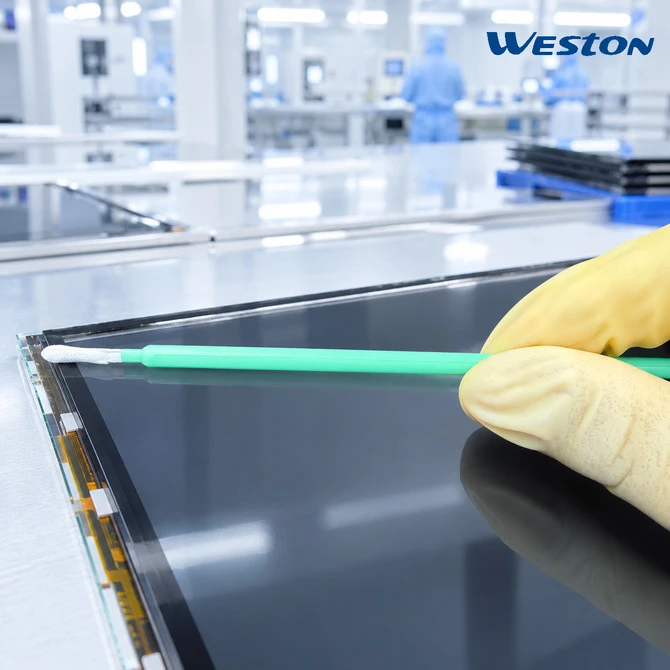
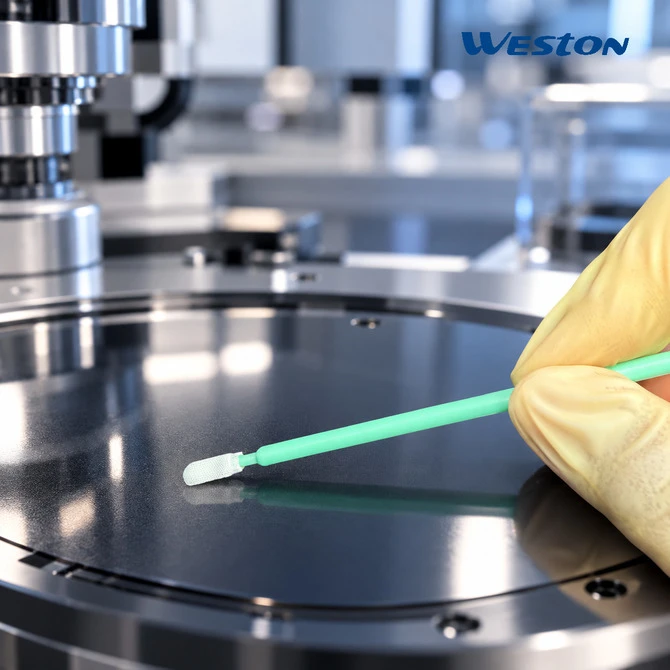
The 100 mm handle provides a practical grip for cleaning accessible edges, shallow recesses and other defined areas on equipment components.
Practical example: A maintenance operator removes a cover according to the equipment procedure and cleans an accessible recessed ledge. A fresh swab is used for each visibly contaminated section to avoid carrying residue into the next area.
Printhead Maintenance
Multiple protection devices,can ensure the safety of the sample,more effective protection of equipment components overloaded operation,greatly reducing the incidence of equipment failure,so that the operation of the equipment more stable and reliable.We stand for using natural energy resources,which are solar and wind energy. It' really ensures all people's needs in electricity. It's very affordable and easy to use,so every person can make its impact to planet saving.
Practical example: During scheduled label-printer maintenance, an operator uses the manufacturer-approved cleaning fluid and a fresh swab to clean the designated area. The operator avoids excess liquid and follows the printer's instructions on pressure, wiping direction and drying time.Do not push the head into nozzle openings or scrub a nozzle plate unless the equipment manufacturer expressly permits that procedure.
Localised Cleaning During Electronics Assembly
The swab format can be evaluated for small accessible areas where a full-size cleanroom wipe would be awkward to position.
Practical example: A technician identifies a small surface mark near a connector housing. Rather than wiping across the whole assembly, the technician uses a lightly moistened swab to treat the affected area, then inspects it before continuing production.
For ESD-sensitive assemblies, qualify the swab within the site's ESD-control procedure. This product specification does not establish ESD-safe performance.
Colour-Separated Cleaning Workflows
Blue and green options can support a site's own visual identification system.
Practical example: A workshop assigns blue swabs to one maintenance station and green swabs to another. The colour code is recorded in the work instruction so operators follow the same allocation across shifts.
Colour identifies the assigned task; it does not indicate a different cleanliness grade or solvent rating.
Recommended Handling
- Check the equipment manufacturer's cleaning instructions.
- Confirm that the head profile fits the cleaning area without forcing it.
- Qualify the swab, cleaning fluid and surface together before routine use.
- Apply only the amount of fluid required by the procedure.
- Wipe with light, controlled pressure rather than aggressive scrubbing.
- Replace the swab when it becomes contaminated or before moving to a separate cleaning area.
- Keep unused swab heads protected from handling and environmental contamination.
FAQ
Q: Can I use these swabs directly on a printhead nozzle plate?
A: Only where the printer manufacturer permits that cleaning method. Some printheads require specific tools, fluids and wiping procedures. Check the maintenance instructions before making contact with the nozzle plate.
Q: Which cleaning solvent should I use?
A: Use the fluid approved for the equipment and contamination being removed. The supplied SGS report is a restricted-substance test, not evidence of solvent compatibility. Qualify the intended solvent, contact time and cleaning method before production use.
Q: Are these swabs suitable for fibre-optic connector cleaning?
A: Do not select a connector-cleaning tool by fabric material alone. Confirm the connector geometry, access dimensions and approved cleaning procedure. The stated Ø4.3 mm head measurement does not establish compatibility with a particular fibre-optic adapter or ferrule.
Q: Are they completely lint-free?
A: An absolute zero-lint claim is not supported by the supplied report. Applications with defined particle-release requirements should be evaluated using the relevant test method and acceptance criteria.
Q: Does the SGS report cover the whole swab?
A: No. The report identifies a white fabric sample. It does not separately list the assembled swab, PP handle or coloured components as tested samples.
Q: Can these swabs be used in an ISO Class 5 cleanroom?
A: The supplied report does not establish suitability for a particular cleanroom class. Approval should follow your facility's consumable-qualification process and any required cleanliness testing.
Q: What should I check before ordering for a narrow opening?
A: Check the opening dimensions, required reach and head clearance. Because this product has a flat head, confirm its actual width and thickness rather than relying only on the nominal Ø4.3 mm measurement.
Hot Tags: microfiber cleanroom swabs, China microfiber cleanroom swabs manufacturers, suppliers, factory


