

Products Description
Laser Cut Cleanroom Wipes Manufacturer – Custom Sizes & GSM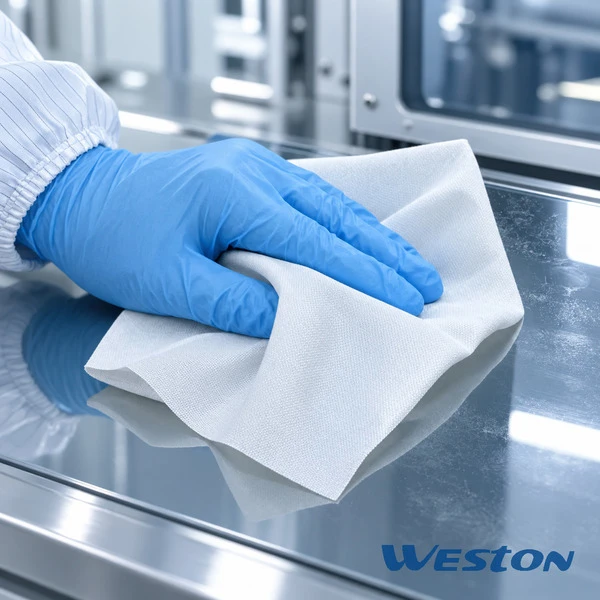
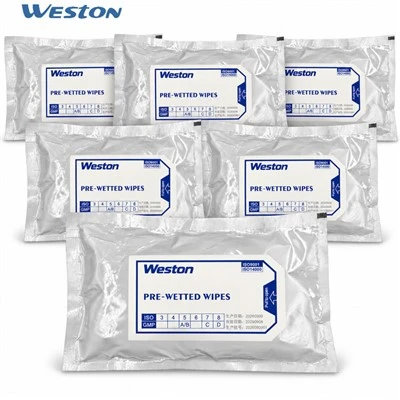
WestonWiper Laser Cut Cleanroom Wipes are 100% polyester filament wipes with laser-sealed edges, supplied in 4, 6, 9 and 12 inch sizes (about 10, 15, 23 and 30 cm), with 100 wipes per pack and 50 packs per carton. Fabric weight is customizable from 80 to 250 gsm, and pre-wetted versions can be made with a solution ratio you specify.
They are intended for controlled-environment cleaning in semiconductor, optical and medical applications. Suitability should be confirmed against your own process and acceptance criteria.
- Material: 100% polyester filament
- Edge: CO₂ laser cut, non-contact melt-sealed on all four sides
- Cutting precision: up to ±0.05 mm
- Sizes: 4, 6, 9 and 12 in; other sizes by agreement
- Fabric weight: 80–250 gsm, customizable
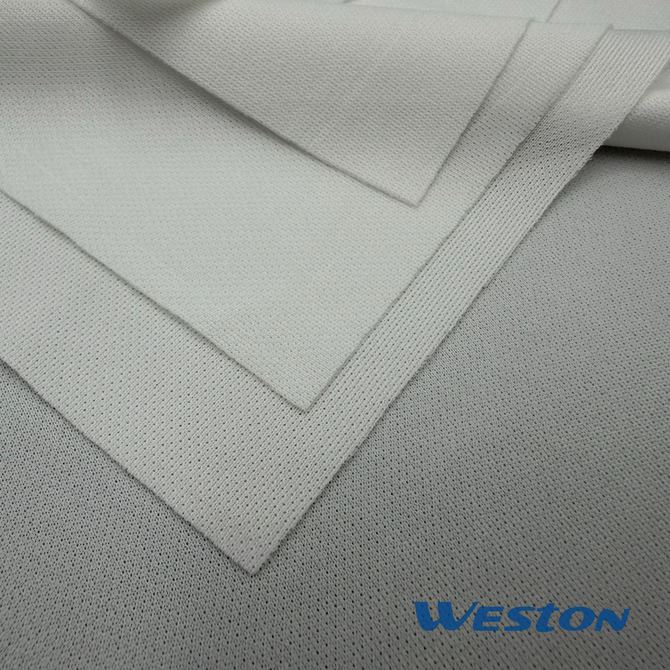
- Texture: grid pattern or straight-line pattern
- Packing: 100 wipes per pack, 50 packs per carton; double-layer vacuum or single-layer PE bag
- Options: pre-wetted with custom solution, logo printing on packaging bags
Technical specifications
The standard configuration is a 100% polyester, laser-cut wipe in four sizes; fabric weight, size, texture, solution and packing can all be customized.
|
Parameter |
Specification |
|
Product name |
Laser Cut Cleanroom Wipes |
|
Brand |
WestonWiper |
|
Material |
100% polyester filament |
|
Edge processing |
CO₂ laser cutting; non-contact melt-sealed edges on all four sides |
|
Cutting precision |
Up to ±0.05 mm; finished-size tolerance agreed in the approved specification |
|
Standard sizes |
4 × 4 in (101.6 × 101.6 mm), 6 × 6 in (152.4 × 152.4 mm), 9 × 9 in (228.6 × 228.6 mm), 12 × 12 in (304.8 × 304.8 mm) |
|
Custom sizes |
Available by agreement |
|
Fabric weight |
Customizable, 80–250 gsm; tolerance agreed per order |
|
Fabric texture |
Grid pattern or straight-line pattern; custom texture by agreement |
|
Pre-wetted option |
Available; solution type and mixing ratio customizable |
|
Pack quantity |
100 wipes per pack; other quantities by agreement |
|
Carton quantity |
50 packs per carton (5,000 wipes in the standard configuration) |
|
Packaging |
Double-layer clean bag with vacuum packing, or single-layer PE bag |
|
Packaging-bag printing |
Customer logo and label information available |
|
Production flow |
Clean base fabric → laser cutting → in-line dust removal → cleanliness inspection → double-layer vacuum packing |
What laser-cut edges are and why they matter
A laser-cut edge is formed by melting the polyester filaments as the wipe is cut, so the cut ends fuse together instead of staying open.
WestonWiper cuts with high-precision CO₂ laser equipment. The high-energy beam does not touch the fabric: it melts the filament ends, and all four edges of each polyester cleanroom wipe are sealed in the same cutting operation. Locking the fiber ends in place is intended to reduce the loose threads and fragments that open, cold-cut edges can release, and the equipment cuts to a precision of up to ±0.05 mm, which keeps wipe dimensions consistent from piece to piece.
Edge condition and particle release also depend on the fabric and process settings, so any quantitative claim should be backed by test data for the exact configuration ordered.
|
||||||||||||||||||||
How to choose size and fabric weight
Choose the size by the surface you are wiping and the fabric weight by the liquid load and wiping pressure of the task, then validate with a sample.
|
Size |
Metric |
Typically suited to |
|
4 in |
101.6 mm |
Small components, connectors, tight spaces, spot cleaning |
|
6 in |
152.4 mm |
Bench-top work, small instruments and fixtures |
|
9 in |
228.6 mm |
Equipment surfaces, trays, mid-size parts |
|
12 in |
304.8 mm |
Larger panels, workstations, wide-area wiping |
Test Reports
The available report excerpts show PASS results for restricted substances and non-detected (N.D.) results for four phthalates in the tested sample.
| Substance group listed in the report | Reported result |
| Lead, cadmium, mercury, hexavalent chromium, PBBs and PBDEs | PASS |
| DEHP, BBP, DBP and DIBP | PASS |
Phthalate results
|
Tested substance |
Result |
Method detection limit |
Reported limit |
| Dibutyl phthalate (DBP) | N.D. | 50 mg/kg | 1,000 mg/kg |
| Butyl benzyl phthalate (BBP) | N.D. | 50 mg/kg | 1,000 mg/kg |
| Di-(2-ethylhexyl) phthalate (DEHP) | N.D. | 50 mg/kg | 1,000 mg/kg |
| Diisobutyl phthalate (DIBP) | N.D. | 50 mg/kg | 1,000 mg/kg |
N.D. means the substance was not detected at the stated method detection limit; it does not mean the concentration is zero. These results apply to the tested sample identified in the report.
Applications and usage guidance
These wipes are intended for cleaning tasks in semiconductor, optical and medical-device environments, provided they pass your own qualification.
|
Application area |
Typical tasks |
What to verify |
|
Semiconductor and electronics assembly |
Wiping tools, fixtures, work surfaces and component housings |
Particle and ionic limits for your process; solvent compatibility |
|
Optical components |
Cleaning housings and fixtures, wiping around optics |
Whether the wipe is allowed on coated surfaces; lens cleaning paper is a different material |
|
Medical-device manufacturing |
Surface wiping in controlled assembly areas |
Sterile status is not established in the current documentation; confirm if sterility is required |
Manufacturing process and facility
Clean base fabric in: clean polyester filament base fabric is fed into the line.
Laser cutting: a CO₂ laser cuts each wipe to size with up to ±0.05 mm precision and seals all four edges.
In-line dust removal: cut wipes are cleaned in line to remove loose dust.
Cleanliness inspection: sampling checks cover particles, appearance and dimensions.
Double-layer vacuum packing: wipes are sealed in double-layer clean bags under vacuum.
The workshop is equipped with high-precision CO₂ laser cutting equipment and uses a non-contact melt-sealing process. The high-energy beam instantly melts the polyester filaments and fuses the edge, locking fiber ends in place. This is intended to reduce the loose threads and shedding associated with cold-cut edges, and the cutting precision keeps dimensions consistent for semiconductor, optical and medical users with tight requirements.
FAQ
Q: What are WestonWiper Laser Cut Cleanroom Wipes made of?
A: They are made of 100% polyester filament fabric, cut with a CO₂ laser that melts and seals all four edges.
Q: Which sizes are available?
A: The standard sizes are 4, 6, 9 and 12 inches (about 102, 152, 229 and 305 mm). Other dimensions can be made by agreement; confirm the finished length × width when ordering.
Q: Which fabric weights are available?
A: Fabric weight is customizable from 80 to 250 gsm. State the target gsm and the tolerance you need during quotation.
Q: How many wipes come in a pack and a carton?
A: The standard is 100 wipes per pack and 50 packs per carton, which is 5,000 wipes. Other quantities require separate confirmation.
How is a laser-cut edge different from a cold-cut or ultrasonic edge?
A laser melts the filament ends without touching the fabric, so the edge is fused and sealed. A cold-cut edge is sheared and its fiber ends stay open, while ultrasonic cutting fuses the edge with vibration and tool contact.
Q: Do laser-cut wipes release fewer fibers?
A: Sealing the edge is intended to reduce loose threads compared with open cut edges, but the amount released depends on the fabric and the process. Request particle-release data for the exact configuration you plan to order.
Q: What is the cutting accuracy?
A: WestonWiper's laser cutting equipment cuts to a precision of up to ±0.05 mm. The finished-size tolerance for your order is agreed in the approved specification.
Hot Tags: laser cut cleanroom wipes, China laser cut cleanroom wipes manufacturers, suppliers, factory