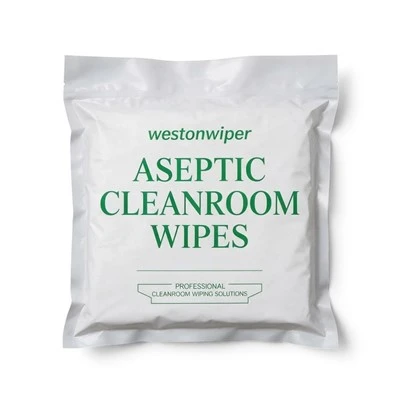
Cleanroom wipes are not automatically sterile. A wipe can be manufactured for use in a controlled cleanroom environment, with low particle and lint characteristics, without being sterile. To be considered sterile, the wipe must undergo a validated sterilization process and be packaged in a way that maintains its sterile condition until use.
Cleanroom Does Not Mean Sterile
The confusion comes from the word "cleanroom." A cleanroom is a controlled environment designed to limit contamination, particularly airborne particles. A cleanroom wipe is therefore developed and processed to reduce the amount of contamination it may introduce during wiping.
Sterility is a different requirement.
A sterile product is concerned specifically with the absence of viable microorganisms following a validated sterilization process. In other words, cleanroom compatibility and sterility describe different aspects of contamination control.
A wipe can therefore be:
Suitable for cleanroom use
Low in lint and particle shedding
Manufactured under controlled conditions
Non-sterile
This is normal for many cleanroom wiping applications.
What Makes a Cleanroom Wipe Sterile?
A cleanroom wipe becomes a sterile product through its processing and sterilization system, rather than simply because of the fabric material.
The typical sequence is:
Controlled manufacturing → controlled packaging → sterilization → sterile barrier maintenance
The sterilization step is particularly important. Depending on the product and packaging system, gamma irradiation is one commonly used method for sterilizing prepackaged cleanroom wipes.
However, simply stating that a wipe has been "irradiated" is not enough to understand its sterile status. The sterilization process needs to be appropriately controlled and validated for the product.
This leads to an important distinction:
Sterility is a process-controlled product attribute, not an automatic property of a cleanroom wipe.

Does the Wipe Material Determine Whether It Is Sterile?
No.
Materials commonly used for cleanroom wipes include polyester, cellulose-based materials, polypropylene, and blended constructions. The choice of material affects characteristics such as absorbency, particle release, abrasion, and chemical compatibility, but the material itself does not make a wipe sterile.
For example, a polyester cleanroom wipe may be supplied as either a non-sterile product or a sterilized product.
The important factors are the overall production system, including:
|
Factor |
Why It Matters |
|
Wipe material |
Determines wiping and contamination characteristics |
|
Manufacturing environment |
Controls initial contamination |
|
Cleaning and processing |
Helps reduce residual particles and contaminants |
|
Sterilization |
Reduces viable microorganisms |
|
Packaging |
Protects the product after sterilization |
|
Package integrity |
Helps maintain sterility until opening |
So, asking only "What material is the wipe made from?" cannot determine whether it is sterile.
How Can You Tell Whether a Cleanroom Wipe Is Sterile?
The first thing to check is how the product is specifically identified.
A product described only as:
should not automatically be interpreted as sterile.
A product specifically identified as:
should have supporting information explaining how sterility is achieved and maintained.
Useful information to check includes:
- Sterilization method
- Sterile packaging format
- Lot or batch identification
- Product specifications
- Relevant quality or validation documentation
- Packaging integrity and shelf-life information
This is more reliable than judging sterility from terms such as "clean," "low-lint," "ISO cleanroom," or "particle controlled."
Are Non-Sterile Cleanroom Wipes Still Suitable for Cleanrooms?
Yes.
Many cleanroom processes require excellent particle and lint control but do not require a sterile wiping product. In these situations, a properly manufactured non-sterile cleanroom wipe can be completely appropriate.
The key question is therefore not:
"Is this a cleanroom wipe?"
but:
"Does this application require sterility?"
If the process requires control of viable microorganisms or involves a specific sterile or aseptic operation, a sterile wipe may be necessary.
If the main concern is particle, fiber, or residue contamination, a non-sterile cleanroom wipe may meet the requirement.
Why Are Sterile Wipes Not Always Better?
Sterility should be treated as a specific process requirement, not as a universal indicator that one wipe is better than another.
A sterile wipe requires additional sterilization and packaging controls. When the application does not require sterility, those additional requirements may provide little practical benefit.
For routine cleanroom surface wiping, equipment cleaning, or other applications where microbial sterility is not the controlling requirement, the more important factors may instead be:
- Low particle generation
- Low lint
- Absorbency
- Chemical compatibility
- Wiping efficiency
- Cleanroom processing and packaging
The right choice depends on what contamination the process is trying to control.

Cleanroom Wipe vs. Sterile Wipe
The difference can be summarized simply:
|
Cleanroom Wipe |
Sterile Cleanroom Wipe |
|
Designed to minimize contamination introduced during wiping |
Designed to minimize contamination and meet a sterility requirement |
|
May be non-sterile |
Sterilized through a validated process |
|
Sterilization is not automatically required |
Sterilization is a core part of the product |
|
Packaging protects product cleanliness |
Packaging must also maintain sterile status |
|
Used where cleanroom contamination control is sufficient |
Used where sterility is specifically required |
FAQ
Are all cleanroom wipes sterile?
No. Cleanroom wipes are not automatically sterile. Sterility requires an appropriate sterilization process and packaging system.
Can a non-sterile wipe be used in a cleanroom?
Yes. Many cleanroom applications require particle and lint control rather than sterility.
Does an ISO Class 5 or ISO Class 7 environment mean the wipes are sterile?
No. Cleanroom classification and product sterility are different requirements.
Can the same wipe material be sold as both sterile and non-sterile?
Yes. The material may be the same, while processing, sterilization, packaging, and product specifications differ.
What is the easiest way to verify sterility?
Look for explicit sterile product identification, the stated sterilization method, appropriate packaging information, and supporting quality documentation.
The Key Point
Cleanroom wipes are not necessarily sterile. Cleanroom wipes are designed to control contamination such as particles and lint, while sterile wipes have the additional requirement of achieving and maintaining a defined sterile condition. The difference comes primarily from the manufacturing, sterilization, packaging, and quality-control process, not simply from the wipe material itself.