


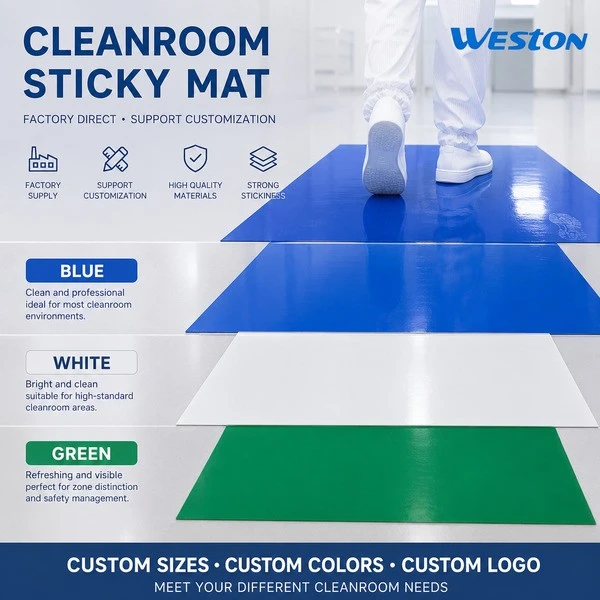
Cleanroom Sticky Mat - Antibacterial Multi-Layer Tacky Mat
Model WN406 · Spec 4.0C
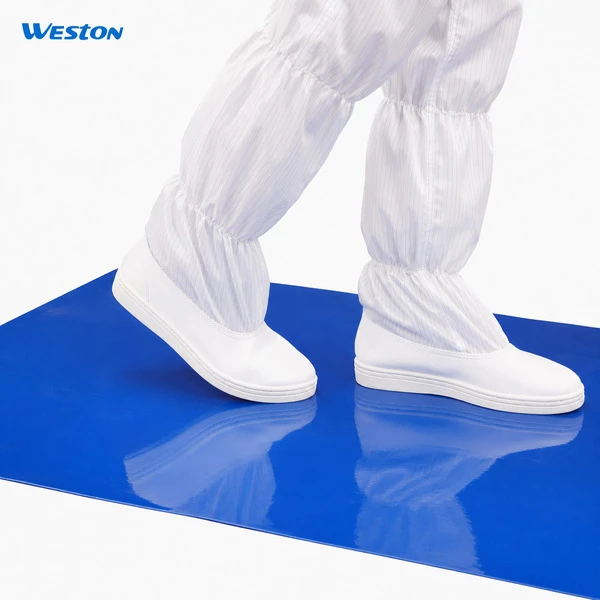
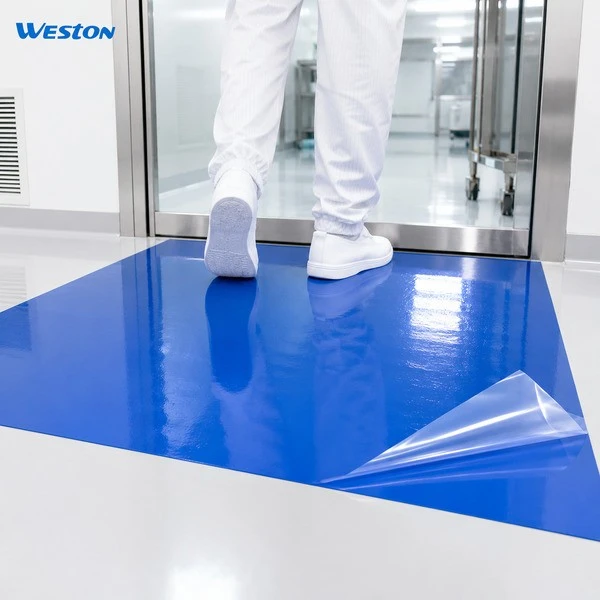
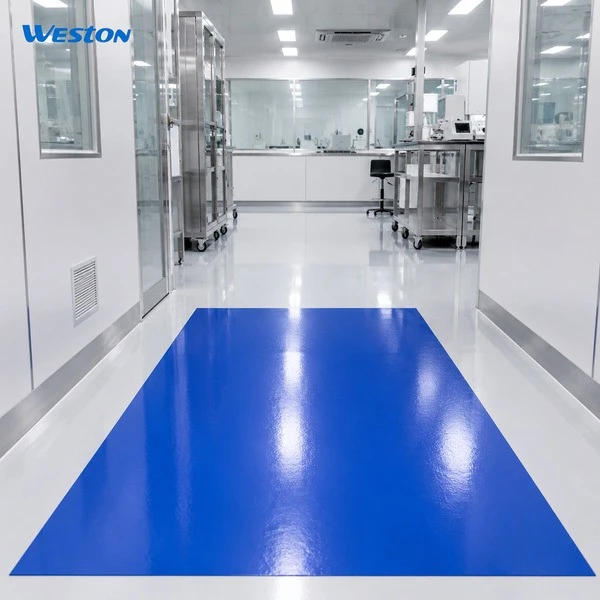
The Weston WN406 is a peel-away antibacterial tacky mat made from layered PE composite film, placed at the threshold of cleanrooms, labs, and gowning rooms to strip dust, fibers, and footborne particles off shoes and wheels before they ever reach the controlled environment.

Why It Belongs at Your Entryway
Particle counts don't rise inside a cleanroom - they walk in through the door. Every pass through an ungated entryway tracks in dust, lint, and skin flakes that no amount of HEPA filtration upstream can undo. The WN406 sits exactly at that choke point: a high-tack surface bonded in stacked, individually peelable sheets, so the mat resets to a fresh adhesive layer in seconds instead of being replaced or laundered. It's built for facilities where particle control and microbial control matter at the same time - wafer fabs, pharma suites, and hospital corridors alike.
Core Features
Antibacterial Layer Protection
The adhesive coating carries an antibacterial additive that suppresses growth of common bacteria and mold on the mat surface, lowering the risk of the mat itself becoming a cross-contamination point in pharmaceutical and hospital settings.
01
Peel-Away Multi-Layer System
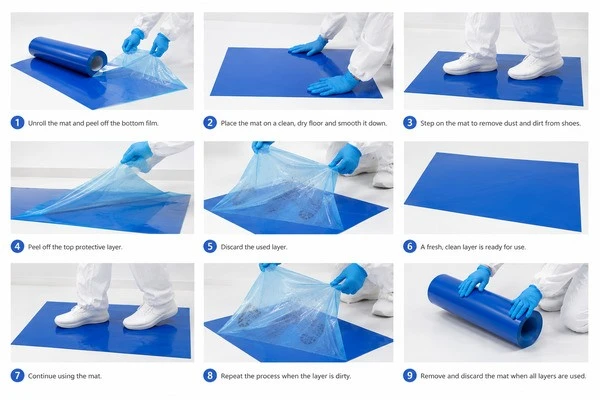
Each pad is built from dozens of stacked sheets. Once the top layer fills with visible dust or footprints, staff simply peel it away - the layer underneath is already tacky and ready to work, with no mat-swap or downtime.
02
Static-Dissipative Surface
Surface resistance of 10⁸–10¹¹ Ω puts the WN406 in the static-dissipative range, so it won't generate or hold a static charge that could damage ESD-sensitive components - a requirement most general-purpose mats simply don't meet.
03
High-Tack, High-Tensile Composite
A multi-layer polyethylene film construction gives each sheet a tensile strength of ≥18 MPa, so layers peel cleanly along their seam without tearing or leaving adhesive residue behind on the floor.
04
RoHS-Verified Material Safety
Independently lab-tested for heavy metals, brominated flame retardants, and phthalates - every regulated substance came back Not Detected (see test report below), so the mat is safe to specify in pharma and medical environments without a separate material-safety review.
05
Product Specifications
|
Parameter |
Value |
|
Product name |
Antibacterial Cleanroom Sticky Mat |
|
Model |
WN406 |
|
Spec code |
4.0C |
|
Material |
Multi-layer polyethylene (PE) composite film |
|
Sheet thickness |
0.04 ± 0.01 mm |
|
Hardness rating |
A |
|
Surface resistance |
10⁸ – 10¹¹ Ω (static-dissipative) |
|
Tensile strength |
≥ 18 MPa |
|
Mat size |
0.6 m × 0.9 m (≈ 23.6 in × 35.4 in) |
|
Colors available |
Blue / Green / Clear |
|
Packaging |
10 pads per box, 5 boxes per carton (50 pads/carton) |
|
Export-exclusive item |
No - same spec available for domestic and overseas orders |
|
Typical industries |
Semiconductor, TFT-LCD, microelectronics, pharmaceutical, hospital |
Independent Lab Test Report - RoHS Compliance
All results below are from third-party lab testing of Specimen No. 1.
|
Substance |
Result |
Regulatory Limit |
|
Cadmium (Cd) |
N.D. |
≤ 100 mg/kg |
|
Lead (Pb) |
N.D. |
≤ 1000 mg/kg |
|
Mercury (Hg) |
N.D. |
≤ 1000 mg/kg |
|
Hexavalent Chromium (Cr(VI)) |
N.D. |
≤ 1000 mg/kg |
|
Polybrominated Biphenyls (PBBs, mono- through deca-) |
N.D. |
≤ 1000 mg/kg |
|
Polybrominated Diphenyl Ethers (PBDEs, mono- through deca-) |
N.D. |
≤ 1000 mg/kg |
|
DEHP (Di-2-ethylhexyl phthalate) |
N.D. |
≤ 1000 mg/kg |
|
DBP (Dibutyl phthalate) |
N.D. |
≤ 1000 mg/kg |
|
BBP (Benzylbutyl phthalate) |
N.D. |
≤ 1000 mg/kg |
|
DIBP (Diisobutyl phthalate) |
N.D. |
≤ 1000 mg/kg |
N.D. = Not Detected, below Method Detection Limit (MDL). MDL = 2 mg/kg for Pb/Cd/Hg; 8 mg/kg for Cr(VI); 5 mg/kg for PBBs/PBDEs; 30 mg/kg for the four phthalates.
Where It's Used
Semiconductor & TFT-LCD Fabs Scenario
At the gowning-room airlock before a Class 100 wafer bay, a WN406 mat catches particles off cleanroom booties before staff ever cross into the bay. Because the surface sits in the static-dissipative range, it doesn't introduce the ESD risk that a standard adhesive mat would right next to wafer-handling stations.
Pharmaceutical Manufacturing & Hospitals Scenario
Outside a sterile filling suite or an ICU corridor, foot traffic is constant and the cost of microbial cross-contamination is high. The antibacterial coating works alongside the particle-trapping function, so the mat isn't just collecting dust - it's also suppressing the bacterial load that builds up on a high-traffic adhesive surface.
Microelectronics & PCB Assembly Scenario
Placed at the entrance to a clean bench area for component placement, the mat strips dust and lint that would otherwise settle on exposed circuit boards or connector pins during assembly.
Labs, Offices & General Facilities Scenario
Research labs, commercial offices, and public-service facilities use the same mat at entry points where dust and outdoor debris are a housekeeping issue rather than a yield issue - the peel-layer design means cleaning staff change the surface in seconds instead of mopping or vacuuming the entry zone repeatedly through the day.Fats are deployed.
Frequently Asked Questions
Hot Tags: cleanroom sticky mat, China cleanroom sticky mat manufacturers, suppliers, factory, 30 Layer Sticky Mat, Cleanroom Sticky Mat, sticky mats, Washable Silicone Sticky Mat


