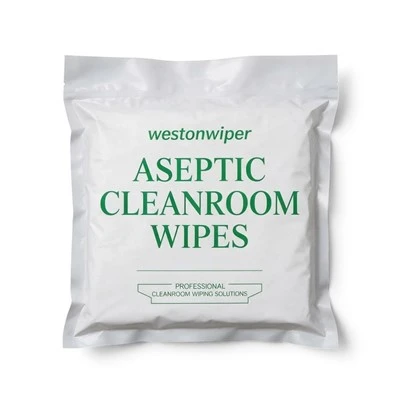
Cleanroom wipers support contamination control by removing particles, residues, liquids, and other unwanted contaminants from surfaces while minimizing the risk of introducing new contamination. Their role is more complex than simply making a surface look clean. A suitable wiper must capture contamination effectively, retain it during wiping, resist excessive fiber or particle release, and work correctly with the cleaning method and chemical being used. In a controlled environment, the wiper is therefore part of the overall contamination-control process, not just a general-purpose cleaning cloth.
What Does Contamination Control Mean in a Cleanroom?
A cleanroom is not simply a room with little visible dust. Cleanroom cleanliness is controlled according to defined requirements for airborne particle concentration, and ISO 14644-1 classifies air cleanliness by measured concentrations of particles within specified size ranges. It does not, however, describe the chemical, biological, or other properties of those particles.
This distinction is important because contamination can take several forms.
Particles may come from people, equipment, packaging, materials, or normal production activity. Fibers may be released from garments, wipes, or other materials. Liquids can leave residues on surfaces. Oils and processing residues may remain even when a surface appears visually clean. Microbial contamination is another concern in applications where viable contamination must be controlled.
For this reason, contamination control has two goals:
- Remove unwanted contamination.
- Avoid introducing or redistributing additional contamination.
A wiping process that removes one contaminant but spreads another has not fully solved the problem.

Why Are Cleanroom Wipers Important?
Many contamination-control programs depend on regular cleaning of work surfaces, tools, equipment, enclosures, and other critical areas. IEST maintains a dedicated recommended practice for evaluating wiping materials used in cleanrooms and other controlled environments, covering characteristics related to both cleanliness and function.
A cleanroom wiper can contribute to contamination control in several ways.
First, it physically removes particles from a surface. Second, it absorbs or captures liquids and dissolved residues. Third, it can reduce the amount of contamination available for transfer to products, tools, or other surfaces. Finally, a properly selected wiper can perform these tasks without generating an unacceptable amount of new particle or fiber contamination.
This is why the phrase "cleanroom compatible" should not be treated as a complete description of performance. The actual application matters.
How Does a Cleanroom Wiper Remove Contamination?
The cleaning action of a wiper involves several mechanisms working together.
Mechanical Removal
When a wiper moves across a surface, the pressure and movement help detach particles and residues from that surface. The effectiveness depends partly on contact between the wiper and the surface.
A smooth, hard surface may require different wiping behavior from a textured or irregular surface. Excessive pressure is not automatically better. Too much pressure can sometimes increase material wear or spread contamination rather than improve removal.
Absorption
Liquid contamination can be taken into the structure of the wiper. This is especially important when removing water, alcohol-based solutions, cleaning agents, oils, or other process liquids.
However, high absorbency alone does not make a wiper suitable for every cleanroom application. The wiper must also retain the liquid rather than readily releasing it again during use.
Surface Capture
Some particles and residues are captured within or on the surface of the wiping material. The structure of the fibers, the surface area, and the physical characteristics of the material all influence how contamination is retained.
This leads to an important difference between removing contamination and simply moving contamination. A good wiping process should result in the contamination being captured and controlled rather than transferred to another location.
Retention
Retention is often overlooked. The question is not only whether a wiper can pick up contamination, but whether it can keep that contamination contained during the rest of the cleaning operation.
A wiper that picks up particles but releases them again through excessive linting, material damage, or poor handling can reduce the overall effectiveness of the cleaning process.
Why Does Wiper Material Matter?
Cleanroom wipers are available in different constructions and fiber compositions because different processes require different balances of performance.
Materials may be selected for properties such as:
- Low particle and fiber release
- Absorbency
- Liquid retention
- Chemical compatibility
- Mechanical strength
- Low residue
- Surface cleaning performance
There is no single material that is automatically best for every application.
For example, a process focused on removing small particles from a sensitive surface may place a greater emphasis on low particle generation and surface contact. A process that removes large amounts of liquid may place greater emphasis on absorbency and retention. A process involving aggressive chemicals may require careful consideration of chemical compatibility.
This is why wiper selection should begin with the contamination problem rather than with the material name alone.

Low-Lint Performance Is More Than a Marketing Term
The term "lint-free" is often used in the cleaning industry, but it should be interpreted carefully.
A realistic contamination-control question is not whether a wiper releases absolutely zero particles or fibers under every possible condition. Instead, the relevant question is whether its particle and fiber release characteristics are appropriate for the intended application and controlled environment.
Loose fibers can become airborne, remain on a critical surface, or become attached to equipment or products. A damaged wiper can also become a new source of contamination.
Wiper construction therefore matters. The way a material is knitted, woven, nonwoven, cut, finished, and packaged can influence its behavior during use. Edge construction is particularly relevant because poorly controlled edges can generate additional particles or fibers during repeated wiping.
For technical applications, buyers should look for objective test information rather than relying only on broad terms such as "lint-free" or "cleanroom grade." IEST-RP-CC004 specifically addresses evaluation and testing of wiping materials for cleanliness and functional characteristics.
Absorbency Is Important, But It Is Not the Whole Story
A common purchasing mistake is to assume that the most absorbent wiper is automatically the best wiper.
Absorbency matters when the process involves liquids. But cleaning performance also depends on how quickly the liquid is taken up, how much liquid is retained, whether the material releases the liquid under pressure, and whether the wiper leaves residues behind.
The chemistry of the liquid also matters.
A wiper used with purified water may not behave exactly the same way when used with alcohol, solvents, detergents, or other process chemicals. The wiping material should therefore be evaluated for compatibility with the actual cleaning chemistry.
In some processes, the chemical itself can become a contamination concern. A surface that has been wiped may appear clean but still contain an unwanted residue. Surface cleanliness standards can address chemical contamination separately from particle cleanliness. ISO 14644-10:2022, for example, addresses assessment of surface cleanliness with respect to chemical contamination.
Clean Does Not Mean Sterile
Another common misunderstanding is treating cleanroom cleanliness and sterility as the same thing.
They are not.
A cleanroom wiper may be suitable for a controlled environment without being sterile. Conversely, a sterile wiper is not automatically the best choice for every particle-sensitive application.
Sterility concerns viable microorganisms and the validated process used to achieve and maintain a sterile state. Particle cleanliness concerns unwanted particulate contamination. These are related but separate performance requirements.
IEST also maintains specific guidance on microorganisms and viable contamination in cleanrooms, reflecting the fact that microbial control requires its own strategy rather than relying on general surface wiping alone.
For applications where sterility is required, the wiper, packaging, sterilization method, handling process, and storage conditions all need to be considered together.
The Wiper Cannot Control Contamination by Itself
Even a high-quality wiper can perform poorly when used incorrectly.
The wiping procedure affects the final result. Important variables include pressure, direction, speed, overlap, folding technique, and the amount of surface area exposed to the wiper.
A common principle is to move from cleaner areas toward areas with greater contamination rather than repeatedly moving contamination back across an already cleaned surface.
Using a fresh section of the wiper can also reduce cross-contamination. Folding a wiper correctly can provide multiple usable surfaces while reducing unnecessary handling.
The number of times a wiper should be reused depends on the application and procedure. There is no universal rule that one wiper is suitable for a fixed number of cleaning strokes. The key consideration is whether the wiper remains effective and whether continued use creates an unacceptable contamination-transfer risk.
Why Can Ordinary Cloths Be a Problem?
A general-purpose cloth may look clean and may even clean a surface effectively in a normal environment. That does not automatically make it suitable for a cleanroom.
The difference is the level of contamination control required.
Ordinary materials may have higher levels of loose fibers, particles, extractable residues, or chemical incompatibility. Their manufacturing and packaging may also not be controlled for cleanroom use.
A cleanroom wiper is selected not simply because it can remove dirt, but because its own contamination characteristics need to be understood.
This is one of the most important differences between ordinary cleaning and precision cleaning.
Does the Cleanroom Class Determine Which Wiper to Use?
Not by itself.
ISO cleanroom classification describes airborne particle cleanliness. ISO 14644-1 does not classify a specific wiper as "good" or "bad," and it does not establish that a product is suitable simply because it is labeled for use in a particular ISO class.
A better approach is to consider the entire application:
Cleanroom environment + surface + contamination type + cleaning chemical + wiping method + required cleanliness level
For example, the requirements for wiping semiconductor equipment may differ from those for pharmaceutical surfaces, medical-device manufacturing, optics, aerospace components, or general controlled manufacturing areas.
The room classification is therefore an important starting point, but it should not be the only selection criterion.

What Should You Check When Selecting a Cleanroom Wiper?
A practical selection process can begin with five questions.
1. What contamination needs to be removed?
Is the main problem particles, liquid, oil, chemical residue, microbial contamination, or a combination?
2. What surface will be cleaned?
Consider stainless steel, glass, plastics, coated surfaces, equipment, sensitive components, or other materials.
3. What cleaning chemical will be used?
Check compatibility with the actual solution rather than assuming all wipers perform equally with every chemical.
4. What contamination can the wiper itself introduce?
Look for relevant information about particle generation, fiber release, residue, extractables, and material integrity.
5. How will the wiper be used?
The wiping procedure, number of wipes used, storage, packaging removal, and disposal method can all influence contamination control.
These questions are more useful than choosing a wipe based only on thickness, softness, appearance, or price.
What Test Data Matters?
Technical buyers should look beyond general claims.
Depending on the application, relevant characteristics may include:
- Particle release
- Fiber or lint release
- Absorbency
- Liquid retention
- Nonvolatile residue
- Extractables
- Ionic contamination
- Chemical compatibility
- Mechanical strength
- Sterility or microbial characteristics where required
Not every application requires every test. Testing should match the contamination risks of the process.
This approach is consistent with the broader cleanroom industry practice of evaluating both cleanliness and function rather than treating a wiping material as a simple commodity.
How Should Cleanroom Wipers Be Used?
A basic controlled wiping process can be thought of as six steps:
Identify → Select → Prepare → Wipe → Inspect → Dispose
Identify
Understand what needs to be removed and where it is located.
Select
Choose a wiper and cleaning chemistry appropriate for the surface and contamination.
Prepare
Control the opening of packaging and avoid unnecessary contact with the wiping surface.
Wipe
Use a defined wiping pattern and direction. Maintain consistent technique.
Inspect
Check whether the surface has been adequately cleaned and whether residue or visible contamination remains. Where required, use appropriate monitoring or verification methods.
Dispose
Remove used wipers according to the site procedure before they become a source of redistribution.
Modern cleanroom housekeeping guidance also emphasizes procedures for cleaning, sanitization, monitoring, residue, coverage, and evaluating the effectiveness of housekeeping activities.

How Do You Know Whether the Wiping Process Is Working?
This is one of the most important questions.
A surface can look clean and still contain contamination that cannot be seen with the naked eye.
For particulate cleanliness, surface cleanliness can be assessed using defined methods. ISO 14644-9 addresses classification of surface cleanliness by particle concentration, while ISO 14644-10 addresses surface cleanliness in relation to chemical contamination.
In practice, verification may involve:
- Visual inspection
- Particle measurement
- Surface cleanliness testing
- Residue testing
- Microbiological monitoring where relevant
- Process-specific validation
The correct verification method depends on the application. A semiconductor process, a pharmaceutical environment, and a general controlled manufacturing area may have very different contamination risks.
The most reliable approach is therefore to evaluate cleaning as a complete process rather than judging the wiper by appearance alone.
Common Mistakes in Cleanroom Wiping
Mistake 1: Assuming "Lint-Free" Means Zero Contamination
No marketing phrase should replace objective performance information. The important question is whether the measured release characteristics are appropriate for the process.
Mistake 2: Reusing a Wiper Too Long
As contamination accumulates, a used wiper may become less effective and increase the risk of transferring contamination.
Mistake 3: Using One Wiper for Multiple Areas
Moving the same contaminated wiper between different surfaces can create cross-contamination.
Mistake 4: Ignoring Chemical Compatibility
A wiper should be compatible with the actual cleaning chemical and surface.
Mistake 5: Focusing Only on Airborne Particles
A cleanroom may meet its airborne particle requirements while surfaces still require controlled cleaning. ISO 14644-9 specifically recognizes surface particle cleanliness as a separate consideration.
Mistake 6: Assuming the Wiper Alone Guarantees Cleanliness
Contamination control also depends on personnel, equipment, airflow, cleaning procedures, materials, packaging, and monitoring.

Three Questions That Reveal Whether a Wiper Is Suitable
When evaluating any cleanroom wiper, ask three basic questions:
What Does It Remove?
Can it effectively remove the type of contamination that matters to the process?
What Does It Release?
Could the wiper itself introduce particles, fibers, residues, or other unwanted materials?
What Happens After Wiping?
Does the contamination remain captured and controlled, or has it simply been moved to another surface?
These three questions provide a simple way to understand why cleanroom wiping is more demanding than ordinary cleaning.
Frequently Asked Questions
What is the main purpose of a cleanroom wiper?
The main purpose is to remove and control contamination on surfaces while minimizing the introduction of new particles, fibers, residues, or other unwanted contaminants.
Are cleanroom wipers completely lint-free?
The term "lint-free" should not be interpreted as an absolute guarantee of zero particle or fiber release. Performance should be assessed using relevant test data and against the requirements of the specific application.
Does a higher ISO cleanroom class always require a special type of wiper?
Not necessarily. ISO classification describes airborne particle cleanliness. Wiper selection also depends on the surface, contamination type, chemical compatibility, particle and fiber requirements, and cleaning procedure.
Can a cleanroom wiper be sterile but still unsuitable for an application?
Yes. Sterility and particle or residue control are different requirements. A sterile wiper may still need to meet additional cleanliness and functional requirements for the intended process.
How often should a cleanroom wiper be replaced?
There is no universal replacement interval. Replacement should follow the validated cleaning procedure and the contamination risk of the application. A wiper should not continue to be used simply because it still appears physically intact.
Why is wiping technique important?
Because cleaning is not only about the material. Pressure, direction, overlap, surface contact, folding, and the point at which a wiper is replaced can affect whether contamination is removed or redistributed.
Cleanliness Is a Process, Not Just a Product
A cleanroom wiper works best when it is treated as one component of a broader contamination-control system. The material must be appropriate. The wiper must be manufactured, handled, packaged, and stored in a way that supports the intended cleanliness level. The cleaning chemical must be compatible. The operator must follow a controlled procedure. The process must be monitored when the application requires verification.
The central principle is simple:
A good cleanroom wiper should remove the contamination that matters while introducing as little new contamination as possible.
That is the real purpose of contamination-control wiping. The goal is not merely a surface that looks clean. The goal is a controlled surface with a cleaning process that is repeatable, appropriate for the application, and supported by measurable performance.