ISO 14644-1 cleanroom classes describe how clean the air is by measuring the concentration of airborne particles. The lower the ISO class number, the fewer particles are permitted in the air. ISO Class 1 is the cleanest classification, while ISO Class 9 allows the highest particle concentration.
The idea sounds simple, but cleanroom classifications can be confusing when you first see terms such as ISO 5, ISO 7, ISO 8, Class 100, or 0.5 µm in a specification.
The key is to understand what the number actually measures.
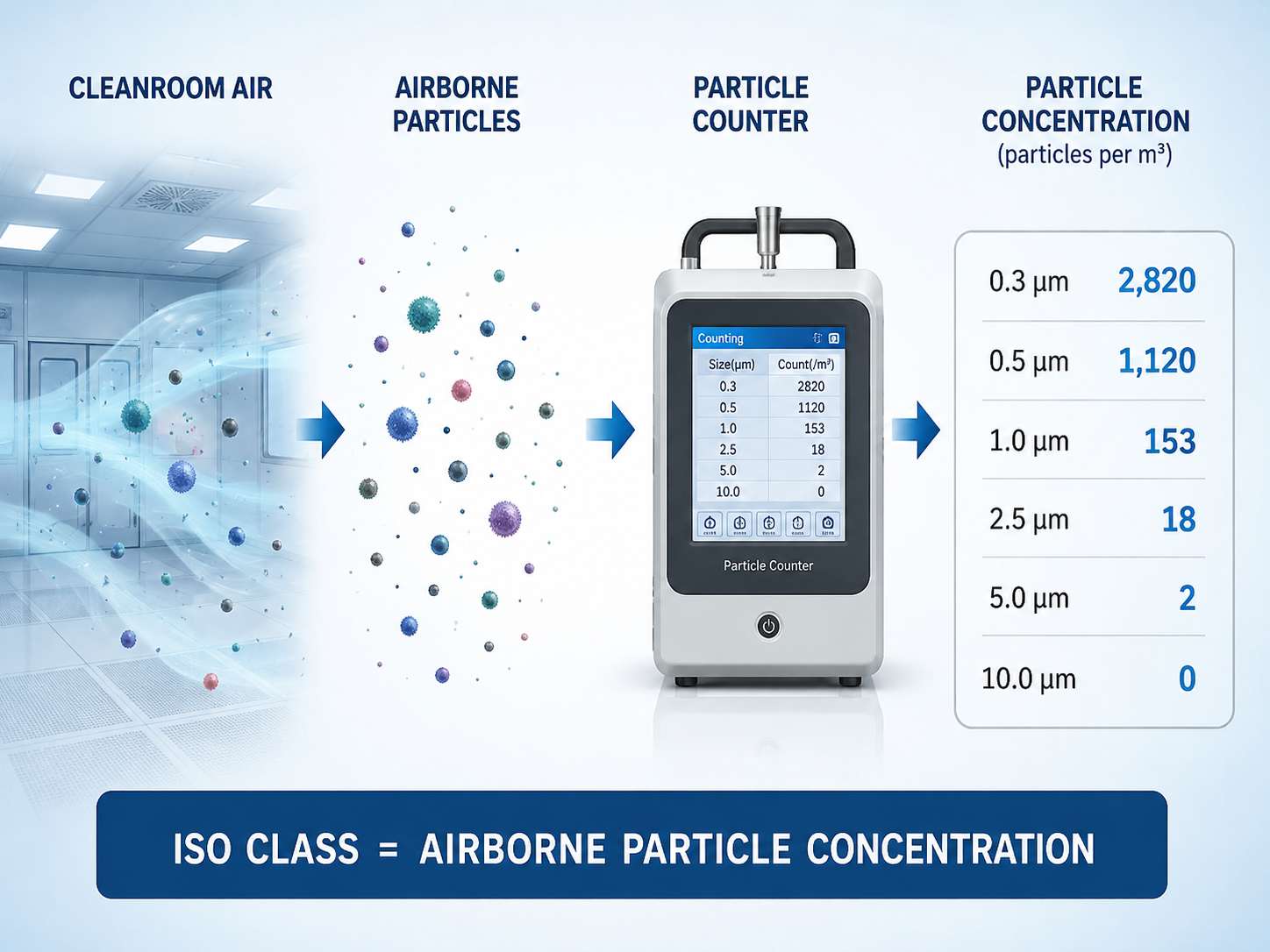
ISO 14644-1:2015 classifies air cleanliness based on the concentration of airborne particles at specified particle sizes. The standard considers particle populations with threshold sizes from 0.1 µm to 5 µm and uses airborne particle counters to determine the concentration of particles equal to or larger than the specified size. It does not classify particles by whether they are viable, biological, chemical, or otherwise.
What Does an ISO Cleanroom Class Measure?
An ISO cleanroom class is essentially a particle concentration limit for the air.
For each ISO class, the standard defines the maximum number of particles allowed in one cubic metre of air at specified particle sizes.
For example, an ISO Class 5 cleanroom allows a maximum of 3,520 particles per cubic metre at ≥0.5 µm.
An ISO Class 7 cleanroom allows up to 352,000 particles per cubic metre at ≥0.5 µm.
An ISO Class 8 cleanroom allows up to 3,520,000 particles per cubic metre at ≥0.5 µm.
The difference is substantial. At the ≥0.5 µm threshold, ISO 8 permits 1,000 times the particle concentration allowed by ISO 5.
This gives you the most important rule for reading ISO classifications:
The lower the ISO class number, the lower the permitted airborne particle concentration.
What Does "≥0.5 µm" Mean?
The symbol ≥ means "equal to or larger than."
Therefore, ≥0.5 µm means the particle counter is counting particles that are 0.5 micrometres or larger, rather than counting only particles that are exactly 0.5 µm.
The same principle applies to ≥0.1 µm, ≥0.2 µm, ≥0.3 µm, ≥1 µm and ≥5 µm.
For ISO Class 5, for example, the limit at ≥0.5 µm is 3,520 particles per cubic metre, while the limit at ≥1 µm is only 832 particles per cubic metre.
The permitted number becomes smaller as the particle-size threshold increases because the measurement is based on cumulative particle concentration above that threshold.
ISO 14644-1 Cleanroom Class Table
The following figures show the maximum particle concentrations used for ISO 14644-1 classification. Values are expressed as particles per cubic metre of air.
|
ISO Class |
≥0.1 µm |
≥0.2 µm |
≥0.3 µm |
≥0.5 µm |
≥1 µm |
≥5 µm |
|
ISO 1 |
10 |
2 |
- |
- |
- |
- |
|
ISO 2 |
100 |
24 |
10 |
4 |
- |
- |
|
ISO 3 |
1,000 |
237 |
102 |
35 |
8 |
- |
|
ISO 4 |
10,000 |
2,370 |
1,020 |
352 |
83 |
- |
|
ISO 5 |
100,000 |
23,700 |
10,200 |
3,520 |
832 |
29 |
|
ISO 6 |
1,000,000 |
237,000 |
102,000 |
35,200 |
8,320 |
293 |
|
ISO 7 |
- |
- |
- |
352,000 |
83,200 |
2,930 |
|
ISO 8 |
- |
- |
- |
3,520,000 |
832,000 |
29,300 |
|
ISO 9 |
- |
- |
- |
35,200,000 |
8,320,000 |
293,000 |
Not every particle-size threshold is used for every ISO class. The applicable particle sizes depend on the class and the classification table defined by ISO 14644-1.
Which ISO Class Is Cleaner?
A lower number always means a stricter particle concentration limit.
The relationship can be shown simply:
ISO 5 → ISO 6 → ISO 7 → ISO 8
As you move from ISO 5 toward ISO 8, the permitted airborne particle concentration increases.
For example:
|
ISO Class |
Maximum particles ≥0.5 µm/m³ |
|
ISO 5 |
3,520 |
|
ISO 6 |
35,200 |
|
ISO 7 |
352,000 |
|
ISO 8 |
3,520,000 |
This is why saying that a room is "ISO 8" does not mean it is cleaner than an "ISO 5" room. The opposite is true: ISO 5 has the tighter airborne particle limit.
What Is the Difference Between ISO 5, ISO 7 and ISO 8?
These three classes are often encountered in cleanroom specifications.
ISO Class 5
ISO 5 permits up to 3,520 particles ≥0.5 µm per cubic metre.
It represents a much more tightly controlled airborne particle environment than ISO 7 or ISO 8.
The older term Class 100 is commonly associated with this level.
ISO Class 7
ISO 7 permits up to 352,000 particles ≥0.5 µm per cubic metre.
It is less restrictive than ISO 5 but significantly cleaner than ISO 8.
The former Class 10,000 terminology is commonly associated with ISO 7.
ISO Class 8
ISO 8 permits up to 3,520,000 particles ≥0.5 µm per cubic metre.
It allows a substantially higher particle concentration than ISO 5, 6, or 7 and therefore represents a less stringent level of air cleanliness.
Is Class 100 the Same as ISO 5?
Class 100 is the older Federal Standard 209E terminology commonly associated with ISO Class 5.
The older Federal Standard 209E used terms such as Class 100, Class 1,000, Class 10,000 and Class 100,000. ISO 14644-1 replaced that classification approach with an international system based on airborne particle concentration in cubic metres.
The commonly used comparison is:
|
Former FS 209E |
ISO 14644-1 |
|
Class 1 |
ISO 3 |
|
Class 10 |
ISO 4 |
|
Class 100 |
ISO 5 |
|
Class 1,000 |
ISO 6 |
|
Class 10,000 |
ISO 7 |
|
Class 100,000 |
ISO 8 |
This is why a supplier may still describe a product or facility as "Class 100" even though the current cleanroom specification is written as ISO 5.For current technical documents, it is better to state the ISO 14644-1 classification clearly rather than relying only on older terminology.

What Does ISO 14644-1 Not Tell You?
An ISO class describes airborne particle concentration. It does not provide a complete description of every condition inside a cleanroom.
ISO 14644-1 does not tell you:
- Whether airborne particles are viable microorganisms
- Whether a process is sterile
The exact air-change rate required for a room
The temperature or humidity requirement
The complete HVAC design
The surface cleanliness of equipment or products
The complete contamination-control procedure
These are separate considerations governed by other requirements, standards or process specifications.
This distinction is important because an ISO number should not be treated as a complete definition of cleanroom performance.
For example, ISO 14644-1 specifically states that it cannot be used to characterize the physical, chemical, radiological, viable or other nature of airborne particles.
Why the ISO Number Matters
The ISO class gives a common way to describe the cleanliness of air.
Instead of simply saying that one room is "very clean" and another is "less clean," the classification provides measurable particle concentration limits.
That makes ISO classes useful when comparing cleanroom requirements, reviewing test results, designing controlled environments, and communicating specifications between manufacturers and buyers.
The most useful way to remember the system is simple:
ISO 1 is the cleanest classification. ISO 9 is the least stringent. The lower the number, the fewer airborne particles are permitted.
When you see ISO 5, ISO 7 or ISO 8, do not look only at the class number. Also look at the particle size being measured, the permitted concentration, and the test conditions.
Once those three details are clear, the ISO 14644-1 classification becomes much easier to understand.