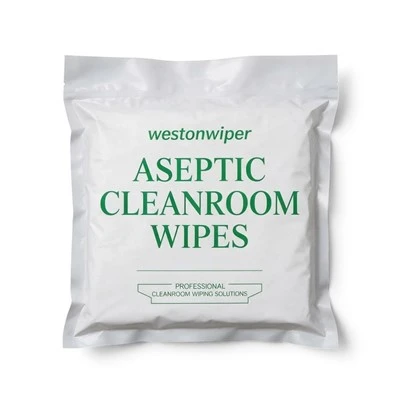
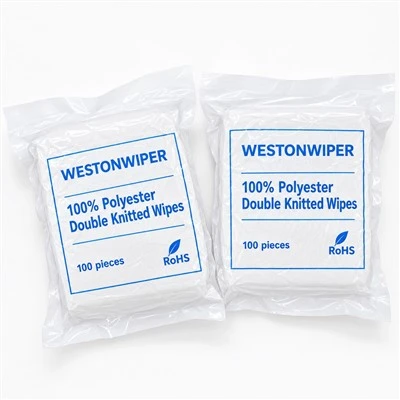
Choose Cleanroom Dry Wipes for battery dry rooms by matching the wipe to the specific process zone, then qualifying it for residual moisture, moisture uptake, particle and fiber release, solvent compatibility, and moisture-barrier packaging. Do not select a wipe solely because it is labelled "cleanroom grade" or "lint-free"; in a lithium-ion battery dry room, the wipe itself can become a source of moisture, contamination, and process variation.
There is no single industry standard for a "low-moisture wipe." In a dry room, treat the term as a wipe that adds as little water as possible, from its fabric, from any wetting liquid and from its packaging, while still meeting your limits for particles, ions, residue and static.
Check five things before you buy:
- Substrate: polyester knit, polyester/cellulose blend or microfiber, judged for water carry-in as well as absorbency.
- Format: dry or pre-wetted, and how much water the wetting liquid contains.
- Edge: heat-sealed or laser-cut edges to limit linting.
- Cleanliness: particle class, releasable ions, non-volatile residue and metals.
- Packaging and entry: sealed, ESD-safe, traceable packs moved through the airlock by a written routine.
A dry room exists to keep water out of the air, and anything carried in, including a pack of wipes, can undo that work. The sections below explain why each check matters and how to verify it.
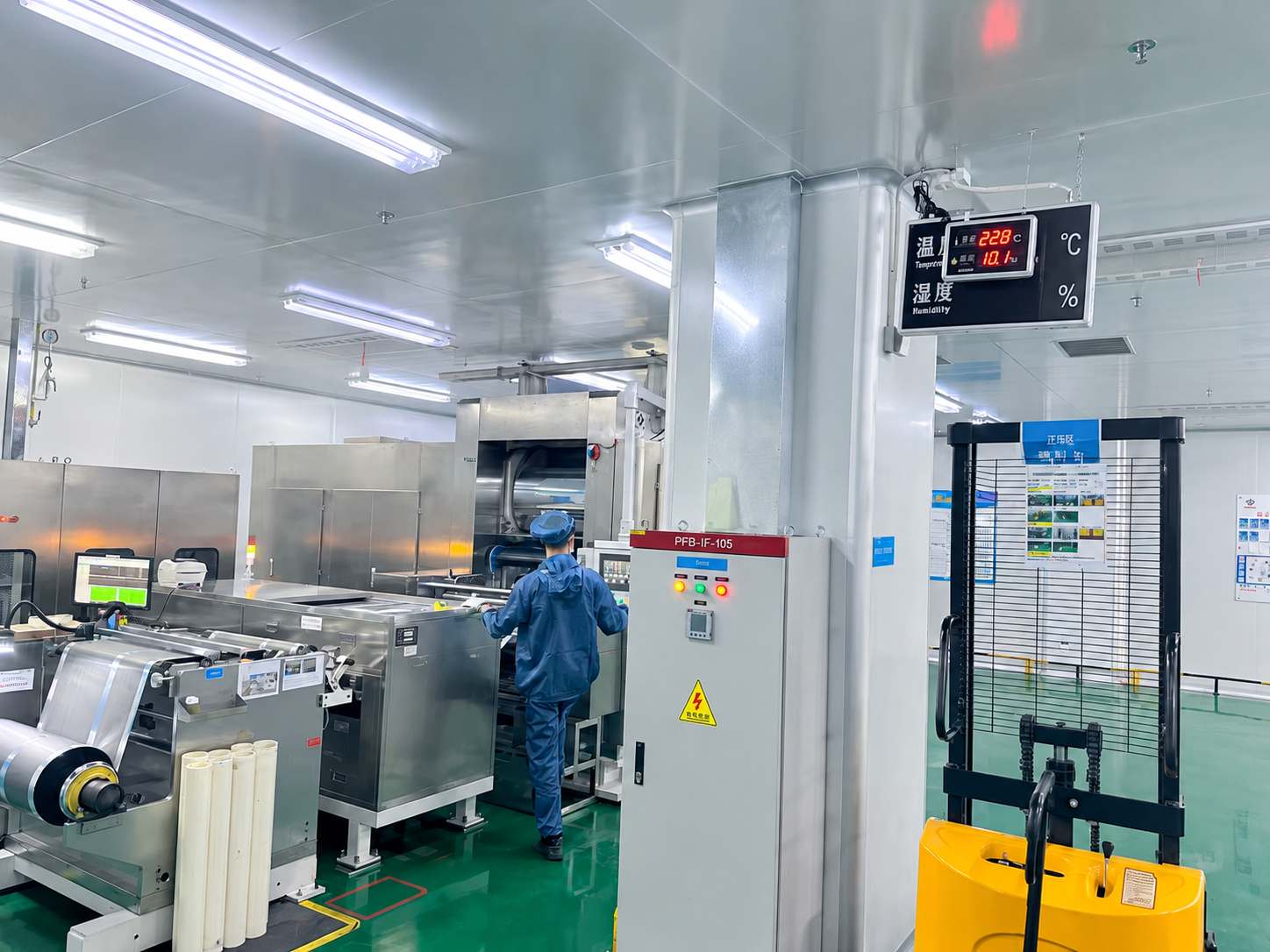
Why Wipes Matter in a Battery Dry Room
A wipe can carry water, particles, ions and static charge into a room built to exclude all four. Each one is a quality risk for a lithium-ion cell, which is why wipe selection belongs in the dry room specification, not only in the purchasing list.
What a dry room actually controls
A dry room is a production area where industrial dehumidification holds the air at a very low dew point. Dew point is the temperature at which water vapor starts to condense, so the lower it is, the less water the air holds. Air at 20°C and 50% relative humidity has a dew point of about 9.3°C. Battery production is far drier than that.
|
Environment |
Typical dew point |
|
Comfort-cooled office (20°C, 50% RH) |
About 9.3°C |
|
General dry room |
−30°C or lower (under 1% RH) |
|
Common lithium-ion cell specification |
About −40°C (roughly 0.08 g of water per kg of dry air, or 79 ppm by weight) |
|
Some solid-state and next-generation processes |
−40°C at return air; as low as −80°C at supply in critical areas such as electrolyte filling |
Sources quote slightly different figures, from −30°C to −55°C depending on the process step and chemistry. Always follow your own process specification.
What moisture does inside a cell
When water meets lithium hexafluorophosphate (LiPF₆), the salt used in many liquid electrolytes, it produces hydrofluoric acid (HF). Lithium metal reacts with moisture to form lithium hydroxide and hydrogen gas. The results include shorter cell life, lower performance and, in extreme cases, safety problems. Moisture sealed inside a finished cell can keep reacting after assembly.
This is why dried electrode and cell components must stay in a dry room for every later step. Otherwise they pick moisture back up. Even the electrolyte has a limit: for conventional carbonate-based electrolytes, research guidance keeps water content below about 20 ppm.
Where wipes add moisture and contamination
Most of a dry room's moisture load comes from people and from airlock openings. Anything carried in adds to it, and wipes are carried in constantly. A wipe can introduce risk in four ways:
Water, from the fabric or from a pre-wetting liquid.
Particles and fibers, which can become part of the cell. Even a small metal particle can create a conductive path between anode and cathode and cause an internal short.
Ions and residue released from the fabric.
Static charge, which in electrode mixing zones can ignite solvent vapors.
The cost of a mistake is high. One industry source warns that a seemingly minor contamination issue on a cell line can become a six-figure scrap event. For the cleanliness target, battery engineers commonly cite an environment equivalent to ISO 5 (Class 100) for cell manufacturing, although no formal industry standard exists.
What "Low-Moisture" Really Means for a Wipe
A low-moisture wipe is one that adds the least water to the room, but "least" has to be measured because the term is not standardized. Treat it as a requirement you define and verify, not a label you trust.
Three ways a wipe brings water into the room
The fabric. Fibers hold some residual moisture and can absorb more from the air. Natural fibers such as cellulose are absorbent by nature, which is why they pick up liquid so well, and also why they deserve a second look in a very dry space.
The wetting liquid. The most common pre-wetted format is 70% isopropyl alcohol (IPA) and 30% deionized water, so about a third of the liquid is water. IPA grades on the market range from 50% to 99%.
Packaging and handling. A torn bag, an opened pack or long exposure to ambient air lets a dry wipe pick up moisture before it reaches the work area.
Dry wipes or pre-wetted IPA wipes?
Both formats are used in battery plants. The trade-off is control against convenience.
|
Factor |
Cleanroom Dry Wipes |
Pre-wetted IPA wipes |
|
Water added by the wipe |
Only what the fabric holds |
Fabric moisture plus the water in the wetting liquid |
|
Solvent choice |
Yours: any solvent you have qualified for the zone |
Fixed by the product (often 70/30 IPA and water) |
|
Consistency between shifts |
Depends on how operators apply solvent |
Consistent solvent delivery, no mixing |
|
Solvent storage and handling |
Solvent must be stored and dispensed separately |
No solution to store, control or dilute; fewer VOCs |
|
Typical fit |
Zones where you want to decide exactly what liquid enters |
Routine wipe-downs where consistency matters most |
IPA itself is not the problem: it is available in high purity and evaporates almost completely without leaving residue. The question is how much water comes with it. If you choose pre-wetted wipes, ask for the IPA concentration and the water source, and validate the result against your dew point trend.
How to verify a moisture claim
We did not find a published industry standard that sets an acceptable moisture level for wipes used in dry rooms. That makes the supplier's data, and your own validation, the real basis for a decision. Ask for:
The test method used (for example, a Karl Fischer-type water-content method or loss-on-drying) and the conditions: temperature, humidity and time.
Whether the figure describes the bare fabric or the finished, packaged wipe.
Lot-level results, not a single typical value.
What the wipe's moisture pickup looks like after the pack is opened.
Set your own acceptance limit in the validation plan and record it.
The Selection Checklist: Six Criteria That Matter
Work through these in order: substrate, edge, particles, ions and residue, solvent compatibility, then static. The first two set the physical behavior of the wipe; the rest decide whether it is clean enough for your zone.
1. Substrate: polyester knit, poly-cellulose blend or microfiber
Polyester knit is the common choice where low linting and high cleanliness come first. A hydroentangled polyester/cellulose nonwoven, often 55% cellulose and 45% polyester, offers high absorbency and strength at lower cost, and data sheets for such blends commonly list ratings between ISO 5 and ISO 7, with low extractables and moderate particle counts. Microfiber and sub-microfiber wipes are specialized; verify residue and compatibility before using them.
For a dry room, add one more question: is absorbency or low water carry-in more important for this task? Cleanroom Dry Wipes made from polyester are a reasonable first candidate where water carry-in matters most, because synthetic fibers absorb less than cellulose, while blends suit tasks where liquid pickup matters more. Ask the supplier for moisture data on whichever you pick.
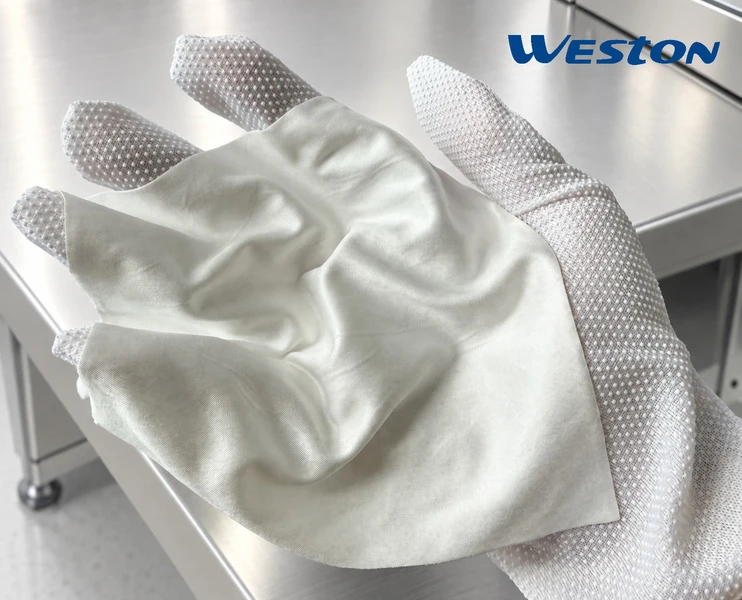
2. Edge finish: sealed or cold-knife cut
Heat-sealed or laser-cut edges melt and seal the fiber ends, which further reduces linting. Cold-knife cut edges are common on economical nonwovens. For work near open cells or electrodes, sealed edges are the safer specification.
3. Particle level and ISO class
There is no established industry standard for the cell-manufacturing environment, but a general guideline is cleanliness equivalent to ISO 5 (Class 100). Dry cleanrooms are often built to ISO 6, 7 or 8 depending on the process step. Manufacturers should state a recommended ISO class for each wipe, and the wipe's class should match the room where it is used. Some nonwoven wipes are rated only for ISO 6–7, so check before taking them into an ISO 5 area.
4. Ions, non-volatile residue and metals
Textile wipes can release ions, including lithium, sodium, potassium, calcium, iron, fluoride and chloride. They can also leave non-volatile residue (NVR) from surfactants, sizing compounds, waxes, oils, adhesives and anti-static agents. In a cell, ionic and residue contamination is hard to detect once the cell is sealed.
Metals need special care. One automation supplier's contamination guideline singles out copper, nickel and zinc as metals to avoid in components, because metal particles can cause internal shorts. Ask for a lot-level report on releasable ions, NVR and metals, and prefer wipes that state they contain no chemical binders.
5. Solvent compatibility
IPA is the usual cleaning solvent, and N-methyl-2-pyrrolidone (NMP) is widely used in electrode coating. A wipe must not swell, shed or leach when it meets the solvents in your process. Ask for the supplier's compatibility data, then run a small in-house test: soak a sample, inspect it, and check for residue on a clean coupon.
6. Static control
Uncontrolled discharge in an electrode mixing area can ignite solvent vapors, and dry-room walls and floors are specified to dissipate static because the humidity is so low. Choose static-dissipative wipes where the task calls for them, and look for packs that use ESD-safe wrappers to limit dust attraction.
Match the Wipe to the Zone and the Task
No single wipe suits every zone. Start from what the zone is doing and how moisture-sensitive it is, then pick the format and substrate for each task.
Which process steps run in the dry room
Steps that typically require dry-room conditions include electrode coating, stacking or winding, cell assembly, laser welding, vacuum drying, electrolyte filling, sealing, aging and formation. Their dew point targets differ. Some of the most sensitive steps run in dry booths or glove boxes, because drying a whole room to the lowest dew point is usually not economical. Treat the area around those booths as your most demanding wipe zone.
Decision table: task and wipe type
Use this table as a starting point, then validate each row against your own specification.
|
Task |
Suggested starting point |
Watch for |
|
Routine wipe-down of benches, carts and pass-throughs |
Sealed-edge Cleanroom Dry Wipes with a qualified solvent, or a pre-wetted wipe with a validated water content |
Fiber shedding; water from the wetting liquid |
|
Equipment and tooling between process steps |
Sealed-edge polyester wipes; low-ion grades |
Releasable ions and metals; static |
|
Areas near electrolyte filling and sealing |
The lowest-moisture, lowest-ion, sealed-edge option you can validate |
Strictest limits; moisture pickup after opening |
|
Electrode coating and NMP areas |
Substrate proven compatible with the solvent in use |
Swelling, leaching, residue |
|
Corners, gasket channels and ports |
Swabs instead of wipes |
Wipes that cannot reach or clean predictably |
When a wipe is the wrong tool
Complex shapes such as corners, gasket channels and ports often need swabs. Forcing a wipe into a geometry it cannot clean predictably leaves residue behind and can shed fibers into the very spot you were trying to clean.
Packaging, Airlock Entry and In-Room Handling
The best wipe can still fail if the pack is mishandled on the way in. Treat packaging and entry as part of the specification.
Packaging that protects the spec
Look for wipes that are laundered and packaged in a cleanroom, then double-bagged or vacuum-packed in solvent-safe film. Some suppliers state the packing environment, for example an ISO Class 5 cleanroom. ESD-safe wrappers help limit dust attraction. Lot coding gives traceability, which you will need if a contamination event has to be traced back. For in-room use, a resealable pouch or tub keeps the remaining wipes protected between uses.
Moving wipes through the airlock
Airlock openings are one of the two main moisture loads on a dry room, so the way wipes enter matters as much as the wipe itself. Write the routine down and train to it. A reasonable starting structure, to be adapted to your site:
- Remove the outer bag in the anteroom, away from the dry room door.
- Clean or replace the outer surface of the inner pack by an approved method.
- Stage the inner pack in the pass-through or airlock for a time set by your own validation.
- Open the inner pack only at the point of use, inside the dry room.
We are not giving a universal staging time, because the right figure depends on the room, the airlock design and the wipe, and none of the sources we reviewed publishes one. Measure it: watch the dew point at the airlock and at the work area while a test pack is staged and opened.
Storage and use inside the room
Keep the inner pack sealed until use and reseal it every time. Do not return used or dropped wipes to the pack. Define a discard rule for opened packs, such as a maximum open time, and base it on your validation data. Never decant wipes into unmarked containers.
How to Qualify a Supplier and Run a Trial
A data sheet tells you what a supplier claims. A trial tells you what happens in your room. Do both, and compare options on total cost, not unit price.
The spec-sheet questions to ask
Send the same list to every supplier so the answers are comparable.
|
Topic |
What to ask for |
|
Moisture |
Test method, conditions and lot-level data for the packaged wipe |
|
Particles and ISO class |
Test method, recommended ISO class, edge type |
|
Ions |
Releasable ions in ppm, including Li, Na, K, Ca, Fe, F and Cl, with the method |
|
Non-volatile residue |
NVR value and method |
|
Metals |
Control of copper, nickel and zinc; any metal-free claims |
|
Solvent compatibility |
Data for IPA, NMP and any other solvent you use |
|
Packaging |
Bag layers, ESD properties, packing environment |
|
Traceability |
Lot coding and certificate of analysis |
Run a practical in-room trial
Choose one zone and run the candidate wipe for a fixed period. Before you start, record a baseline: the dew point trend and particle counts for that zone. Place dew point sensors at critical points, not only at the return duct, since local conditions can differ from the room average. During the trial, track dew point changes when packs are staged and opened, take particle counts, check residue on clean test coupons, and collect operator feedback on handling and linting. Compare the results with the baseline before you decide.
Price per wipe versus the cost of a bad lot
Wipes are a small line item next to what they protect. Drying and dry-room operation account for roughly 40% of total energy use in battery manufacturing, so every unit of avoidable moisture load has a running cost. A single contamination event can also become a six-figure scrap problem. Weigh the unit price against these risks, and against the cost of qualifying a second source.
Common Mistakes to Avoid
Most wipe problems in dry rooms come from a handful of repeated assumptions.
- Treating "cleanroom wipe" as "dry-room ready." An ISO class says nothing about how much water the wipe brings in.
- Using 70/30 pre-wetted wipes in the most sensitive zones without checking the water content against the dew point spec.
- Judging only on particles and ignoring ions, residue and metals.
- Opening packs in the airlock or on the dry room floor instead of following a written entry routine.
- Assuming solvent compatibility instead of testing it with the solvents in your process.
- Comparing unit prices without counting scrap risk, trial cost and the cost of a single-source supply.
FAQ
Can I use 70% IPA wipes in a −40°C dew point dry room?
Pre-wetted IPA wipes are used in EV battery manufacturing, but a 70/30 wipe carries water in its liquid, about 30% of it. Whether that is acceptable depends on your zone and specification. Validate by watching the dew point while the wipes are staged and used, and consider higher-IPA wipes or Cleanroom Dry Wipes with a qualified solvent in the most sensitive areas.
Are polyester/cellulose wipes acceptable in a dry room?
They are widely used and many carry ISO 5–7 ratings with low extractables. Cellulose is absorbent, so ask for moisture data and test them in your zone. One practical approach is to use blends for routine surfaces and polyester-only wipes for the most sensitive areas.
Dry or pre-wetted: which is better near electrolyte filling?
This is the most moisture-sensitive part of the line. Cleanroom Dry Wipes give you control over exactly which liquid enters the area. Pre-wetted wipes can work if their water content, ions and residue are validated for that zone.
Do dry room wipes need to be ISO 5?
A general guideline for cell manufacturing is cleanliness equivalent to ISO 5, while dry cleanrooms are built to ISO 6, 7 or 8 depending on the step. Match the wipe's stated ISO class to the room class where it will be used.
How should opened packs be stored?
Keep the inner pack sealed, reseal it after each use, and keep it inside the dry room. Set a maximum open time from your own moisture and dew point data rather than a generic figure.
What data should I request from a supplier?
Ask for moisture data with the test method, particle counts and ISO class, releasable ions, NVR, metal control, solvent compatibility, packaging details and lot traceability. The table in the supplier qualification section lists each item.