Choose ESD gloves by matching the glove to the exact task: identify which parts are static-sensitive, confirm how the operator is grounded, and then balance static control with grip, dexterity, cleanliness, and any additional hand hazards. There is no single glove that is automatically right for every battery module and electronics assembly step-and an ESD glove alone does not ground the wearer or protect against electric shock.
How to Verify an ESD Glove Is Truly ESD-Safe
Do not trust the words "anti-static" on a label; ask for a measured surface resistance and the standard it was tested against.
Resistance ranges explained
For use in an EPA, a glove should be either conductive or static-dissipative. The dissipative range commonly referenced in ANSI/ESD S20.20 and IEC 61340-5-1 is 1 × 10⁶ to 1 × 10⁹ Ω. A glove that measures far above that range cannot reliably drain charge.
Why "anti-static" on the label is not enough
One supplier's comparative test, run on the same calibrated meter, shows how much constructions differ:
|
Glove construction |
Measured surface resistance (Ω/sq) |
In dissipative range? |
|
Carbon fiber knit, PU fingertip |
2.5 × 10⁶ to 2.0 × 10⁷ |
Yes |
|
Nitrile, powder-free |
about 4 × 10⁸ |
Yes |
|
Plain knit, PU fingertip |
6.5 × 10¹⁰ to 8.2 × 10¹⁰ |
No |
The plain knit glove looks identical to a carbon fiber one but sits roughly four orders of magnitude outside the range. Treat these figures as one vendor's results and request equivalent data for the gloves you buy.
Standards to look for
ANSI/ESD S20.20 and IEC 61340-5-1: the control-program standards that set the dissipative reference range.
EN 16350 and EN 1149-2: European standards for ESD protective gloves and electrostatic properties.
ANSI/ESD STM11.11 and SP15.1: test methods for surface resistance and for resistance in a glove-to-hand path.
Test conditions matter
Resistance changes with humidity. Staticide, for example, publishes glove results at both 12% and 50% relative humidity, which is the kind of disclosure you should expect. Ask for the test voltage, humidity, temperature and sample count, not just a single number.
Do not forget mechanical ratings
ESD performance does not tell you whether the glove survives your line. Check EN 388 or ANSI abrasion and cut levels, and the EN ISO 21420 dexterity rating, so the glove suits the task and lasts a full shift.
Match Glove Construction to the Assembly Task
For fine electronic component and BMS assembly
When handling small components, circuit boards, or connectors, prioritize fingertip sensitivity, a close fit, and enough grip to control the part without excessive force. A lightweight knitted glove or a glove with a thin finger coating may be worth evaluating. Try it on representative parts and tools before approving it for production; catalogue descriptions cannot predict how well a glove will perform at a particular workstation.
For battery module handling
For module housings, busbars, and larger assemblies, assess the physical task as well as the ESD requirement. Check whether workers handle sharp edges, oily surfaces, adhesives, or components that are difficult to grip. If those hazards are present, compare appropriate grip or cut-protection options while confirming that the complete glove remains suitable for the facility's ESD and cleanliness requirements. EV manufacturing guidance describes ESD and cleanroom hand protection as potentially overlapping with other needs such as cut, chemical, and temperature protection.
For clean or controlled environments
ESD performance and cleanroom suitability are separate questions. A glove that meets an ESD requirement is not automatically low-shedding or suitable for a particular controlled environment. Confirm the facility's cleanliness requirements, particle-control procedures, and any restrictions on glove materials or coatings.
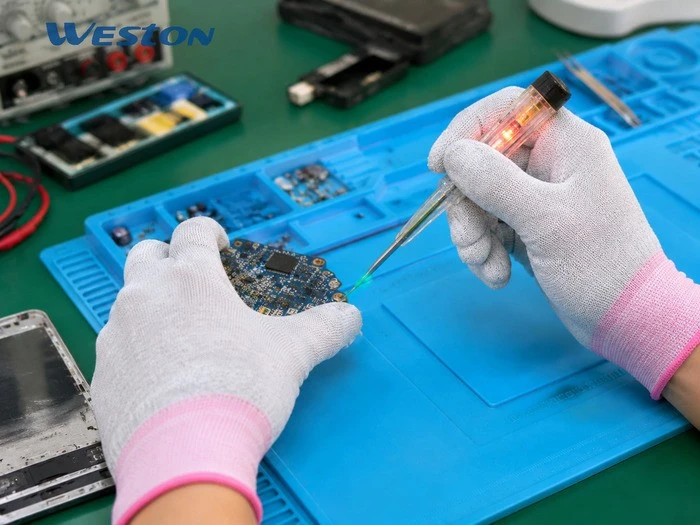
How to Evaluate Carbon-Fiber and Double-Sided ESD Gloves
Carbon Fiber ESD Gloves are one construction option to consider when conductive fibers are incorporated into the glove. But the words "carbon fiber" do not, by themselves, tell you the finished glove's electrical performance, grip, durability, or cleanroom suitability. Ask for documentation for the exact model and construction, and evaluate it under conditions relevant to your process.
Likewise, Double-sided ESD Gloves is a product-description term, not enough information to approve a glove. Check what "double-sided" means for the specific model: for example, whether the conductive or dissipative material is present on both surfaces, whether both sides have a coating, or whether the glove is designed to be worn either way around. Request test details for the actual surfaces that may contact the part, and confirm that the product meets your process requirements.
For both types, do not select by color, material name, or marketing label alone. Request the model-specific test report, including the test method and conditions, and compare it with your ESD control plan. Manufacturer guidance also emphasizes evaluating glove features such as material, coating, grip, and ergonomic fit against the application.
Selecting ESD Gloves for Battery Module Assembly: What Is Different?
Battery module assembly asks one glove to cope with three hazards at once, and it must never be mistaken for electrical protection.
Three hazards on one line
ESD: BMS boards, sensing harnesses and controllers.
Mechanical: sharp busbar edges, module housings and end plates.
Process: thermal paste, adhesives, sealants and cleaning agents around the cells.
The critical warning: ESD gloves are not insulating gloves
A conductive or dissipative glove is designed to drain charge, which is the opposite of insulation. Near exposed cell terminals or busbars, a glove that conducts can contribute to a short-circuit path. Electrical protection must come from your plant's safety procedures and from insulating gloves rated for the voltage involved, such as those classified under IEC 60903 or ASTM D120. Confirm the rules for each live-work step with your safety engineer before choosing any glove for that zone.
When to choose cut-resistant ESD gloves
Where operators handle stamped busbars, module frames or end plates, a cut-resistant ESD glove combining ESD fibers with HPPE gives static control and edge protection together. Pick the cut level from the actual edges on your line, and accept that thicker material reduces feel.
When Double-sided ESD Gloves make sense
For lifting and positioning modules, Double-sided ESD Gloves protect the back of the hand from scrapes against fixtures and frames while keeping the palm grip. Use them in the stacking and handling zones, not at the control-board bench.
Chemical and contamination control
Where thermal paste, adhesive or solvents are present, a nitrile-coated ESD glove resists oils and wears longer than PU. Keep gloves free of substances that could interfere with bonding or insulation, and change them when contaminated.
A zoned approach
|
Zone |
Main risk |
Suggested direction |
|
BMS and control-board assembly |
ESD, fine handling |
PU-coated Carbon Fiber ESD Gloves |
|
Module stacking and handling |
Scrapes, weight |
Double-sided ESD Gloves |
|
Busbar and housing handling |
Cuts |
Cut-resistant ESD gloves |
|
Dispensing and sealing |
Oils, adhesives |
Nitrile-coated ESD gloves |
|
Live electrical work |
Shock, short circuit |
Insulating gloves per safety procedure, not ESD gloves |
This zoning is general industry practice, not a substitute for your own risk assessment.
Using and Maintaining ESD Gloves Correctly
A glove only protects while it is clean, intact and used inside a grounded system.
Pair gloves with the rest of the ESD system
Use gloves together with wrist straps, grounded mats, ESD footwear or flooring, and a common grounding point. Remove and replace a glove rather than working on with a torn or contaminated one.
Washing and drying
Follow the maker's instructions. As one example, Staticide advises air drying, or tumble drying on low heat up to 25 °C (77 °F), to limit shrinkage and fiber damage. Many Carbon Fiber ESD Gloves are rated for repeated washing, but wash cycles, detergents and heat still shorten life.
When to replace
Replace gloves when coating peels, fibers break, the knit is stained or oily, or a resistance check falls outside your limits. Set a replacement interval by station, because a handling station wears gloves faster than an inspection bench.
Verify routinely
Sample gloves at intervals with a surface resistance meter under controlled conditions, record the results, and include them in your ESD program audits.
Common Mistakes When Buying ESD Gloves
Most bad purchases come from judging by appearance or price instead of measured performance.
Believing color indicates ESD performance. Color is for visibility and contamination spotting; gray, black, white and blue gloves can all pass or fail.
Using ordinary exam or work gloves. A plain knit glove can measure around 10¹⁰ Ω/sq, far outside the dissipative range.
Ignoring humidity. A result at 50% relative humidity may not hold in a dry plant.
Using one glove for every station. Fine placement, module handling and dispensing need different gloves.
Buying on price per pair. A cheaper glove that wears out in days costs more per shift than a durable one.
Treating an ESD glove as electrical protection. It is not one, as covered in the battery section above.
ESD Glove Selection Checklist
Work through these ten questions before you approve a glove for any station.
- What is the task: fine assembly, inspection, handling or dispensing?
- How ESD-sensitive are the parts being touched?
- Is the measured surface resistance within 10⁶ to 10⁹ Ω, at what humidity?
- Which standard was it tested to (ANSI/ESD S20.20, IEC 61340-5-1, EN 16350)?
- Do you need low lint or cleanroom compatibility?
- Are there sharp edges that call for cut-resistant material?
- Will the glove contact oils, adhesives or solvents?
- Does the back of the hand need protection, pointing to Double-sided ESD Gloves?
- Does the zone involve live electrical work that needs insulating gloves instead?
- What is the cost per shift once wear and washing are counted?
What to ask your supplier
- The test report, with method, voltage, humidity, temperature and sample size
- Batch-to-batch consistency data
- Wash-cycle durability of the ESD property
- Samples for a trial on your own line
FAQ
Are nitrile gloves ESD-safe?
Only some are. A powder-free nitrile glove in one test measured about 4 × 10⁸ Ω/sq, inside the dissipative range, but ordinary nitrile varies by product, so check the data sheet.
Can ESD gloves replace a wrist strap?
No. Gloves are one layer of an ESD control system, used together with grounding.
Do ESD gloves protect against electric shock?
No. They are designed to dissipate static, not to insulate. Use insulating gloves rated for the voltage where shock is a risk.
How often should ESD gloves be replaced?
Replace them when the coating or fibers are worn, when they are contaminated, or when a resistance check fails. Set the interval per station.
Can ESD gloves be washed?
Many knitted Carbon Fiber ESD Gloves are washable, but follow the manufacturer's wash and drying limits and re-test periodically.
Do I need cut-resistant ESD gloves for battery assembly?
If operators handle sharp busbars, frames or end plates, yes, in those zones. Use PU-coated gloves where fine electronics are handled.