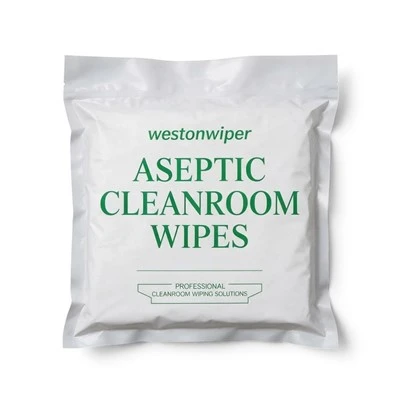
How to Choose Wipes for Food Packaging Lines: Material, Colour and Food-Contact Safety
Choose a food-line wipe in a fixed order: where it is used, what it must not add, then material, colour, documents, liquid, handling and a sample trial.
- Zone: decide whether the wipe touches food, a surface that touches food, or neither.
- Risk: list what the wipe must not add: fibres, residue, odour and torn fragments.
- Material: match polyester, microfibre to the surface and the task.
- Colour: use colour for contrast, zone control and foreign-body visibility, never as proof of safety.
- Food-contact documents: ask for a declaration of compliance that states the conditions of use.
- Liquid: choose the wipe and the cleaning liquid together and test them as one system.
- Handling: fix packaging, storage and wiping rules before wipes reach the line.
- Verify: trial samples against written acceptance criteria before any bulk order.
|
Line zone |
Wipe direction |
Colour |
Documents to request |
|
Food-contact surfaces (nozzles, sealing jaws) |
Low-lint polyester or microfibre, sealed edge |
White or blue, set by your hygiene plan |
Declaration of compliance with conditions of use; lot traceability |
|
Indirect-contact surfaces (guides, conveyors, film path) |
Polyester or poly-cellulose, sealed or cut edge |
Zone colour |
Material specification; lot traceability |
|
Non-contact surfaces (frames, guards, exteriors) |
Economical woven |
Zone colour |
Material specification; SDS if pre-wetted |
|
Spills and changeovers |
Absorbent woven with good wet strength |
Blue for visibility |
Composition and absorbency data |
|
Electronics and sensor enclosures |
Static-control wipe |
Per site rules |
Static-performance data; laundering rules if reusable |
Where Will the Wipe Be Used on Your Packaging Line?
The right wipe depends first on where it touches the line, because contact with food decides which documents and liquids you can use.
Which areas of a packaging line need wiping?
Most packaging lines need wipes in six places, and each one raises a different concern.
|
Area |
What builds up |
Main wipe concern |
|
Filling and dosing nozzles |
Product film, drips |
Residue; fibres near product |
|
Heat-seal jaws and bars |
Melted film, product traces |
Fibres left on seal faces |
|
Conveyors, guides and star wheels |
Dust, spills, grease |
Strength when wet |
|
Film, lidding and label-stock areas |
Dust, static-attracted particles |
Lint transfer to packaging |
|
Coding and printer heads |
Ink, adhesive |
Solvent compatibility |
|
Changeovers and spills |
Liquids, sauces, powders |
Absorbency and wet strength |
Electronics deserve their own rule. Vision cameras, sensor windows and control cabinets sit beside the same film and dust, and static attracts both. A static-control wipe such as Thickened ESD Wipes, a woven wipe with conductive fibre stripes, suits these enclosures. Keep it away from food-contact surfaces, and because it is designed for reuse, set a laundering and replacement rule before it enters the plant.
What is the difference between food-contact, indirect-contact and non-contact surfaces?
Food-contact surfaces touch food directly, indirect-contact surfaces touch the packaging or the food-contact parts, and non-contact surfaces touch neither.
Food-contact: surfaces that meet product or the food-facing side of the pack, such as filling nozzles, hoppers and sealing jaws.
Indirect-contact: guides, star wheels, belts and film-path parts that can drip, splash or transfer soil onto food-contact parts.
Non-contact: frames, guards, panels and exteriors.
The class decides which documents you request, whether a rinse follows wiping, and how strict your fibre limits are. Write the class beside each wipe in your cleaning SOP.
Do you need a cleanroom wipe or a general food-service wipe?
Use cleanroom-grade wipes where fibre and residue control matter most, and general wipes where cost and absorbency matter more.
A food packaging line is not automatically a cleanroom, although high-care and aseptic filling areas may run under controlled-environment classes. Westonwiper's industry guide places general packaging and manufacturing areas in the ISO Class 7–8 band, where cost-effective wipes suit the work, and lists food processing as a hygiene-focused cleaning use.
In practice, specify low-lint wipes for seal faces, fill points and final wipes. Use general wipes for frames, guards and exteriors.
What Risks Should a Wipe Never Introduce?
A food-line wipe must remove soil without adding fibre, residue, odour or loose fragments, so define these four risks before you compare materials.
Fibre and lint
A wipe that sheds fibres can leave them on seal faces, in the pack or in the product, and a fibre trapped in a seal can reduce seal quality. No wipe is completely lint-free, so ask for low-lint data and the test method behind it.
Particle results from different methods are not directly comparable. Westonwiper's own selection guide points to ISO 14644-18:2023 for assessing consumables and to IEST-RP-CC004 for evaluating wiping materials.
Chemical residue, binders and odour
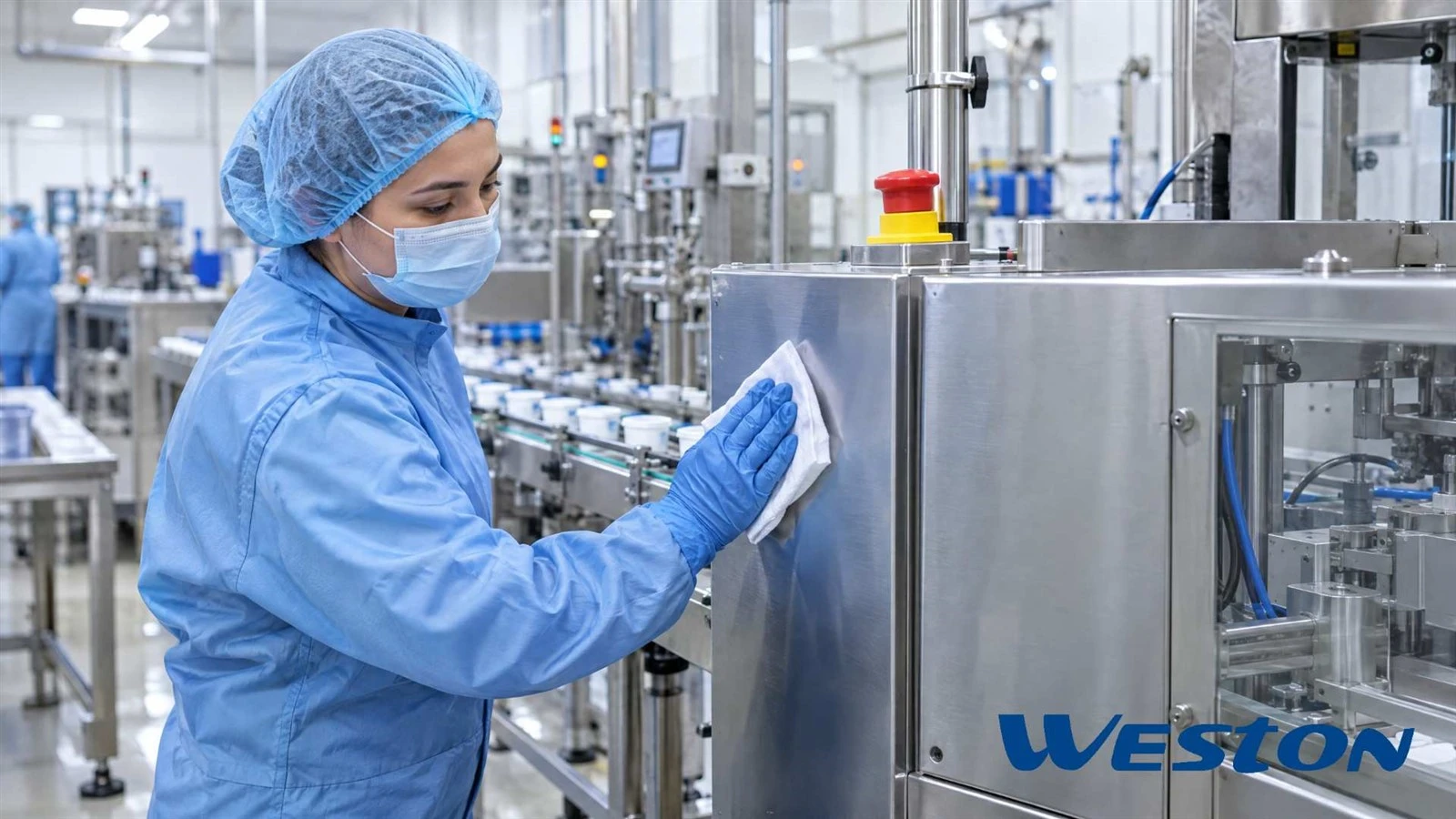
Binders, finishing agents and surfactants in a wipe can transfer to a surface, and some leave non-volatile residue (NVR) once the liquid evaporates. Residue can affect the smell of a sensitive product and can disturb heat-sealing or printing.
Ask for the full composition, and request extractables or residue data where your process needs it.
Torn fragments as foreign bodies
A torn piece of wipe is a foreign body like any other. Two properties lower the risk: strength when wet, so the wipe does not tear, and visibility, so a lost fragment is found quickly. Material and colour, covered next, control both.
Cross-contamination between zones
A wipe moves soil as easily as it removes it. Sharing one wipe between areas, or re-dipping a used wipe in clean liquid, spreads contamination. Assign one wipe to one defined area and, where it helps, one colour to one zone.
Which Wipe Material Suits a Food Packaging Line?
No single material is best: polyester knit suits seal faces and nozzles, microfibre suits films and printed surfaces, and woven suits spills and general wiping.
|
Material |
Best use on the line |
Watch-outs |
Typical edge |
|
Polyester knit or woven |
Seal faces, nozzles, final wipe |
Confirm particle and fibre data |
Laser, ultrasonic or heat-sealed |
|
Polyester/nylon microfibre |
Films, printed surfaces, oils and fingerprints |
Residue; compatibility with your liquid |
Laser cut |
|
Cellulose/polyester |
Spills, changeovers, non-contact surfaces |
Fibre release; wet strength |
Cut or sealed |
|
Paper, cotton, general towels |
Floors, frames, non-critical areas |
Higher fibre release; keep away from product |
Cut |
Polyester knit or woven wipes
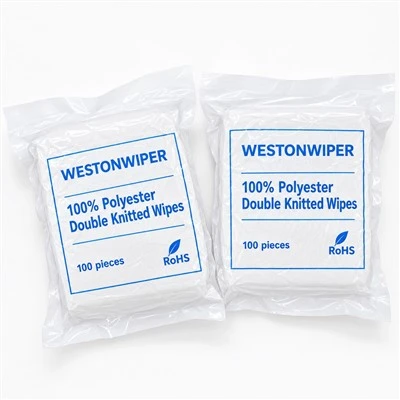
Continuous-filament polyester gives a strong, stable fabric with low fibre release when the edges are sealed. It is the usual choice for seal faces, filling nozzles and final wipes. Westonwiper's double-knitted polyester wipe, for example, is 100% polyester at 130 GSM in white.
Polyester/nylon microfibre
Fine fibres give a soft, wide contact surface that lifts oils and fingerprints from films, printed surfaces and polished metal. Westonwiper's IPA pre-saturated wipe uses an 80% polyester / 20% nylon knit with a laser-cut edge. Test any microfibre for residue and liquid compatibility before approval.
Does edge finish matter?
Yes. A cut edge can fray and shed fibres, while a sealed edge limits release. Westonwiper uses ultrasonic slitting and laser slitting or cross-cutting to hold size and reduce fraying, and its disposable wipes are offered with cold, laser or ultrasonic sealed edges. Choose a sealed edge wherever fibre release matters.
How do you specify size, GSM and format?
Match size to the task: small wipes for nozzles and jaws, large sheets for conveyors and guides. GSM (grams per square metre) describes fabric weight, and a higher number does not automatically mean less lint.
Westonwiper's laser-cut polyester wipes come in 4, 6, 9 and 12 inch sizes, with custom weights from 80 to 250 gsm.
How to Choose Wipe Colour: White, Blue or Colour-Coded
Colour is a control measure: blue helps you spot a lost fragment, white helps you see soil, and zone colours stop wipes crossing between areas.
Why is blue so common in food factories?
Few foods are blue, so a blue fragment stands out against product. Suppliers of detectable consumables describe colour as one of the simplest foreign-body controls, working before any metal detector or X-ray check.
Blue improves visibility, but it does not make a wipe detectable by machine.
When is white the better choice?
White shows soil, residue and discolouration, which suits final wipes on seal faces, films and polished surfaces. It is also the usual colour for cleanroom wipes.
If your plant uses blue for foreign-body visibility, reserve white for inspection-critical steps and label the difference clearly.
How do you set up colour-coding by zone and task?
Pick one colour per zone or task, write it into the hygiene plan and train operators on it. No universal scheme exists, so the table below is an example to adapt.
|
Colour |
Example use |
Control to add |
|
Blue |
Wiping near open product, where a lost fragment must be seen |
Detectability check on your line |
|
White |
Final wipe of seal faces, films and inspection surfaces |
Residue check after drying |
|
Green |
Non-contact exteriors and guards |
Separate lidded bin |
|
Other colours |
Tasks or areas you define, such as changeovers or maintenance |
Signage at point of use |
Do dyes and pigments migrate into water, alcohol or sanitiser?
Dye can bleed when a wipe is wet, especially with solvents. Ask for colourfastness data tested with your own liquids.
A simple check: wet a wipe with your liquid, press it on a white cloth for the contact time, and look for colour transfer.
Does blue mean metal-detectable?
No. Metal-detectable wipes are specialist products that standard detectors can identify, and colour alone proves nothing. If your plant needs detectability, ask the supplier whether it can be supplied, then test it on your own detector. Record the result in your foreign-body control plan.
What Does Food-Contact Safe Really Mean for a Wipe?
Food-contact safe is a documented claim about a specific wipe in a specific use, not something the words food grade can prove.
Are cleaning wipes covered by food-contact regulations?
It depends on use. The EU framework, Regulation (EC) No 1935/2004, covers materials that are meant to touch food, already touch it, or can reasonably be expected to touch it or transfer constituents to it under normal or foreseeable conditions. A wipe used on a food-contact surface may fall under that wording, while a wipe used only on a frame may not.
The core rule in Article 3 is that a material must not transfer constituents to food in amounts that endanger health, change the food's composition or alter its taste and smell. In the United States, food-contact materials fall under FDA rules in Title 21 of the Code of Federal Regulations. Ask your supplier which rules apply to the wipe, and have your QA team confirm the current text. This article is not legal advice.
Which documents should you ask the supplier for?
Request these six items. A gap in any of them is a question to resolve before approval.
- A declaration of compliance naming the regulation, the material and the conditions of use, such as food types, contact time and temperature.
- Migration or compliance test reports, where they apply to the material.
- Full material composition, including binders and finishing agents.
- A statement of good manufacturing practice, for example under Regulation (EU) No 2023/2006 in the EU.
- Lot traceability and batch records.
- A quality system certificate such as ISO 9001, plus the SDS and liquid specification for pre-wetted wipes.
What do food grade, food safe and approved for food areas really cover?
They are marketing phrases until a document defines their scope. One pre-wetted cleanroom wipe on the market, for example, carries an NSF A1 listing as a general cleaner for surfaces in and around food processing areas, yet the listing states that it is not for direct food contact. Its instructions also require food and packaging to be removed or protected, and a potable-water rinse afterwards.
Read the scope sentence, not the headline. Suitable for food areas and safe for direct food contact are different claims.
How do certificate scopes differ?
Each document answers one question only.
|
Document |
What it covers |
What it does not prove |
|
Declaration of compliance |
A named material for the stated uses |
Compliance for other uses or liquids |
|
RoHS document |
Restricted substances, within its stated scope |
Food-contact compliance, sterility or low particle release |
|
SGS or similar test report |
The samples, properties and methods listed in the report |
Other lots, other properties or your process |
|
ISO 9001 certificate |
A quality management system |
Food-contact compliance of a specific product |
Westonwiper's own selection guide makes the same point for RoHS and SGS documents: check what each one actually covers before relying on it.
What will a HACCP or BRCGS-style audit ask about wipes?
Audit frameworks such as HACCP-based systems, BRCGS and FSSC 22000 expect documented foreign-body control and supplier approval. For wipes, an auditor is likely to ask for the supplier approval record, the declaration of compliance, lot traceability, the wiping procedure and records of how torn or lost wipes are handled. Keep these in one file per wipe type.
Dry, Pre-Wetted or Pre-Saturated: Choosing Wipes and Liquids Together
Choose the wipe and the liquid as one system, because the liquid decides residue, wet strength and whether a rinse is needed.
Which cleaning liquids are used on packaging lines?
Four groups cover most lines: water, detergent solutions, alcohols such as IPA or ethanol, and sanitisers or disinfectants. Each changes how a wipe behaves. Alcohol dries fast, while detergent and sanitiser may need a rinse. Your SOP, not the wipe, should name the liquid.
Is IPA or ethanol acceptable near food and packaging?
Only within your own risk assessment: control ventilation, ignition sources and drying time, and restart the line once the surface is dry.
Westonwiper's IPA pre-saturated wipe uses 70% IPA and 30% purified water to remove particles, oils, fingerprints and light residues. Its product page states that it should not be presented as a registered disinfectant unless that use is separately validated. Westonwiper also lists alcohol wipes in 70% IPA or 75% ethanol formulas.
Dry wipes plus your liquid, or pre-saturated wipes?
Neither format is better for every task. Pre-saturated wipes cut on-site solvent mixing and operator-to-operator variation, while dry wipes keep the choice of liquid open.
|
Consideration |
Dry wipes |
Pre-saturated wipes |
|
Liquid supply |
You supply the approved liquid |
Liquid added during manufacture |
|
Consistency |
Depends on how operators dispense |
Fixed saturation per wipe |
|
Flexibility |
Pair with different approved liquids |
Formulation fixed by the specification |
|
Key checks |
Wipe compatibility, liquid quality, dispensing method |
Formulation, shelf life, packaging compatibility |
|
Handling |
Needs bottles or buckets on the line |
Fewer mixing and handling steps |
Do you need to rinse or air-dry after wiping?
Follow the product label and your SOP. Some products require a potable-water rinse after use, and some require food and packaging to be removed first. For IPA-treated surfaces, allow air-drying before further processing, as Westonwiper's usage steps state. Do not assume a no-rinse result from the wipe alone.
How do you test wipe and liquid compatibility?
Wet the wipe with your approved liquid and hold it for the normal contact time.
Pull and rub it to check wet strength and tearing.
Wipe a dark and a white test surface and look for lint.
Press it on a white cloth to look for dye transfer.
Let the surface dry, then check for residue, film and odour.
How Should Wipes Be Packaged, Stored and Used in a Food Plant?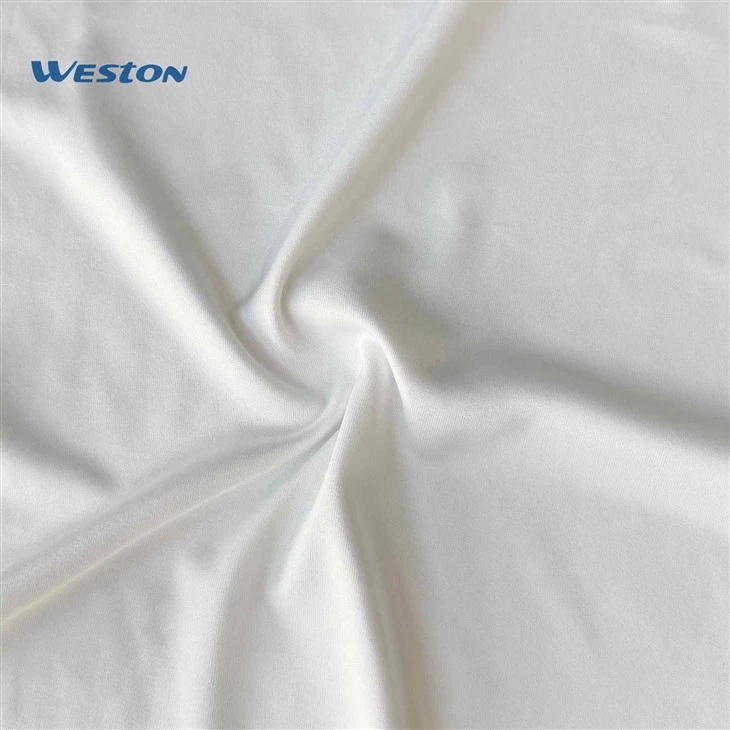
A well-chosen wipe still fails if it is stored badly or used loosely, so fix packaging, storage and wiping rules before wipes reach the line.
Bag-in-bag, double-layer vacuum or roll: which suits your transfer procedure?
Folded wipes in double-layer vacuum packs stay clean until opened, and the outer layer can be removed at the zone entrance. Packaging protects the wipe in storage and transfer, but it does not by itself prove sterility or compliance.
Rolls suit fast changeovers and lines that tear off one sheet at a time. If your team prefers rolls, work with a Cleanroom Wiper Rolls supplier that cuts, washes and packs in a controlled workshop, so the rolls arrive as clean as folded wipes.
How should you store opened and unopened packs?
Keep packs in their original packaging, away from chemicals, moisture and heat, and use older stock first. Close opened packs after taking a wipe. There is no universal open-pack period, so follow the supplier's instructions and your own procedure.
What four wiping rules cut contamination?
Use one wipe for one defined area.
Wipe in one direction with a slight overlap.
Discard the wipe when it is saturated or soiled, and never re-dip a used wipe.
Let the surface dry before the line restarts.
Should wipe issue and breakage be controlled on the line?
Yes. Treat wipes as a controlled consumable: issue them by shift, keep used wipes in lidded bins, record any torn or missing wipe, and recover fragments before restart. This ties the wipe directly to your foreign-body control plan.
How to Qualify a Wipe Supplier and Test Samples
Qualify a supplier on manufacturing controls, documents and a sample trial, then compare options by cost per acceptable cleaning task.
What manufacturing controls should you ask about?
Ask where and how the wipes are cut, washed and packed. Look for these controls:
- A dedicated cleanroom production area with dust control and constant temperature and humidity.
- Washing in ultrapure water to remove loose particles and ionic contaminants.
- Sealed-edge cutting by laser or ultrasonic equipment.
- Control of the fabric or woven base as well as the finished wipe.
- A certified quality system, raw-material and finished-product testing, and lot traceability.
Westonwiper's factory, for example, reports a dedicated cleanroom workshop, ultrapure-water washing, laser and ultrasonic cutting, in-house woven production and an ISO 9001 system. It also reports monthly output above 500,000 units and more than 20 years of manufacturing experience. Treat these as claims to confirm with documents and a sample trial.
What should a sample trial measure?
Write the pass criteria before the trial, and record the lot you tested.
|
Test |
How to run it |
What to look for |
|
Lint transfer |
Wipe a dark test surface and the real seal face, then inspect |
Visible fibres |
|
Wet strength |
Wet with your liquid, then rub and pull |
Tearing or shredding |
|
Residue and odour |
Wipe, dry, then inspect and smell |
Film or taint |
|
Colourfastness |
Press a wet wipe on a white cloth |
Dye transfer |
|
Effect on seals and print |
Run test packs after wiping |
Seal failures, print defects |
How do you compare two wipes fairly?
Compare on the same factors, and judge by cost per acceptable cleaning task, not unit price. A cheaper wipe that needs more sheets, fails inspection or causes rework costs more.
|
Factor |
Question to ask |
|
Material and edge |
Is the construction right for the surface and task? |
|
Cleanliness data |
Are particle and fibre tests relevant and comparable? |
|
Residue |
Is composition or extractables data available? |
|
Liquid compatibility |
Was it tested with your liquid and surface? |
|
Colour |
Does it meet your zone and visibility rules? |
|
Documents |
Is there a declaration of compliance with conditions of use? |
|
Traceability |
Can each lot be linked to your records? |
|
Total cost |
What does one acceptable cleaning task cost? |
What can be customised?
- Size and GSM.
- Material composition.
- Packaging format and quantity, including OEM logo and packaging.
- Liquid and saturation level for pre-wetted wipes.
- Colour or detectability, which may not be standard options, so ask early.
Westonwiper offers custom size, material composition and packaging, and for volume B2B orders it will discuss saturation level and cleanroom processing requirements.
Five common mistakes when choosing wipes for food lines
- Choosing on unit price alone.
- Treating suitable for food areas as safe for direct food contact.
- Treating colour as proof of safety or detectability.
- Ignoring the cleaning liquid and its compatibility.
- Approving a bulk order without a sample trial.
Frequently Asked Questions About Wipes for Food Packaging Lines
Can cleanroom wipes be used on food-contact surfaces?
Only if the supplier documents that use. Cleanroom grade means low particles and residue, not food-contact compliance. Ask for a declaration of compliance that states the conditions of use, then follow your SOP for the liquid, drying and any rinse.
Are blue wipes always metal-detectable?
No. Blue improves visibility, but detectability by machine is a separate property. Specialist suppliers offer metal-detectable wipes, and you should test any claimed option on your own detector before relying on it.
Can IPA pre-saturated wipes be used on food-contact surfaces?
That depends on the product's stated use, local rules and your SOP. A 70% IPA wipe is a cleaning product unless it is separately validated or registered as a disinfectant. Check the label, control ventilation, allow full drying, and follow any rinse requirement.
Is lint-free really lint-free?
No wipe sheds nothing, so low-lint is the accurate term. Ask for particle and fibre data with the test method and unit, because results from different methods cannot be compared directly.
Do food packaging lines need sterile wipes?
Most do not. Sterile wipes belong in processes that require validated sterility, such as some aseptic filling areas. Packaging alone does not make a wipe sterile, so confirm the requirement and the evidence with your QA team.
Which documents should be ready for an audit?
Keep the supplier approval record, the declaration of compliance with conditions of use, the material specification, lot traceability, the wiping SOP and records for torn or lost wipes. One file per wipe type keeps audits quick.
How often should a wipe be changed during a line clean?
Use one wipe per defined area and replace it when it is saturated, soiled or torn. Never re-dip a used wipe in clean liquid.