ISO Class 5 means that the air in a controlled cleanroom contains no more than a defined number of airborne particles of specific sizes. It does not mean that the room has zero particles, that every surface is clean, or that every product inside is automatically protected from contamination.
Under ISO 14644-1, ISO Class 5 allows up to 3,520 particles measuring 0.5 micrometers or larger per cubic meter of air.
The Basic Meaning of ISO Class 5
ISO Class 5 is an air-cleanliness classification. It is based on particle concentration, not on a general claim that a room is "very clean." The classification is determined by measuring airborne particles at selected locations and comparing the results with the limits in ISO 14644-1.
The permitted concentrations are cumulative. This means the limit for particles of 0.5 micrometers includes particles that are 0.5 micrometers and larger. The main ISO Class 5 limits are:
|
Particle Size |
Maximum Concentration per Cubic Meter |
|
≥ 0.1 µm |
100,000 |
|
≥ 0.2 µm |
23,700 |
|
≥ 0.3 µm |
10,200 |
|
≥ 0.5 µm |
3,520 |
|
≥ 1.0 µm |
832 |
These figures are maximum allowable values, not the number of particles that should normally be present during every moment of production. The result may change according to room activity, equipment, personnel movement, airflow, and sampling conditions.
A smaller ISO number means a cleaner air environment. ISO Class 4 is cleaner than ISO Class 5, while ISO Class 6 is less clean. ISO Class 5 is also commonly associated with the older "Class 100" terminology at the 0.5-micrometer level.

What ISO Class 5 Does Not Mean
Many users misunderstand ISO Class 5 because they treat the classification as a complete cleanliness guarantee. It is not.
ISO Class 5 does not directly confirm:
- Surface cleanliness.
- Product cleanliness.
- Microbial control.
- Chemical residue control.
- Molecular contamination.
- Low fiber release from wipes or garments.
- Correct operator behavior.
- Effective cleaning technique.
A particle counter can tell you how many particles are in the air and their approximate size. It usually cannot tell you whether a particle is a skin flake, fiber, metal fragment, plastic particle, salt crystal, or biological carrier.
This distinction matters because contamination can reach a product through direct contact. A workbench may pass its airborne particle test while still containing particles, oil, or residue on its surface.
Classification States Matter
An ISO Class 5 result must be understood together with the condition under which the room was tested.
As-Built
The room is complete, but production equipment, materials, and personnel may not be present. This test shows the basic capability of the facility, but it may not represent real production.
At-Rest
The equipment is installed and operating, but personnel are not performing normal work. This condition is more realistic than as-built, but it still excludes much of the contamination produced by people.
Operational
The room is operating with personnel, materials, tools, and processes present. This is often the most useful condition for understanding actual production cleanliness.
A room can pass in an empty or quiet state and fail during normal work. Operators, packaging, equipment, wipes, gloves, and unnecessary movement can all increase contamination.
Therefore, the key question is not simply "Is this room ISO Class 5?" It is "Under which condition was it classified?"
How the Room Maintains Clean Air
ISO Class 5 performance depends on a complete contamination-control system.
High-efficiency filters remove particles from the supply air. Airflow then carries contamination away from critical areas or dilutes it through controlled air changes. Positive pressure can also reduce the entry of contaminated air from nearby areas.
However, filtration cannot stop contamination that is created inside the room. People are often a major source of particles. Skin flakes, hair, garment fibers, respiratory droplets, and particles from movement can enter the environment if gowning and behavior are poor.
Materials must also be controlled. Cardboard, packaging, labels, tools, plastic parts, gloves, lubricants, and cleaning products may introduce contamination. Proper transfer procedures and cleanroom-compatible packaging are essential.

Why Cleanroom Wipes Matter
A cleanroom wipe is not automatically suitable just because its label includes the words "cleanroom" or "low lint." Wipes may release particles, fibers, chemical residues, ions, or extractables during use. They may also damage delicate surfaces through abrasion.
For ISO Class 5 cleaning, users should review:
- Particle and fiber release.
- Nonvolatile residue.
- Ionic contamination.
- Chemical compatibility.
- Absorbency.
- Edge construction.
- Packaging and traceability.
- Sterility, where required.
Knitted polyester wipes are often used for critical cleaning because they can provide low-lint performance. Still, the material name alone is not enough. The wipe construction, sealed edge, test method, solvent, and actual application all affect performance.
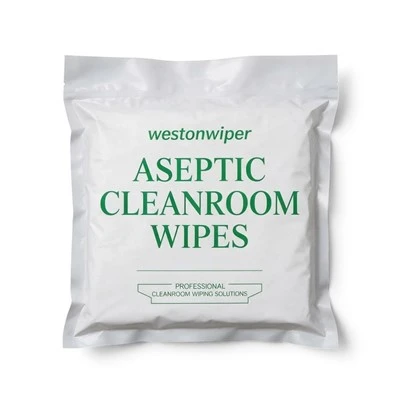
For example, Westonwiper Nano Scale Ultra Fine Cleanroom Wipes may be considered when a process requires fine, controlled wiping performance. Buyers should still review technical data and validate the wipe with the actual surface and cleaning agent.
A supplier serving customers as an OEM Cleanroom Wipes Manufacturer should be able to provide clear product specifications and lot information.
How to Clean in ISO Class 5
Cleaning should move from the cleanest area toward the dirtiest area. Operators commonly work from top to bottom and from the back toward the front. Overlapping, parallel strokes help reduce missed areas.
The wipe should be folded so that a clean surface is used for each pass. A used wipe should not be returned to an area that has already been cleaned. Excessive pressure may cause abrasion, while excessive speed may create turbulence and spread particles.
Wet wiping can improve particle capture, but the solvent must be compatible with the surface and the process. The wipe should not be so dry that it pushes particles around, and it should not leave unacceptable residue.
The procedure should be validated with the real surface, solvent, wipe, equipment, and operator technique. A wipe that performs well in a laboratory test may behave differently in production.
A Practical Way to Judge ISO Class 5
When evaluating a facility or consumable, ask for specific evidence:
- The applicable ISO standard and revision.
- The classification condition.
- Particle sizes measured.
- Sampling locations.
- Test date and calibration information.
- Wipe particle and fiber data.
- Residue and extractables data.
- Chemical compatibility information.
- Lot traceability.
The central idea is simple: ISO Class 5 controls airborne particle concentration. Reliable contamination control requires much more. Airflow, filtration, gowning, material transfer, cleaning methods, wipes, solvents, monitoring, and operator discipline must work together.