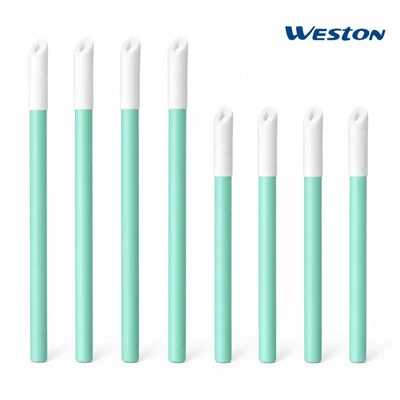
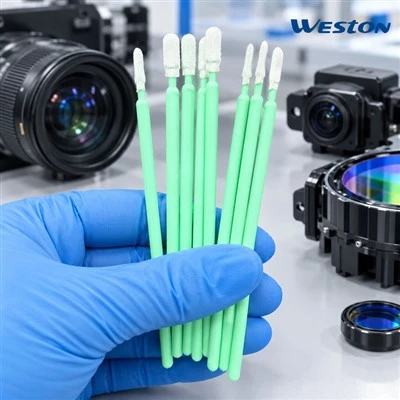
Foam vs. Polyester vs. Microfiber Cleanroom Swabs: Which Tip Material Is Right?
Cleanroom swabs are designed for precision cleaning in areas where larger wipes may be difficult to control, including narrow gaps, recessed surfaces, small components, and delicate equipment. However, choosing a swab based on its tip material alone can lead to an incomplete assessment of cleaning performance.
Foam, polyester, and microfiber tips differ in their construction, liquid-handling characteristics, and interaction with target surfaces. Their actual performance also depends on the cleaning fluid, the contaminant being removed, the tip geometry, and the wiping procedure.
When comparing foam vs. polyester vs. microfiber cleanroom swabs, buyers should look beyond general claims about absorbency or low particle generation. A more useful question is whether a particular swab can remove the intended contaminant while meeting the cleanliness requirements of the application.
This guide explains the differences between the three tip materials, explores how they behave during practical cleaning tasks, and provides a structured approach to evaluating swabs before purchasing.

Why Cleanroom Swab Performance Is More Than a Material Comparison
A cleanroom swab is a complete cleaning tool, not simply a piece of absorbent material attached to a handle. Its performance depends on several interacting factors, including the tip material, manufacturing process, head shape, handle construction, cleaning fluid, and operating technique.
Two swabs made from the same nominal material may deliver different results if their fiber structures, bonding methods, or dimensions differ.
Contaminant Pickup, Retention, and Redeposition
One important distinction is the difference between picking up contamination and removing it effectively from the cleaning process.
Three stages are worth considering:
1. Contaminant Pickup
The tip must make appropriate contact with the surface and transfer the target contamination onto the swab. The outcome depends on the type of contamination, the surface finish, the cleaning fluid, and the contact conditions.
2. Contaminant Retention
After pickup, the contaminant must remain on or within the swab rather than transferring back to the surface during movement. Material structure, liquid distribution, and the amount of contamination collected can influence this process.
3. Potential Redeposition
As the swab moves across a surface, previously collected material may be transferred elsewhere. Excessive liquid, repeated use of a contaminated tip, or an unsuitable wiping procedure can complicate contamination control.
These stages explain why a material with high liquid absorption is not automatically the most effective choice for every cleaning task. Liquid absorption, contaminant removal, and residual cleanliness are different performance characteristics and should be evaluated separately.
Why Tip Construction Matters
Material names do not provide a complete technical specification.
For foam, buyers may need to distinguish between open-cell and closed-cell structures. Polyester tips may use different textile constructions, while microfiber tips depend on the properties of their fine fibers and the way those fibers are assembled.
The shape and attachment of the tip also matter. A flat head may provide a different contact pattern from a rounded or pointed head. Handle rigidity and overall dimensions influence access to recessed areas and the amount of control an operator can maintain.
Industry selection guidance likewise emphasizes tip construction, dimensions, handle design, and chemical compatibility when choosing a precision cleaning swab.
Understanding the Three Cleanroom Swab Tip Materials
1. Foam Cleanroom Swabs: Evaluating Liquid Handling and Surface Contact
Foam tips are commonly manufactured from polyurethane foam. Depending on the design, the material may have an open-cell or closed-cell structure, which can influence how liquid enters, moves through, and remains within the tip.
A foam cleanroom swab may be a candidate for tasks such as applying a controlled amount of cleaning fluid, removing localized residues, or cleaning areas that require a compliant tip.
However, foam products should not be treated as interchangeable.
Open-cell and closed-cell structures can behave differently during liquid application. Tip density, shape, and manufacturing method may also influence how the swab contacts a surface and releases liquid.
Solvent compatibility deserves particular attention. The fact that a product uses polyurethane foam does not establish compatibility with every alcohol, ketone, or industrial cleaning agent. Some foam formulations can swell, weaken, or otherwise change when exposed to incompatible chemicals. Manufacturer compatibility information should therefore be checked against the exact solvent and operating conditions.
What Buyers Should Evaluate:
Liquid uptake, retention, and controlled release.
Compatibility with the actual cleaning fluid.
Tip integrity following exposure to the fluid.
Particle release and residue under the intended conditions.
Head dimensions and compliance for the target surface.
Foam may be suitable for one task and unsuitable for another. The relevant question is how the complete swab performs under the conditions in which it will be used.
2. Polyester Cleanroom Swabs: Evaluating Textile Construction and Controlled Wiping
Polyester swab tips commonly use synthetic textile structures, including knitted or continuous-filament constructions. These designs can provide a different contact surface and liquid-handling behavior from foam.
A polyester cleanroom swab may be considered when a process requires controlled wiping, a defined tip geometry, and documented cleanliness or chemical compatibility characteristics.
Nevertheless, polyester is a broad material category rather than a guarantee of a particular performance level. Textile construction, fiber characteristics, surface treatment, cutting or sealing methods, and manufacturing cleanliness can all affect the final product.
For example, a buyer cleaning a precision component may need to understand not only whether the tip can collect surface contamination, but also whether it leaves unacceptable particles or chemical residues after wiping.
Compatibility must also be assessed at the product level. The behavior of the textile, handle, and head-to-handle attachment may differ when exposed to a particular solvent.
What Buyers Should Evaluate:
- Textile structure and tip construction.
- Particle and fiber release.
- Residue levels when relevant to the application.
- Solvent compatibility and mechanical integrity.
- Consistency of dimensions and manufacturing specifications.
Polyester should therefore be selected on the basis of relevant product data and cleaning results, rather than a general assumption that all polyester tips offer the same level of performance.
3. Microfiber Cleanroom Swabs: Evaluating Fine-Fiber Contact
Microfiber describes the fine-fiber structure of a material rather than one single polymer composition. Depending on the product, microfibers may be made from polyester or blends of synthetic polymers.
This distinction matters because two products described as microfiber can have different fiber compositions and textile constructions.
Fine-fiber structures may influence the contact between the tip and a target surface, including how the tip interacts with small particles or localized residues. However, the final cleaning result depends on the complete material structure and application conditions, not simply the fineness of the fibers.
For sensitive components, buyers should also consider the possibility of fiber release, surface residue, and incompatibility with the cleaning fluid.
What Buyers Should Evaluate:
- Fiber composition and construction.
- The suitability of the tip for the target surface and contamination.
- Particle and fiber release under relevant test conditions.
- Residue and solvent compatibility.
- Tip integrity and dimensions during repeated movements within a cleaning procedure.
Fine-fiber construction is one factor in the selection process; it does not by itself prove that a swab will remove more contamination or leave less residue than a different design.
Foam vs. Polyester vs. Microfiber: A Practical Comparison
The following table summarizes the main considerations buyers should investigate. It is a comparison framework, not a universal performance ranking.
|
Selection Factor |
Foam |
Polyester |
Microfiber |
|
Basic construction |
Commonly polyurethane foam |
Commonly knitted or continuous-filament textile |
Fine-fiber textile; composition and construction vary |
|
Liquid handling |
Evaluate uptake, retention, and release |
Evaluate uptake and release for the specific textile |
Evaluate liquid distribution and release for the specific construction |
|
Contaminant removal |
Depends on the contaminant, surface, and tip structure |
Depends on textile structure and wiping conditions |
Depends on fiber construction and wiping conditions |
|
Particle and fiber control |
Verify particle release and tip integrity |
Verify particle release and fiber shedding |
Verify particle release and fine-fiber shedding |
|
Residue control |
Test relevant chemical and particulate residues |
Test relevant chemical and particulate residues |
Test relevant chemical and particulate residues |
|
Solvent compatibility |
Confirm the exact foam formulation and solvent |
Confirm the textile and complete assembly compatibility |
Confirm the fiber composition and complete assembly compatibility |
|
Surface interaction |
Evaluate compliance, geometry, and contact pressure |
Evaluate textile contact and tip shape |
Evaluate fine-fiber contact on the target surface |
|
Important purchasing question |
Does the tip handle the required liquid and contamination? |
Does the textile meet the wiping and cleanliness requirements? |
Does the fine-fiber construction meet the removal and residue requirements? |
A practical comparison should also account for the fact that these categories can overlap. Microfiber may itself be made from polyester, so a meaningful comparison must distinguish conventional polyester textile tips from a specified fine-fiber construction.
Without this distinction, buyers may compare product names rather than the materials and structures they will actually receive.
Which Tip Material Should You Evaluate for Your Application?
There is no universal answer for every cleanroom process. A useful selection process begins with the cleaning task, then identifies which material and product construction should be evaluated.
Applying or Removing Cleaning Fluid in a Recessed Area
For recessed areas, narrow gaps, and small components, consider whether the head can reach the target surface while maintaining sufficient control.
Assess the amount of liquid the tip can retain and release, whether the head can be positioned accurately, and whether the cleaning fluid is compatible with all relevant components.
Foam may be one candidate, but its actual structure and solvent compatibility should be confirmed. The same evaluation should consider alternative tip designs when liquid control or access is particularly important.
Wiping Precision Components With Defined Residue Requirements
Where chemical residues and particle contamination are tightly controlled, begin by defining the acceptance criteria.
Consider the target contaminant, surface material, approved cleaning fluid, and procedure. Then review relevant evidence for particle release, non-volatile residue (NVR), ionic contamination where applicable, and material compatibility.
A knitted textile tip may be worth evaluating, but a material label alone cannot demonstrate that a product meets the required limits.
Cleaning Small, Smooth Surfaces
For small, smooth surfaces, fine-fiber construction may be worth investigating when the contact characteristics match the cleaning task.
The evaluation should determine whether the candidate removes the intended contamination without leaving unacceptable fibers, particles, or residues.
Do not assume that a finer fiber automatically produces a better result. Surface properties, contamination type, liquid use, tip condition, and wiping technique all contribute to the outcome.
Cleaning Static-Sensitive Electronic Components
For electronics and other static-sensitive assemblies, tip material and electrostatic performance should be treated as separate selection criteria.
A foam, polyester, or microfiber tip does not automatically establish that the complete swab is suitable for an electrostatic discharge (ESD)-controlled process.
Check whether the product has relevant electrostatic specifications or test results, and confirm compatibility with the facility's ESD-control procedures.
The handle, tip, and complete assembly may all need consideration, depending on the process requirements.
Cleaning Narrow Openings, Grooves, and Delicate Components
For restricted access, geometry can be as important as material.
Review the head width, thickness, length, shape, and handle rigidity. A pointed tip may access a feature that is difficult to reach with a broad, flat head, while a more compliant head may be appropriate for another type of surface.
The intended cleaning procedure should also specify how the tip contacts the surface and whether the swab can be used without damaging the component.
Before ordering, confirm actual dimensions rather than relying only on a general product description.
How to Qualify a Cleanroom Swab Before Purchasing
Material comparisons help narrow the options, but product qualification determines whether a candidate is appropriate for the real application.
The most useful approach is to define the cleaning conditions, identify relevant performance requirements, and compare candidates using consistent procedures.
Step 1: Define the Surface, Contaminant, Fluid, and Method
Start with four variables.
|
Variable |
Information to Document |
|
Target surface |
Glass, metal, polymer, optical component, or another specified substrate |
|
Contaminant |
Particles, oil, ink, process residue, or another defined contaminant |
|
Cleaning fluid |
Exact product, concentration, and relevant conditions of use |
|
Cleaning method |
Wet or dry use, fluid quantity, contact pressure, wiping direction, and number of passes |
These variables should remain consistent when comparing candidate swabs, wherever practical.
Otherwise, differences in cleaning results may reflect changes in the test conditions rather than the tip material.
Step 2: Request Evidence for the Performance Requirements
The appropriate documentation depends on the application. Buyers may need to request evidence relating to:
- Particle generation or release.
- Fiber shedding and tip integrity.
- Non-volatile residue.
- Ionic contamination, where relevant.
- Compatibility with the intended cleaning fluid.
- Liquid uptake, retention, and release.
- Contaminant removal on the intended surface.
Ask for the test method, sample identification, results, and applicable conditions. A statement such as "low particle" is less informative than data tied to a defined test and acceptance criterion.
Not every application requires every test. The purpose is to match the evidence to the risks and cleanliness requirements of the actual process.
Step 3: Understand What a Compliance Report Can Prove
Different reports answer different questions.
A restricted-substances report may address the presence of specified chemicals in the submitted sample. It does not automatically establish particle release, ionic cleanliness, NVR, solvent compatibility, or cleaning effectiveness.
Similarly, a clean manufacturing environment is relevant to production control, but it does not independently demonstrate that every finished swab meets a particular application's cleanliness requirements.
For example, Westonwiper's published documentation for its microfiber product identifies an SGS restricted-substances test on a submitted white fabric sample. That information should be interpreted within the stated sample scope rather than treated as proof of every assembled-swab performance characteristic.
When reviewing documentation, confirm:
- Which material or finished product was tested.
- Whether the test represents the product configuration being purchased.
- Which test method and limits were used.
- Whether the result addresses the specific requirement in question.
- Whether additional qualification is needed for the intended cleaning process.
This distinction helps prevent a compliance document from being used to support claims it was not designed to establish.
Step 4: Conduct a Controlled Cleaning Trial
When the choice remains uncertain, compare representative candidate products using a documented trial.
A practical process is to:
Select a representative surface and a defined contaminant.
Use the approved cleaning fluid and a consistent application method.
Apply comparable wiping conditions to each candidate.
Inspect or measure contaminant removal using the process's established method.
Check for residual contamination, tip damage, and any relevant particle or chemical residues.
Record the results against predefined acceptance criteria.
Where possible, use repeatable conditions and document any variation between samples.
The objective is not to create a universal score for foam, polyester, and microfiber. It is to determine which tested configuration satisfies the requirements of the intended process.
Cleanroom Swab Purchasing Checklist
Before selecting a product for routine use, buyers and process engineers should be able to answer the following questions.
- Is the task primarily liquid application, contaminant removal, or both?
- Is the cleaning fluid compatible with the complete swab assembly?
- Does the tip shape and size fit the target area?
- Are particle, fiber, NVR, or ionic limits defined where necessary?
- Is the exact tip material and construction documented?
- Do the available test reports cover the relevant material or finished product?
- Has the swab been evaluated under the intended surface and cleaning conditions?
- Are packaging, handling, and batch-identification requirements defined?
- Are the product specifications and qualification records suitable for the facility's procedures?
A documented checklist also helps procurement teams compare suppliers on technical suitability instead of relying solely on general material descriptions.
Frequently Asked Questions
Is Microfiber Always Different From Polyester?
No. Polyester identifies a polymer, while microfiber describes a fine-fiber structure. Some microfiber products are made from polyester or polyester blends. For a meaningful comparison, request the actual fiber composition and construction details.
Which Cleanroom Swab Tip Absorbs the Most Liquid?
There is no reliable universal answer based on material name alone. Uptake and retention depend on the tip's structure, density, surface area, and the liquid being used. Buyers should evaluate the specific product under relevant conditions.
Can Foam, Polyester, and Microfiber Swabs All Be Used With IPA or Acetone?
Compatibility depends on the specific formulation, tip construction, handle, attachment method, solvent concentration, and exposure conditions. Do not assume that one product's compatibility applies to every swab made from the same material. Consult the manufacturer's compatibility information and qualify the actual combination before routine use.
Does an ISO Cleanroom Classification Determine Which Swab to Choose?
No. Cleanroom classification is one consideration, but it does not by itself establish that a swab meets the particle, residue, ionic, electrostatic, or material-compatibility requirements of a particular process. Product documentation and application-specific qualification remain important.
How Can Buyers Verify Low-Particle or Low-Residue Performance?
Request test data relevant to the requirement, including the method, tested sample, results, and applicable limits. Particle release, fiber shedding, NVR, ionic contamination, and chemical compatibility are different characteristics; evidence for one should not be treated as proof of the others.
Does a RoHS Report Prove That a Cleanroom Swab Is Suitable for Precision Cleaning?
No. A RoHS report addresses specified restricted substances within its sample scope and testing limits. It does not independently demonstrate particle cleanliness, residue performance, solvent compatibility, or the effectiveness of the swab on a target surface.
How Should Buyers Compare Swab Samples From Different Suppliers?
Use a consistent evaluation protocol. Define the surface, contaminant, fluid, wiping method, and acceptance criteria before comparing samples. Record the exact product construction and review any available test reports alongside the results of the cleaning trial.
Choose a Cleanroom Swab Based on Verified Performance
Foam, polyester, and microfiber tips each offer different construction characteristics that may be relevant to precision cleaning. However, no material name alone guarantees the required level of contaminant removal, low residue, or chemical compatibility.
The most reliable selection process connects three elements: the cleaning task, the complete swab construction, and verifiable performance evidence.
For manufacturers working with sensitive components, this means defining the target surface and contamination first, narrowing the candidate materials, and confirming suitability through relevant documentation and controlled evaluation.
Need help evaluating a swab for your cleaning process? Contact Westonwiper with your target surface, contaminant, cleaning fluid, required dimensions, and cleanliness criteria. This information helps establish which product configurations and technical documents are relevant to your application.