How to Prevent Cross-Contamination When Transferring Components Between Cleanroom Areas?
You can reduce cross-contamination by treating a transfer as a chain of small steps, not as one door. Clean the component before it crosses. Remove packaging one layer at a time. Use separate tools on each side. Limit waiting time. Then check the result with data. Most failures happen in these hands-on steps, so this guide shows where each one tends to go wrong.
Start with the component, not the doorway
Transfer guidance often begins with the airlock or pass-through. A useful alternative is to begin with what is being moved, because the component decides which steps deserve the most attention.
|
Component type |
Where contamination tends to hold |
Transfer step to review |
|
Connectors and threaded parts |
Threads, crevices, mating faces |
Wipe method and drying, so residue is not pushed into crevices |
|
Porous or woven materials |
Loose fibres, absorbed liquids |
Packaging integrity, and whether wiping suits the material at all |
|
Static-sensitive parts |
Charged surfaces can attract particles |
Whether wipes, bags and carriers suit static-controlled work |
|
Parts that must stay sterile or bioburden-controlled |
Outer packaging layers |
Layer-by-layer unwrapping aligned to zone entry |
This table is a thinking aid, not a standard. Your own risk assessment should decide which rows apply.
Five ways contamination crosses during a transfer
Commentary from R&D World and other industry sources points to a similar pattern: the transfer hardware may be sound, while the steps around it are where things slip.
Carry-over on tools and carriers. Trolley wheels, tracks and tray surfaces can hold particles and residue. R&D World reports observing both on transfer-equipment tracks.
The wipe moves contamination or leaves residue. Over-wetting, reusing a loaded wipe face and a mismatch between chemistry and surface are listed as common causes of residue and film in a SOSCleanroom biotech guide.
A packaging layer is skipped or removed in the wrong place. An outer bag that is removed but never cleaned is a typical example.
A gap in who owns cleanliness. R&D World describes warehouse staff assuming cleanroom technicians will clean parts, while cleanroom staff assume the parts arrive pre-cleaned.
Time pressure. The same source notes that an extra transfer step is often judged a waste of valuable time, so steps that feel slow tend to be shortened.
One idea for closing the ownership gap (our suggestion, not a published standard): give each component a visible cleanliness state at every handoff, such as received, outer layer cleaned, inner layer cleaned and checked and released to the process, and name who may move it to the next state. A label makes "I assumed someone else did it" harder to say.
Match each packaging layer to a zone step
Summaries of EU GMP Annex 1 describe double or triple wrapping so that outer layers come off progressively, with each unwrapping stage coinciding with entry to a cleaner zone. Check the Annex text itself for the exact expectations that apply to your facility.
In practice, that usually means the outer layer comes off on the dirty side after its surface is cleaned, and the inner bag is wiped and placed on a pre-cleaned surface for cleanroom staff to collect. R&D World describes the same sequence.
A simple rule to build on is one layer, one zone, one set of tools:
Use separate carriers for each side where practical. R&D World describes one trolley to the dirty side and a separate cleanroom-only trolley for the clean side, at the cost of an extra handling step.
Keep separate wiping supplies and gloves for each side, so nothing crosses the boundary on the tool itself.
Treat the last object to touch a component as part of its cleanliness state. For example, a fresh pair of put on at the clean-side bench means the final contact has not been in the dirty-side area.
Treat the wipe-down as a process with outputs
A wipe-down removes some contamination and can also move or add some. R&D World notes that simply spraying isopropyl alcohol on a part before transfer may not be adequate. The useful question is not only what the wipe removes, but what it leaves behind.
Technique points that appear in published wiping guidance:
- Wipe in one direction with a slight overlap.
- Do not dip a used wiper back into clean solution.
- Use one wiper per defined area and discard it once saturated.
- Manage wipe faces deliberately and refold to a fresh face rather than spreading soil.
- Avoid over-wetting, which is linked to residue and film.
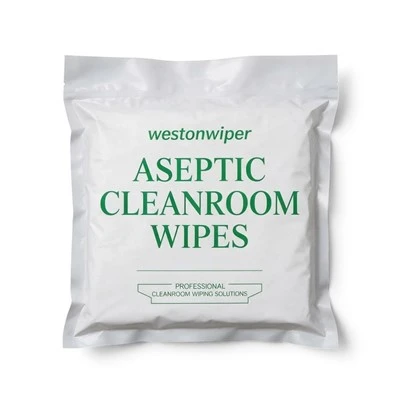
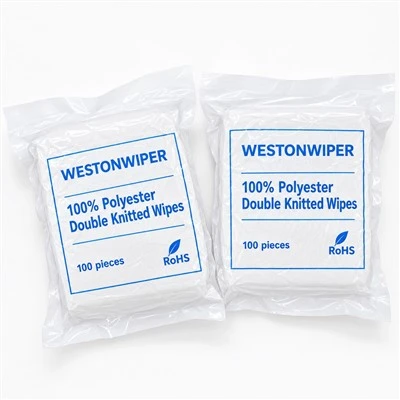
Specify the approved wiper and fluid in the SOP rather than leaving the choice to the operator at the transfer point, as a Racklify guide on packaging transfer also notes. Confirm that the fluid is compatible with the component's materials.
Supply handling counts too. Keeping dedicated stock for each side of the boundary, for example Cleanroom Wiper Rolls stored and dispensed on the clean side only, can reduce cross-boundary carry, provided the cutting and dispensing step is controlled as well.
Pre-saturated wipes have been reported in a patent background section to improve protocol adherence and wetting consistency. Treat that as a reported claim and test it in your own process. Where the result matters, R&D World suggests sampling followed by particle counting or non-volatile residue testing.
Staging is exposure too
Components often wait on a transfer-room bench, inside a pass-through or on a trolley. R&D World advises wiping material again before it enters if it has sat on racking for a long time, and leaving items stored for long periods double bagged.
Treat dwell time as a variable you control:
- Record when a component enters staging.
- Set a maximum dwell time for the area, based on your own monitoring data.
- Re-clean, or re-wrap, when that limit is passed.
Transfers that do not climb the grade ladder
Not every transfer moves from a lower grade to a higher one. Components also move between rooms of the same classification that run different processes, and they come back from process areas for rework or inspection. In these cases the concern is the type of contaminant, such as process chemicals or residues, rather than the grade difference.
Define which transfers between process areas are allowed, and under what conditions.
Decide whether a returned part re-enters at the start of the cleanliness states above.
Give the return path its own flow. Outsourced Pharma notes that a dedicated waste pathway is good practice so that waste does not meet clean items.
How to check that the transfer step works
Annex 1 commentary expects viable and non-viable monitoring at material entry points, with surface monitoring to confirm that disinfection is effective. That shows a trend for the area, but not which step introduced a problem.
One way to find out is paired checks: take the same kind of measurement from the same type of component before and after the boundary step, such as a particle count or a surface swab, and compare the two over several weeks. If the "after" result is consistently worse, the step is adding contamination, and the wipe, glove, carrier or staging time is the place to look.
This is a design idea. Agree the sample plan with your quality team and the standards that apply to your facility.
A self-audit checklist
- Is it written down who owns cleanliness at each handoff?
- Does each packaging layer come off at a defined zone step?
- Are the wiper and cleaning fluid specified in the SOP, not chosen at the door?
- Is the wiping method defined (stroke direction, face change, discard point)?
- Are carriers and trolleys cleaned, including wheels and tracks?
- Is dwell time in staging recorded and limited?
- Do same-grade and return transfers have their own rules?
- Is there before-and-after data showing the step does not add contamination?
No single step removes contamination risk entirely. The aim is to find the weakest point in your own transfer process and reduce it, then confirm with data that it worked. If you want to talk through supplies for each side of your boundary, the Weston Wiper team can help.