How to Prevent Dust and Fingerprint Contamination on Fiber-Optic Connector End Faces?
Dust and fingerprint contamination on fiber-optic connector end faces can affect optical signal transmission, increase insertion loss, and potentially cause permanent physical damage during connection. To prevent these problems, technicians should keep connectors properly protected, avoid touching ferrule surfaces, inspect both mating end faces before connection, and use appropriate optical cleaning tools when contamination is detected.
In fiber-optic communication systems, even very small particles can become a source of connection problems. Dust, skin oils, lint, and cleaning residues may accumulate on connector end faces during manufacturing, transportation, installation, and routine maintenance. Maintaining end-face cleanliness is therefore an essential part of fiber-optic installation and quality control.
This guide explains the common causes of fiber-optic connector contamination, practical prevention methods, proper inspection and cleaning procedures, and how to select suitable cleaning materials for precision fiber-optic applications.
1. Why Is Fiber-Optic Connector End Face Cleanliness So Important?
A fiber-optic connector provides a physical interface between two optical fibers. Its end face must maintain an appropriate level of cleanliness to support reliable optical contact and signal transmission.
Unlike ordinary mechanical surfaces, fiber-optic connector end faces are extremely sensitive to small particles and residues. Contamination does not always need to cover the fiber core to create a problem. Particles elsewhere in the contact area may interfere with mating, move toward the optical interface, or become trapped between two ferrules.
1.1 What Types of Contamination Can Affect Fiber-Optic Connector End Faces?
Several types of contamination can affect fiber-optic connector performance.
Dust particles: Airborne particles can settle on exposed connector end faces during installation or maintenance. Some hard particles may scratch the polished surface when two connectors are mated.
Fingerprint oils: Natural skin oils can transfer to the ferrule when technicians touch the connector end face. These oily residues can attract additional dust and are not always removed effectively through simple dry wiping.
Lint and fibers: Fibers from ordinary cloth, paper tissues, unsuitable cotton swabs, or contaminated cleaning materials can remain on the connector surface after cleaning.
Moisture and cleaning residues: Excess cleaning liquid, unsuitable solvents, or incomplete drying may leave visible or microscopic residues.
Electrostatically attracted particles: Static charges generated during handling or dry wiping may attract airborne particles to insulating connector surfaces.
Identifying the type of contamination is important because different contaminants may require different cleaning methods.
1.2 How Does End Face Contamination Affect Optical Signal Performance?
Contaminants on fiber-optic connector end faces can affect both physical contact and optical transmission.
Common consequences include:
Increased Insertion Loss: Dust or residues can interfere with optical coupling and reduce the amount of light transmitted through the connection.
Increased Return Loss Problems: Contamination and imperfect contact may contribute to unwanted optical reflections.
Signal Instability: Moving particles or changing contact conditions can contribute to inconsistent connection performance.
Permanent End-Face Damage: Hard particles trapped between mating ferrules may scratch or damage polished surfaces.
Cross-Contamination: A dirty connector can transfer particles or oily residues to an otherwise clean mating connector.
These problems are particularly important in single-mode fiber systems, high-density optical networks, data centers, and precision optical equipment.
Keeping connector end faces clean is not simply a matter of appearance. It is part of protecting connection quality and maintaining reliable network performance.
2. What Are the Main Causes of Dust and Fingerprint Contamination?
Understanding how contamination occurs helps technicians prevent it before cleaning becomes necessary.
2.1 Direct Contact During Handling and Installation
Human handling is one of the most preventable sources of connector contamination.
When technicians touch the ferrule end face directly, skin oils, moisture, and small particles can transfer onto the polished surface.
Contamination may also occur when connectors accidentally touch:
- Workbenches or equipment surfaces.
- Clothing and protective garments.
- Unclean gloves or tools.
- Other exposed connector ends.
- Packaging materials that contain loose fibers or particles.
Even when operators wear gloves, contamination is still possible if the gloves themselves are not clean or if their fingertips contact other unclean surfaces.
Best practice: Hold fiber-optic connectors by their housings rather than touching the ferrule or polished end face.
2.2 Airborne Dust and Electrostatic Attraction
Airborne contamination is another common problem, especially in workshops, equipment rooms, installation sites, and manufacturing environments.
Dust particles can settle on exposed connector end faces whenever protective caps are removed.
Static electricity can make the problem worse. Friction between cleaning materials and connector surfaces may generate electrostatic charges, which can attract particles toward the ferrule.
Low-humidity environments, equipment cooling fans, and repeated handling may also contribute to particle movement and accumulation.
For this reason, maintaining a clean work area and following appropriate electrostatic discharge control procedures are important parts of fiber-optic contamination prevention.
2.3 Contamination from Dust Caps, Packaging, and Mating Adapters
Protective dust caps are essential for reducing contamination, but they do not guarantee that a connector is completely clean.
Dust caps may accumulate particles during storage and handling. Their internal surfaces can also become contaminated through contact with unclean environments.
Other overlooked contamination sources include:
- Adapter sleeves and bulkhead connectors.
- Equipment ports and optical receptacles.
- Connector storage boxes.
- Patch cord packaging.
- Fiber-optic testing equipment.
For example, a connector may appear protected because it has a dust cap installed. However, if the cap contains dust, removing it may expose the connector to additional contamination.
The same issue applies to mating adapters. A clean fiber connector can become contaminated immediately after insertion into a dirty adapter.
Therefore, technicians should inspect both sides of a connection rather than focusing exclusively on the connector plug.
2.4 Improper Cleaning Practices and Tool Contamination
Cleaning tools can become contamination sources when they are unsuitable, improperly stored, or reused.
Common mistakes include:
- Reusing disposable swabs or cleaning wipes.
- Using ordinary cotton swabs that may release fibers.
- Using paper tissues or household cleaning cloths.
- Applying excessive cleaning liquid.
- Using solvents that are not compatible with the connector or cleaning material.
- Allowing used cleaning materials to contact clean surfaces.
A cleaning process should remove contamination rather than redistribute it. Selecting suitable materials and following the manufacturer's instructions are essential for achieving consistent results.
3. How to Prevent Dust and Fingerprint Contamination Before Connecting Fiber-Optic Cables?
Preventing contamination before it occurs is generally easier than correcting it after the connector has become dirty.
Several simple handling and storage practices can significantly reduce the risk of contamination.
3.1 Keep Fiber Connectors Protected with Clean Dust Caps
Always install suitable protective caps on unused fiber-optic connectors, adapters, and equipment ports.
Good storage practices include:
- Keep dust caps clean and store them in sealed containers.
- Avoid placing removed caps on workbenches or contaminated surfaces.
- Install caps promptly after disconnecting fiber-optic cables.
- Remove protective caps only when preparing for inspection and connection.
- Inspect the connector after removing its cap.
- Used dust caps should be cleaned appropriately before storage or replaced when necessary.
Importantly, a protective cap should not be treated as evidence that the connector end face is already clean.
3.2 Avoid Touching the Ferrule and Use Proper Handling Procedures
The ferrule is the precision component that holds and aligns the optical fiber. Its polished end face requires careful handling.
Technicians should:
- Hold connectors by the connector housing.
- Avoid touching the polished ferrule surface.
- Keep exposed connector ends away from clothing and other surfaces.
- Use clean gloves or finger protection when required by the working environment.
- Avoid placing uncovered connectors on workbenches.
- Reinstall clean protective caps when connectors are not being used.
Proper handling procedures help reduce fingerprint oils, lint transfer, and accidental physical damage.
3.3 Maintain a Clean and Controlled Working Environment
A clean working environment helps reduce the amount of airborne contamination that can settle on exposed optical connectors.
Depending on the application, contamination control measures may include:
- Performing connector preparation in a designated clean work area.
- Regularly cleaning workbenches and equipment surfaces.
- Keeping cleaning materials sealed until use.
- Using suitable cleanroom garments and gloves where required.
- Controlling electrostatic discharge in sensitive optical assembly environments.
- Separating used cleaning materials from unused supplies.
For high-density optical installations and precision optical manufacturing, environmental cleanliness should be incorporated into routine operating procedures rather than treated as an occasional maintenance activity.
3.4 Inspect Both Mating Connectors Before Every Connection
One of the most important prevention measures is inspecting both mating surfaces before making an optical connection.
Technicians should check:
- The first connector end face.
- The mating connector end face.
- Adapter sleeves and bulkhead interfaces.
- Equipment ports, where inspection is supported by the device design.
- Reference connectors and test equipment interfaces.
This is important because contamination can transfer from one surface to another during connection.
A clean connector should never be assumed to remain clean simply because it has not been used.

4. How to Inspect and Clean Fiber-Optic Connector End Faces Properly?
A reliable fiber-optic cleaning procedure should follow the principle of Inspect–Clean–Inspect.
This means inspecting the connector before cleaning, cleaning only when necessary, and inspecting again to verify the result.
IEC 61300-3-35:2022 provides standardized procedures and acceptance criteria for visually inspecting fiber-optic connector and fiber-stub transceiver end faces.
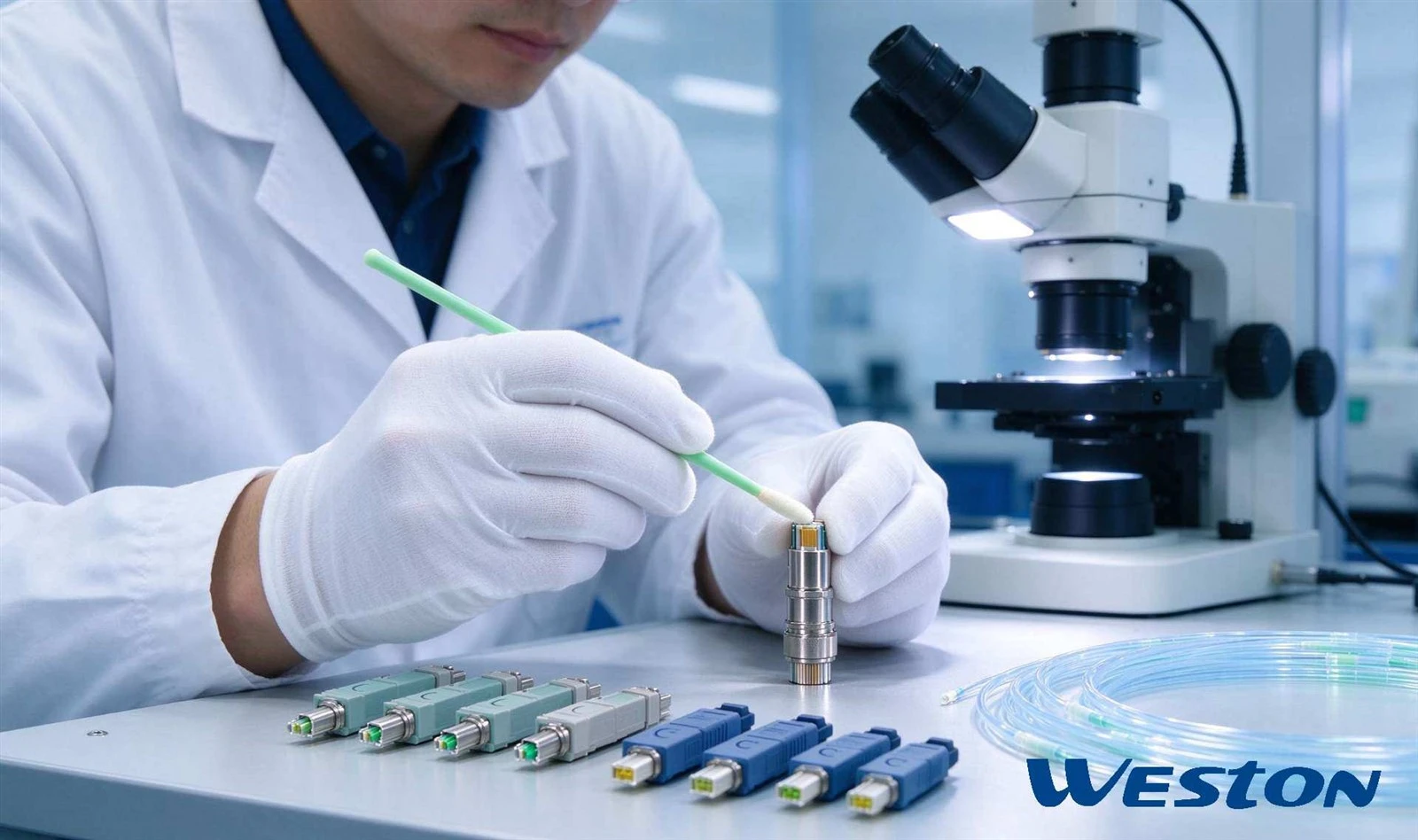
4.1 Step 1 – Inspect the Connector Using a Fiber-Optic Inspection Microscope
Visual inspection with specialized equipment is the first step in identifying contamination.
A fiber-optic inspection microscope allows technicians to examine the ferrule surface at a suitable magnification and identify particles, residues, scratches, and other defects.
During inspection, technicians should look for:
- Loose dust particles.
- Fingerprint or oily residues.
- Lint and fiber fragments.
- Cleaning-fluid residues.
- Scratches and physical defects.
The inspection should cover the relevant end-face and contact areas, not just the visible center of the optical fiber.
IEC 61300-3-35:2022 specifies different inspection requirements for cylindrical and rectangular ferrules. The applicable inspection equipment and acceptance criteria depend on the connector geometry and type.
Important safety precaution: Before inspection, make sure the optical source is safely disabled according to the equipment manufacturer's procedures. Never look directly into a fiber connector or active optical port. Invisible laser radiation can cause eye injury.
4.2 Step 2 – Remove Loose Dust with Dry Cleaning Methods
When loose particles are detected, an appropriate dry cleaning method may be used first.
Common options include:
- Dedicated fiber-optic cassette cleaners.
- Optical cleaning tapes.
- Approved lint-free optical cleaning wipes.
- Connector-compatible dry cleaning tools.
- Dry cleaning can remove many loose particles without introducing additional cleaning liquid.
However, the cleaning material and wiping method must be suitable for the connector type. Excessive pressure, repeated wiping with a contaminated surface, or unsuitable materials may introduce new contamination or damage the polished end face.
Use a fresh, clean area of the cleaning material for each operation.
4.3 Step 3 – Remove Fingerprint Oils and Stubborn Residues with Approved Wet Cleaning Methods
Dry cleaning may not always remove oily contamination or persistent residues.
In these situations, a manufacturer-approved wet-to-dry cleaning procedure may be appropriate for the specific connector.
A typical process involves:
- Selecting an optical-grade cleaning solution compatible with the connector.
- Applying a controlled amount of solution to an approved cleaning material.
- Gently removing the contamination using the recommended wiping technique.
- Following immediately with the appropriate dry cleaning step.
- Inspecting the end face again to check for residual contamination.
Cleaning materials should be damp rather than excessively wet. Too much liquid may spread contaminants instead of removing them.
Avoid assuming that ordinary alcohol or general-purpose cleaning chemicals are suitable for every optical component. Some solvents may leave residues or affect adhesives and other materials.
Wet cleaning is also not universally appropriate for adapters, equipment receptacles, or transceiver ports. Some equipment contains optical structures that can be damaged by improper swab insertion or solvent use. Always follow the equipment manufacturer's specific cleaning instructions.
4.4 Step 4 – Reinspect the End Face After Cleaning
Cleaning is not complete until the result has been verified.
After removing contamination, use the inspection microscope again to check whether:
- Loose particles have been removed.
- Fingerprint oils are no longer visible.
- No cleaning fibers remain.
- No liquid or solvent residues are present.
- The surface meets the applicable visual inspection requirements.
- If removable contamination remains, repeat the approved cleaning procedure as necessary.
However, persistent marks should not automatically be treated as removable dirt. They may represent scratches, embedded particles, or permanent defects.
Repeated aggressive cleaning is not an appropriate solution to every end-face problem.
4.5 Step 5 – Reconnect Only After Verification
Once the end face has passed the applicable inspection requirements, the connector can be prepared for mating.
Before connection:
- Confirm that both mating end faces have been inspected.
- Check that the adapter or equipment port is suitable for connection.
- Remove contamination from the relevant components using approved procedures.
- Avoid touching the cleaned surfaces.
- Complete the connection promptly to minimize recontamination.
Remember that visual inspection evaluates end-face cleanliness and defects. It does not replace optical performance measurements such as insertion loss and return loss.
5. Which Cleaning Tools Are Best for Preventing Fiber-Optic Connector Contamination?
Choosing appropriate cleaning materials is important for preventing secondary contamination during the cleaning process.
Different tools are designed for different connector structures and contamination types. A material suitable for general cleanroom surface wiping is not automatically suitable for direct contact with a polished fiber-optic end face.
5.1 Fiber-Optic Inspection Microscopes
Inspection microscopes are essential for identifying contamination that cannot be reliably evaluated with the naked eye.
When selecting inspection equipment, consider:
- Compatibility with the connector type.
- Appropriate field of view and magnification.
- Clear imaging of the ferrule end face.
- Ability to inspect the relevant contact area.
- Compatibility with the inspection criteria being applied.
Digital inspection systems can also support image documentation and more consistent quality-control records.
5.2 Lint-Free Wipes for Removing Dust and Oil Residues
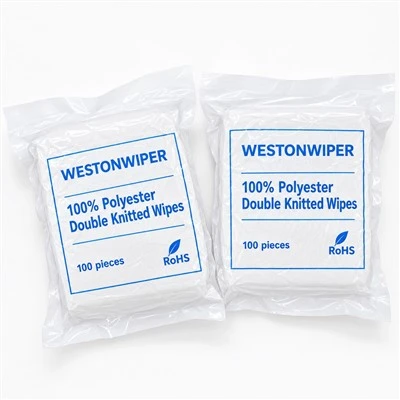
Optical-grade lint-free wipes are used in appropriate cleaning systems to reduce the risk of introducing fibers or particles during wiping.
Important material characteristics include:
Low-lint performance: The wiping material should minimize fiber shedding during normal use.
Absorbency: Suitable absorbency helps collect cleaning liquid and loosened contaminants.
Clean surface construction: The material should be manufactured, processed, and packaged to minimize unwanted residues and particulate contamination.
Chemical compatibility: The wiping substrate should be compatible with the approved optical cleaning solution.
Not every cleanroom wipe is an optical-grade wipe. Product suitability should be established through application-specific evaluation rather than relying only on a low-lint product description.
5.3 Foam Swabs and Microfiber Swabs for Precision Cleaning
Swabs are useful when cleaning small areas, recessed surfaces, and locations that are difficult to reach with a conventional wipe.
Depending on the connector design and cleaning procedure, purpose-designed foam or microfiber swabs may be considered.
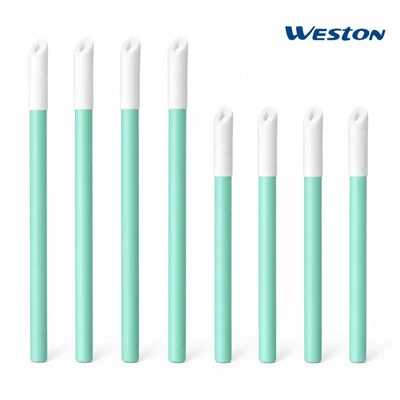
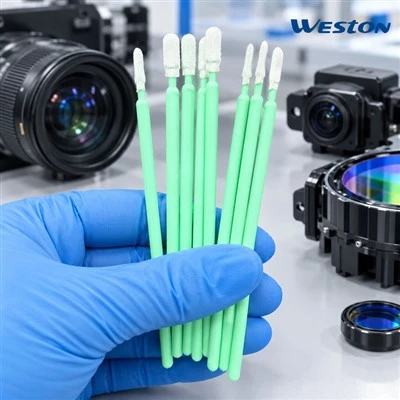
Microfiber Cleanroom Swabs are one type of precision cleaning material that can be evaluated for applications requiring controlled wiping, suitable absorbency, and reduced fiber release.
When selecting these swabs for fiber-optic applications, buyers should consider:
- Tip dimensions and shape.
- Material composition and surface characteristics.
- Lint and particle generation.
- Compatibility with the approved cleaning solution.
- Potential adhesive or manufacturing residues.
- Compatibility with the connector or adapter geometry.
The term microfiber or cleanroom grade alone does not guarantee optical compatibility. Swabs intended for direct contact with fiber-optic end faces should be specifically designed and validated for the intended cleaning process.
5.4 Dry and Wet Cleaning Tools for Different Contamination Types
Choosing a cleaning method according to the type of contamination helps reduce unnecessary handling.
|
Cleaning method |
Suitable contamination |
Main purpose |
|
Dry cleaning |
Loose dust and particles |
Remove loose contamination |
|
Wet cleaning |
Certain oily residues and stubborn contamination |
Loosen and remove persistent residues |
|
Wet-to-dry cleaning |
Contamination requiring an approved solvent |
Remove residues and minimize liquid remaining on the surface |
The correct procedure depends on the connector type, equipment manufacturer's instructions, cleaning-tool design, and cleaning solution.
For this reason, professional fiber-optic maintenance teams should use application-specific cleaning kits rather than relying on general-purpose cleaning materials.
6. Common Mistakes That Lead to Fiber-Optic Connector Recontamination
Even when technicians understand the importance of clean connectors, several everyday mistakes can introduce contamination again.
6.1 Assuming a New or Capped Connector Is Already Clean
New connectors may contain particles from manufacturing, packaging, transportation, or storage.
Dust caps reduce exposure, but their internal surfaces can also become contaminated.
Inspect connectors before mating, regardless of whether they are new or previously used.
6.2 Cleaning Without Inspecting the End Face First
Cleaning an already clean connector introduces unnecessary handling.
Repeated wiping may generate static charge, introduce particles, or create avoidable risks of physical damage.
Inspection should determine whether cleaning is necessary.
6.3 Using Ordinary Cotton Swabs, Tissues, or Household Cleaning Cloths
Ordinary cleaning materials may release fibers, leave residues, or have surface characteristics unsuitable for precision optical cleaning.
Instead, select dedicated cleaning tools with appropriate material construction and connector compatibility.
6.4 Forgetting to Clean Adapters and Equipment Ports
A clean connector can become contaminated when it is connected to a dirty adapter or equipment port.
Inspection and cleaning procedures should therefore account for the entire mating interface.
Do not insert generic cleaning swabs into equipment ports without confirming that the procedure is approved for that particular port design.
6.5 Reusing Contaminated Cleaning Materials
Once a cleaning wipe or swab has collected dust, oil, or other contaminants, using the same area again may transfer contamination to another connector.
Use fresh cleaning surfaces and dispose of single-use swabs according to the manufacturer's instructions.
6.6 Repeatedly Cleaning a Connector with Persistent Defects
Not every mark can be removed by cleaning.
Scratches, pits, embedded particles, and other physical defects may remain after suitable cleaning attempts.
When contamination cannot be removed using the approved procedure, further inspection and evaluation are necessary. The connector should not be subjected to increasingly aggressive wiping in an attempt to force a clean result.
7. How to Establish a Routine for Fiber-Optic Connector Cleanliness Control?
Preventing contamination consistently requires more than selecting suitable cleaning materials. It also requires a repeatable inspection and maintenance process.
7.1 Create a Standard Inspection and Cleaning Checklist
A written checklist helps technicians follow the same procedures during installation, testing, and maintenance.
|
Inspection item |
Recommended action |
|
Connector end face |
Inspect before every mating operation |
|
Dust cap |
Keep clean and properly stored |
|
Mating adapter |
Inspect and clean when necessary |
|
Equipment port |
Follow manufacturer-approved inspection and cleaning procedures |
|
Cleaning materials |
Keep sealed and protected from contamination |
|
After cleaning |
Reinspect before making the connection |
|
Optical performance |
Measure insertion loss and return loss when required |
This checklist can be adapted to different fiber-optic installation and manufacturing environments.
7.2 Train Technicians in Proper Handling and Cleaning Procedures
Personnel training is essential for reducing contamination caused by inconsistent handling.
Training should cover:
- Correct connector handling techniques.
- Recognition of common contamination types.
- Safe use of fiber-optic inspection microscopes.
- Differences between dry and wet cleaning.
- Proper selection and disposal of cleaning materials.
- Prevention of cross-contamination between connectors.
- Optical safety precautions.
Consistent procedures can help reduce avoidable cleaning errors and improve maintenance efficiency.
7.3 Document Inspection Results and Track Recurring Contamination Problems
For high-reliability optical systems, recording inspection and cleaning results can help identify recurring problems.
Useful records may include:
- Connector identification.
- Inspection date and operator.
- Observed contamination type.
- Cleaning method used.
- Inspection results after cleaning.
- Recurring contamination locations.
- Relevant optical performance measurements.
These records help maintenance teams identify whether contamination originates from the working environment, storage conditions, handling procedures, equipment ports, or cleaning materials.
8. Frequently Asked Questions About Fiber-Optic Connector End Face Contamination
8.1 Can Fingerprints Damage Fiber-Optic Connector End Faces?
Fingerprints can leave oily residues on polished connector end faces. These residues may attract dust, interfere with proper optical contact, and become difficult to remove through dry wiping alone.
If a connector is touched accidentally, inspect it using a suitable fiber-optic microscope and clean it according to the manufacturer's approved procedure.
8.2 Do Dust Caps Completely Prevent Fiber-Optic Connector Contamination?
No. Dust caps help protect connectors from airborne particles, physical contact, and accidental damage, but they cannot guarantee complete cleanliness.
Caps themselves may become contaminated during handling and storage. Connectors should therefore be inspected after the protective caps are removed.
8.3 How Often Should Fiber-Optic Connectors Be Inspected and Cleaned?
Fiber-optic connector end faces should be inspected before each connection or mating operation.
Cleaning should be performed when inspection identifies contamination that needs to be removed. Routine cleaning without inspection is not recommended because unnecessary handling may introduce additional contamination.
8.4 Can Ordinary Cotton Swabs Be Used to Clean Fiber-Optic Connectors?
Ordinary cotton swabs are generally unsuitable for precision fiber-optic cleaning because they may release loose fibers or leave residues.
Dedicated optical cleaning swabs should be selected according to the connector type, tip dimensions, material characteristics, and cleaning procedure.
8.5 Is a Visual Inspection Enough to Confirm Fiber-Optic Connector Cleanliness?
Visual inspection using a suitable fiber-optic inspection microscope is essential for assessing end-face cleanliness.
However, visual inspection does not replace optical performance measurements. Insertion loss and return loss should also be measured when required by the application and testing procedure.
8.6 Can a Dirty Fiber-Optic Connector Cause Signal Loss?
Yes. Dust, fingerprint oils, and other contamination may interfere with optical coupling and contribute to increased insertion loss and unwanted reflections.
Hard particles can also scratch the polished end face during mating, potentially causing permanent damage to one or both connectors.
8.7 What Is the Best Way to Prevent Dust from Accumulating on Fiber-Optic Connectors?
The most effective approach combines several preventive measures:
Keep unused connectors covered with clean dust caps.
Avoid touching ferrule end faces.
Perform connection work in a suitably controlled environment.
Inspect both mating surfaces before connection.
Use approved cleaning tools only when necessary.
Reinspect the end face after cleaning.
Following these practices helps reduce contamination and supports more reliable fiber-optic connections.
9. Westonwiper: Customized Cleanroom Cleaning Materials from a Professional Manufacturing Factory
Selecting suitable cleaning materials is an important part of contamination control in optical communication, electronics manufacturing, and other precision cleaning applications.
Westonwiper, backed by Weston Manufacturing's nonwoven manufacturing experience of more than 20 years, provides cleanroom wiping materials and related cleaning consumables for industrial and precision cleaning applications.
As a manufacturer with its own spunlace nonwoven production capabilities, Weston can support OEM and ODM requirements for customers seeking customized cleaning substrates and bulk cleaning products.
Key customization advantages include:
Customized Material Composition: Options involving polyester, viscose, wood pulp, bamboo fiber, and other suitable materials, depending on the intended application.
Adjustable Fabric Specifications: Custom basis weights, thicknesses, dimensions, and web structures for different cleaning requirements.
Customized Surface Patterns: Available embossing and surface-pattern options to meet different wiping and absorbency requirements.
Flexible Product Formats: Jumbo rolls, perforated rolls, cut sheets, and different folding configurations.
OEM and ODM Packaging: Customized packaging formats, printed logos, private-label solutions, and bulk carton specifications.
In-House Laboratory Support: Material evaluation and product development to help assess substrate properties and meet customer-specific requirements.
Factory-Direct Supply: Direct communication with the manufacturing team, sample support, and bulk-order customization.
For customers sourcing cleanroom wipes, precision cleaning materials, and related consumables, Westonwiper can discuss product specifications according to the intended application and required performance.
For fiber-optic cleaning applications, material selection should be evaluated against the actual connector structure, lint requirements, chemical compatibility, and end-face cleanliness criteria. Product suitability should be confirmed through appropriate application testing rather than assumed from the material name alone.
Contact Westonwiper to discuss customized cleanroom cleaning materials, OEM/ODM packaging, and factory-direct bulk supply solutions.