What Should You Check Before Using Cleaning Materials on Food-Contact Surfaces?
A wiper that cleans well can still contaminate the surface it was meant to protect. Lint, binder residue, sanitizer carry-over and allergen transfer all travel from the cleaning material to the surface, and from the surface to the food.
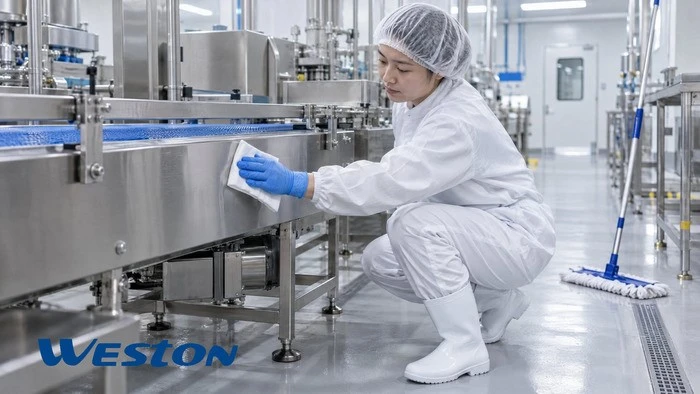
Food-contact surfaces are the parts of equipment, utensils and workstations that touch food, or that drain, drip or splash onto it: conveyors, filler nozzles, hoppers, cutting boards, stainless work tables and packaging machine parts. Because anything left on them can end up in the product, the cleaning materials used on them deserve the same scrutiny as the cleaning chemicals.
That is why Cleanroom consumables for food processing manufacturing are best treated as controlled materials, with their own specifications, supplier documents and records, rather than as interchangeable shop supplies. This article gives quality, EHS and procurement teams a practical pre-use checklist: what to check, what evidence to request, and how to confirm performance on your own line before any wiper or other consumable goes near a food-contact surface.
Key takeaway: cleaning is only safe when the cleaning material itself is verified, documented and controlled.
Why Food-Contact Surfaces Need Extra Scrutiny
Whatever a wiper leaves on a food-contact surface can reach the product, so the wiper is part of your contamination-control system. Direct contact means the surface touches the food. Indirect contact means residue reaches food through splash, drip or condensation. Both count.
Four contamination routes matter:
Chemical: detergent, sanitizer, surfactant, binder and extractable residues left by the wiper or the cleaning solution.
Physical: fibers, particles and fragments shed during wiping, especially from cut edges or low-quality nonwovens.
Biological: bioburden on the wiper itself, or microbes carried from dirty areas to clean ones by reused materials.
Allergen: protein carried from one product or line to the next on a shared wiper.
The risk is highest in high-care and aseptic areas, infant nutrition, dietary supplements, and plants that supply both food and pharmaceutical customers. In those settings limits on residues and particles are tight, and auditors look closely at cleaning materials.
First, Clarify the Regulatory Scope
A cleaning wiper is usually a cleaning consumable, not a food-contact material, yet its residues can still reach food-contact surfaces. There is rarely a single regulation that approves a wiper "for food contact", so you build the case from several sources.
United States
FDA indirect food additive rules, 21 CFR Parts 174 to 178, cover substances that may migrate into food from materials such as coatings, adjuvants and sanitizers.
21 CFR 178.1010 sets conditions for sanitizing solutions used on food-processing equipment and utensils.
FSMA and 21 CFR Part 117 require a hazard analysis and preventive controls, and your sanitation procedures and the materials they rely on belong in that analysis.
European Union
Regulation (EC) No 1935/2004 is the general framework for materials and articles intended to come into contact with food.
Regulation (EC) No 2023/2006 sets good manufacturing practice for those materials and articles.
Food-safety management schemes
ISO 22000, FSSC 22000, BRCGS and SQF expect documented control of supplies, cleaning and sanitation. Auditors commonly ask for supplier documents and verification records for cleaning tools.
Requirements vary by region, product and customer. Confirm the rules that apply to you with your regulatory or food-safety team before you finalize a specification.
The Pre-Use Checklist: Eight Things to Check
Work through these eight checks before a new cleaning material is approved, and again whenever the supplier, the material or the sanitizer changes. Each check follows the same pattern: why it matters, what to verify, and what evidence to ask for.
1. Intended use and surface compatibility
Why it matters: a wiper that works on dry stainless steel may fail on gaskets, plastics, conveyor belts or wet, no-rinse applications.
What to verify: the surface materials (stainless steel, polymer, rubber, coated metal), wet or dry use, contact time, whether a rinse follows, and the risk level of the zone.
Evidence to request: a written intended-use statement in your SSOP and the supplier's recommended applications.
2. Compliance documentation
Why it matters: "food-grade" is not a standard. Without documents, an auditor has nothing to review.
What to verify: a declaration of compliance that names the regulations it covers, an SDS where applicable, a technical data sheet, quality-system certificates, and test reports for restricted substances such as RoHS-related screening and heavy metals (lead, cadmium, mercury and hexavalent chromium).
Evidence to request: a signed declaration, test reports that name the laboratory, date and method, and copies of certificates that show which product they cover.
A note on RoHS: it is written for electrical and electronic equipment, so a RoHS report on a wiper is a material-screening data point, not a food-contact approval. Read it alongside the declaration of compliance, not instead of it.
3. Material composition and additives
Why it matters: binders, dyes, finishes and antimicrobial treatments are common sources of unexpected residue and sensitization.
What to verify: the base fiber (for example polyester, polypropylene or cellulose blends), binders, dyes, surfactant or antimicrobial finishes, latex, silicone and lubricants, plus any PFAS-related declarations your customers require.
Evidence to request: a composition statement, an additive declaration and a commitment to notify you of changes.
4. Cleanliness performance
Why it matters: lint and residue are the failures people notice first, and they are the hardest to explain to an auditor.
What to verify: particle and fiber release, non-volatile residue (NVR), extractable ions, the edge-sealing method (laser, ultrasonic or cut), and the environment in which the product is made and packed, for example an ISO 14644-1 cleanroom class.
Evidence to request: test data with the method named, such as testing based on IEST-RP-CC004, and the batch the data applies to.
5. Chemical compatibility
Why it matters: wipers meet sanitizers every day, and some materials degrade, shed or hold back chemical.
What to verify: compatibility with isopropyl alcohol, ethanol, quaternary ammonium compounds, chlorine-based products and peracetic acid at your working concentrations; absorbency; whether fibers release or color bleeds when the wiper is wet; and what residue remains after the wipe-down.
Evidence to request: the supplier's compatibility data, plus your own wet trial.
6. Microbial and allergen control
Why it matters: a contaminated wiper spreads contamination, and a shared wiper spreads allergens.
What to verify: your bioburden or sterility requirement, single-use or laundered reusable format, color-coding by zone, packaging that protects cleanliness until opening, and storage conditions.
Evidence to request: bioburden data or sterility documents where they are claimed, a packaging description, and your own zone and color-coding procedure.
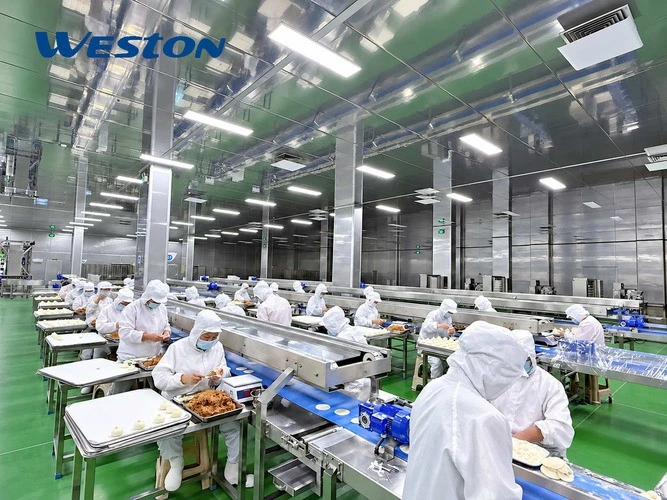
7. Supplier quality and traceability
Why it matters: consistent material is the basis for validation, and a silent change in raw material invalidates it.
What to verify: lot numbers on every pack, change-control notification, quality-system certification, shelf life and storage conditions.
Evidence to request: a certificate of analysis or conformance per lot, and a change-notification clause in the supply agreement.
8. On-site validation and verification
Why it matters: documents show intent, and trials show performance in your plant.
What to verify: run a pilot on real surfaces, inspect under good light for lint and streaks, use ATP or residue swabs, take rinse-water or surface samples where relevant, and link the results to your SSOP and HACCP records.
Evidence to request: a signed trial protocol with results, and an approval record with date and approver.
Quick-Reference Table
Use this table as a one-page screen during supplier review or an internal audit. Any row marked with a red flag should be resolved before approval.
|
Check |
What to look for |
Document or test |
Red flag |
|
Intended use |
Written use case matched to surface and zone |
SSOP entry, supplier application note |
Same wiper used everywhere without review |
|
Compliance |
Declaration naming the regulations covered |
Declaration of compliance, SDS, certificates |
A vague "food-grade" claim and no document |
|
Composition |
Fibers, binders and finishes disclosed |
Composition and additive statement |
Undisclosed binders, dyes or treatments |
|
Particles and fibers |
Low release, sealed edges |
Particle and fiber test data with method named |
Visible lint in your trial |
|
Residues |
Low NVR and extractables |
Test report with method and batch |
No method, no data, or no batch reference |
|
Chemical fit |
Stable with your sanitizers |
Compatibility data, wet trial |
Swelling, shedding or discoloration |
|
Microbial and allergen |
Packaging, zone color-coding, single-use rules |
Bioburden data where claimed, procedure |
Wipers shared across allergen zones |
|
Traceability |
Lot-level records and change notice |
Certificate per lot, supply agreement |
Unlabeled or mixed lots, silent changes |
Common Mistakes and Myths
Most cleaning-material failures trace back to an assumption nobody checked. These five come up most often.
Myth: "Cleanroom-grade means food-safe." Reality: cleanroom grades describe particles and cleanliness, not food-contact suitability. You still need documents that address your use.
Myth: "Alcohol never leaves residue." Reality: evaporation is fast, but denaturants, impurities and dissolved soils can stay behind, and the alcohol grade must be the one your food-safety plan approves.
Myth: "A non-toxic label is enough." Reality: a label is not a test report. Ask for the declaration, the method and the batch it applies to.
Mistake: reusing or mixing wipers across zones. Reality: shared wipers carry allergens, soils and microbes from one area to another, so zone separation and color-coding need to cover the wiper too.
Mistake: skipping re-verification after a change. Reality: a new supplier, a new raw material or a new sanitizer can change residue and compatibility, so each change should trigger a short re-check.
Applying This in Food-Adjacent Cleanroom Environments
In filling, packaging and supplement areas the same eight checks apply, but the work is layered: remove dry debris first, then wipe, then verify.
Filling and packaging lines: dust and fibers settle around fillers, cappers and conveyors, so wiper choice, edge sealing and lot traceability matter most here.
Supplement and pharma-grade facilities: residue and particle expectations are tighter, and wiper lot records often feed batch documentation.
High-care zones: use dedicated, color-coded materials per zone and control how consumables enter the area.
Remove dry debris before wet wiping
Before wet wiping, lift loose dust and particles from floors, carts, gowning-area thresholds and non-product surfaces beside the line. A Tacky Roller With Handle is a simple way to do this, so wipers are not used to push debris around. Adhesive products should stay off food-contact surfaces unless the supplier documents that use and your own validation shows no residue transfer.
What Weston can provide
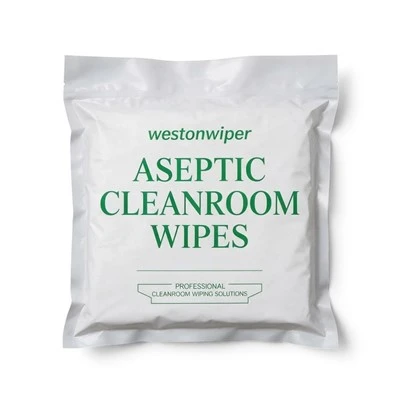
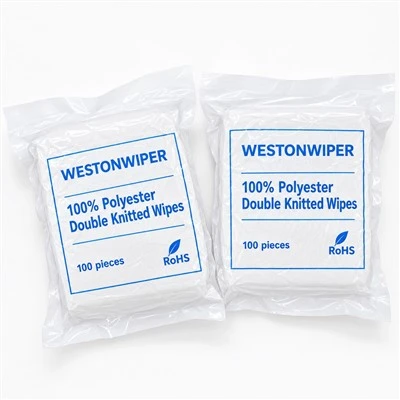
Weston supplies cleanroom wipers and related contamination-control products. For its wipers, Weston can provide a declaration of compliance and supporting certificates, including RoHS and heavy metal test reports, for your team to review during supplier qualification.
Read each document for the product code, test method, date and regulations it covers, and keep the copies in your supplier file. These documents support your qualification. They do not replace your own wet trial, residue check and zone-specific procedure.
To request documents for your application, send Weston's technical team your surface type, sanitizer, zone classification, and whether the wipe is followed by a rinse.
Q&A: What Practitioners and Buyers Actually Ask
These are the kinds of questions that come up repeatedly in food-safety discussion forums, including Reddit communities, and in purchasing conversations about medical and cleanroom nonwovens. Short, practical answers follow.
From QA, sanitation and production teams
Our auditor found lint on a conveyor after wipe-down. Is it the wipers or our process?
Check both. Review the wiper's construction and edge sealing, then your technique: fold, wiping direction and pressure. Also check the surface condition, and whether wipers were stored open or used on more than one surface. Then run a side-by-side trial with a candidate wiper and record the result.
Is "lint-free" real or just marketing?
No wiper sheds literally nothing. Ask for particle and fiber release data with the test method named, for example testing based on IEST-RP-CC004, rather than relying on the phrase "lint-free". Compare suppliers using data from the same method.
Can I wipe stainless food-contact surfaces with IPA and skip the rinse?
It depends on your SSOP, the sanitizer's regulatory status in your market, its concentration and its contact time. In the United States, for example, sanitizers used on food-contact surfaces are subject to specific conditions, such as those in 21 CFR 178.1010 and the label of the registered product. Other regions apply different rules. Follow the product label and your food-safety plan, and do not assume alcohol leaves nothing behind.
Do I really need different wipers for allergen changeovers?
Yes. Use dedicated or single-use materials, color-code them by zone, and confirm cleaning with allergen swabs. Reusing a wiper across allergen zones defeats the cleaning step.
Cheap bulk wipers or cleanroom-grade: is the price gap worth it?
Compare total risk cost rather than unit price: rework, audit findings, line stoppages and complaints. Then match the grade to the zone. High-care and aseptic areas justify tighter specifications, while low-risk non-product areas may not.
From medical nonwoven and cleanroom buyers
Can medical-grade nonwoven be used on food-contact surfaces?
Not automatically. A medical certification, such as a manufacturer's ISO 13485 quality system, shows how a product is made and controlled. It does not show that the product is suitable for cleaning food-contact surfaces. Request a food-related compliance statement, composition details and cleanliness data for the specific product.
What should go into an RFQ or spec sheet for nonwoven wipers?
Material composition and basis weight (gsm), plus size and fold.
Edge type: laser, ultrasonic or cut.
Cleanliness data: particles, NVR and ions, with the test method named.
Packaging and the cleanroom class where the product is made and packed.
Sterility or bioburden requirements, shelf life and lot traceability.
Compliance documents, including RoHS and heavy metal test reports where your customers require them.
Sample policy, minimum order quantity and lead time.