What Size Cleaning Swab Do You Need for LC, SC, and FC Fiber Connectors?
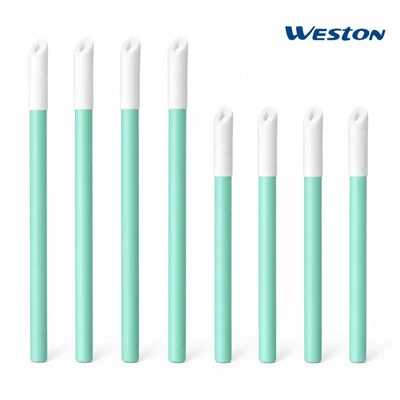
Use a 1.25mm cleaning swab for LC connectors and a 2.5mm cleaning swab for SC and FC connectors. The swab size is set by the diameter of the connector's ferrule, the small ceramic tube that holds the fiber, not by the connector's name. When the swab matches the ferrule, it can reach the whole end-face without being forced in or rattling around loosely.
This guide gives you a quick reference table, explains why the diameter matters, covers the edge cases that cause mix-ups, and walks through a clean-and-inspect routine you can follow on the job.
1. Quick Answer: Swab Size by Connector Type
If you only need the number, start here.
1.1 Swab size reference table
|
Connector |
Ferrule diameter |
Swab size |
Typical use |
|
LC |
1.25mm |
1.25mm |
High-density patch panels, SFP transceivers, duplex patch cords |
|
MU |
1.25mm |
1.25mm |
Compact connectors in small-form-factor equipment |
|
SC |
2.5mm |
2.5mm |
Telecom, FTTx and enterprise cabling |
|
FC |
2.5mm |
2.5mm |
Test instruments, laboratories, industrial links |
|
ST |
2.5mm |
2.5mm |
Legacy multimode networks |
|
E2000 |
2.5mm (verify) |
2.5mm |
European telecom; confirm the actual ferrule size |
1.2 The one rule to remember
Small-form-factor connectors (LC, MU) use a 1.25mm ferrule, so they need a 1.25mm swab. Standard-size connectors (SC, FC, ST) use a 2.5mm ferrule, so they need a 2.5mm swab. When you meet a connector you don't recognise, measure or look up the ferrule diameter and pick the swab to match.
2. Why Ferrule Diameter, Not Connector Name, Decides Swab Size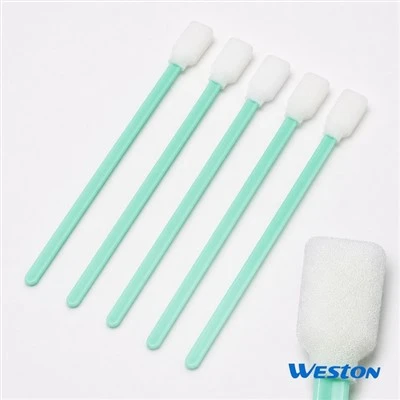
Connector names describe the housing: how it latches, how it is keyed, how it couples. The swab never touches the housing. It touches the ferrule and the sleeve that holds the ferrule in alignment, so those dimensions are what count.
2.1 What a ferrule is and where contamination builds up
A ferrule is a precision cylinder, usually zirconia ceramic, at the tip of a connector. The glass fiber runs through its center. A single-mode core is only about 9 microns across, and even a multimode core is 50 or 62.5 microns, so a speck of dust or a film of oil on the end-face can sit directly in the light path.
Contamination collects in three places: the polished end-face, the side of the ferrule, and the inside of the alignment sleeve in the adapter. Dirt on any of them can be carried onto the end-face the next time two connectors are mated. Contamination is one of the most common causes of high insertion loss and unstable links.
2.2 What happens when the swab is too large
A swab that is wider than the sleeve simply won't go in. Pushing harder risks scuffing the sleeve, crushing the swab head, and leaving fibers or debris inside the adapter. You may also end up cleaning only the entrance of the adapter rather than the ferrule itself.
2.3 What happens when the swab is too small
A swab that is too narrow doesn't press evenly against the end-face. It can skate over the surface, wipe only part of it, or push contamination toward the ferrule edge instead of lifting it away. It also fails to contact the sleeve walls, so the adapter stays dirty.
3. LC Connectors: Use a 1.25mm Swab
3.1 LC ferrule specification and matching swab
The LC connector uses a 1.25mm ferrule, half the diameter of an SC. The matching swab is therefore a 1.25mm swab, and that applies to both simplex and duplex LC cords. The same size works for MU connectors, which share the 1.25mm ferrule.
3.2 Cleaning LC through duplex adapters and transceiver ports
LC adapters and transceiver ports are narrow, and in a duplex adapter the two sleeves sit side by side. Clean one sleeve at a time with a fresh swab, so you don't move contamination from one port to the next. In SFP-style ports the receptacle is deep and tight, so check that the swab shaft is long and stiff enough to reach the ferrule without bending. A bending shaft applies uneven pressure and is hard to control.
3.3 LC-specific tips for high-density panels
In crowded panels, work on one port at a time and cap the ports you aren't using. Keep the shaft of the swab straight as it enters, so it doesn't brush against neighbouring connectors. Take your time: LC ports are close together, and a rushed swab is how a clean connector gets dirty again.
4. SC and FC Connectors: Why They Share the 2.5mm Swab
SC and FC look different from the outside, but inside they have the same 2.5mm ferrule. One swab size covers both, and it also covers ST and E2000 in most cases.
4.1 SC connectors
SC connectors use a push-pull latch and a square body, and they are widespread in telecom, FTTx and enterprise cabling. A 2.5mm swab fits both the exposed ferrule on a patch cord and the sleeve inside an SC adapter. For duplex SC, clean each ferrule and each adapter side individually.
4.2 FC connectors
FC connectors have a threaded metal coupling and a key, and you often find them on test instruments, lab setups and industrial links. The ferrule is still 2.5mm, so the swab is the same as for SC. Because FC ports on equipment can be recessed, make sure the swab shaft is long enough to reach the ferrule or sleeve properly.
4.3 UPC vs APC: does polish type change swab size?
No. UPC and APC connectors use the same ferrule diameter. APC simply has an end-face polished at an 8-degree angle to reduce back reflection. The swab size and cleaning motion stay the same. Don't confuse the colour of the connector housing (APC is usually green and UPC usually blue) with the colour of any swab: the two have nothing to do with each other.
5. Edge Cases: When the Connector Name Isn't Enough
5.1 Cleaning the connector end-face vs. the adapter sleeve
The same-diameter swab can be used for both jobs, but they are separate tasks. Cleaning an exposed ferrule on a patch cord does not clean the sleeve it will plug into, and a dirty sleeve can recontaminate a freshly cleaned connector. When you are cleaning a link, treat the connector and the adapter as two things to clean and inspect.
5.2 ST, MU and E2000 quick notes
ST has a 2.5mm ferrule, so use a 2.5mm swab. MU has a 1.25mm ferrule, so use a 1.25mm swab. E2000 is normally a 2.5mm connector with a spring-loaded shutter, but compact variants exist, so check the ferrule size on the connector you actually have before choosing a swab.
5.3 Test equipment and hybrid ports
Optical power meters, light sources and similar instruments often use 2.5mm universal ports, and adapters are used to connect 1.25mm LC patch cords to them. Each interface in that chain has its own ferrule size, so clean every end with a swab matched to that end rather than assuming one size fits the whole setup.
5.4 1.6mm and 2.0mm termini, and MPO/MTP
Some military and specialty connectors use 1.6mm or 2.0mm termini, and these need swabs made for those diameters. MPO/MTP connectors are a different case altogether: they hold many fibers in a rectangular ferrule, so round 1.25mm or 2.5mm swabs are not the right tool. Use cleaners made for MPO/MTP.
6. How to Choose a Fiber Cleaning Swab Beyond Size
Getting the diameter right is step one. Two swabs of the same size can perform very differently, because fiber end-faces are unforgiving: a swab that sheds particles or leaves residue adds contamination while it is supposed to be removing it.
6.1 Tip material: foam, knitted polyester and microfiber
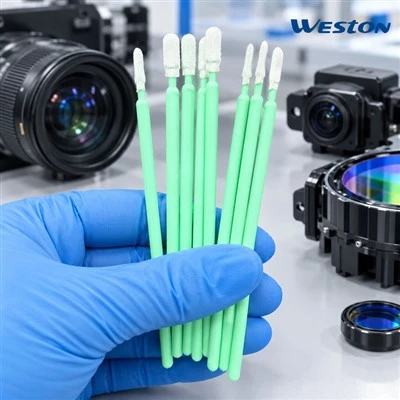
Foam tips are soft and absorbent, which makes them good at carrying a small, controlled amount of solvent. Knitted polyester tips are durable and low-linting, and they hold up well to repeated rotation. Microfiber tips are another option, since their fine fibers lift and hold particles effectively, which is why Microfiber Cleanroom Swabs are often chosen for precision cleaning of optical components. Whichever material you pick, it should be lint-free and low in particles and extractables.
6.2 Tip shape and fit
The head should fit snugly in the sleeve without needing force. A well-shaped round head maintains consistent contact with the ferrule, while some small-form-factor applications use flat-tipped designs for the connector end-face. The head must also be securely attached to the shaft. A tip that comes loose inside an adapter creates a bigger problem than the one you were trying to fix.
6.3 Shaft rigidity and length
The shaft needs to be stiff enough to apply steady, light pressure and long enough to reach into adapters and recessed ports. Shafts made of rigid polymers such as polypropylene hold their shape better than soft ones, and a straight, stable shaft makes the rotation motion more controlled.
6.4 Cleanroom-grade manufacturing and packaging
For optical work, how a swab is made and packed matters as much as its size. Look for swabs that are manufactured and packaged in a controlled environment, ideally with clean, sealed packaging, and that are compatible with the solvents you use. Swabs designed specifically for optical surfaces, such as Colored UV Optical Cleaning Swabs, tend to be produced with those cleanliness requirements in mind. Always check the supplier's data sheet for particle, residue and solvent-compatibility information instead of relying on the product title alone.
6.5 Buyer's checklist
- The swab diameter matches the ferrule: 1.25mm for LC/MU, 2.5mm for SC/FC/ST/E2000.
- The tip material is lint-free and low in particles and residue.
- The head is firmly attached and fits the sleeve without forcing.
- The shaft is rigid and long enough for your adapters and ports.
- The packaging is clean and sealed, and the data sheet confirms solvent compatibility.
7. How to Clean a Fiber Connector with the Right Swab (Step by Step)
7.1 Inspect before cleaning
Start by inspecting the end-face with a fiber inspection scope. Many connectors are already clean, and cleaning a clean connector gives contamination a chance to get in. Pass or fail is usually judged against the end-face cleanliness criteria in IEC 61300-3-35. Make sure the link is powered down first, and never look into a live fiber.
7.2 Dry cleaning vs. wet-dry method
For light dust, a dry swab used with a gentle rotation is often enough. For oils or stubborn residue, use the wet-dry method: lightly moisten the swab tip with a fiber-optic-grade cleaning solvent or the solvent your connector manufacturer recommends. It should be damp, not dripping. Rotate the tip gently against the ferrule two to three times, then finish with a dry swab or a dry area of the tip to remove any remaining film.
7.3 Cleaning through a bulkhead adapter
Guide the swab straight into the adapter until the tip meets the ferrule. Rotate gently, then withdraw it in a straight line. Use a fresh swab for every port. For duplex adapters, clean each sleeve separately.
7.4 Inspect again and discard the swab
Inspect the end-face after cleaning. If it still doesn't pass, repeat the process with a fresh swab. Cap the connector as soon as it passes, and throw the used swab away.
8. Common Swab-Size Mistakes and How to Avoid Them
8.1 Forcing a 2.5mm swab into an LC port
If a swab doesn't slide in easily, don't push it. A 2.5mm swab will not fit an LC sleeve, and forcing it risks damage. The reverse is also a problem: a 1.25mm swab will physically enter an SC adapter, but it will sit loosely and clean poorly.
8.2 Trusting colour codes or listing titles without checking the diameter
Colour coding is brand-specific, so a colour that means one thing from one manufacturer may mean something else from another. Product titles aren't always reliable either, and some retail listings even pair the sizes with the wrong connectors. Always confirm the diameter in millimetres against your ferrule.
8.3 Reusing swabs or touching the tip
A used swab is a contaminated swab. Reusing it spreads dirt from one connector to the next. Likewise, avoid touching the tip with your fingers, which adds skin oil and particles.
8.4 Using non-cleanroom swabs that shed fibers
Household cotton buds shed lint and are not designed for optical surfaces. A shed fiber on an end-face is a new defect, so use swabs designed for low particle release.
8.5 Skipping inspection after cleaning
Cleaning without inspecting means guessing. Inspect after every clean so you know the job is done.
9. Swabs vs. Click Cleaners vs. Cassette Cleaners: Which Tool When?
9.1 Comparison table
|
Tool |
Best for |
Strengths |
Limits |
|
Stick swabs |
Adapters, recessed ports, stubborn contamination |
Precise, reach inside sleeves, support the wet-dry method |
Single-use; results depend on technique |
|
Click cleaners (pens) |
High-volume cleaning of connectors and through adapters |
Fast and consistent |
Fixed to one size; less suited to heavy residue |
|
Cassette cleaners |
Exposed ferrules on patch cords |
Quick for many cords |
Cannot clean inside adapters |
9.2 Why click cleaners follow the same 1.25mm / 2.5mm logic
Click cleaners are also made in 1.25mm and 2.5mm versions for the same reason swabs are: they have to fit the ferrule or sleeve. Choose the version that matches your connector, exactly as you would with a swab.
9.3 When a swab is still the best choice
A swab is the right tool when you need to clean inside an adapter or a recessed port, when contamination is stubborn and needs a wet-dry pass, or when you only have a small number of connectors to clean.
10. FAQ
Can I use a 2.5mm swab on an LC connector?
No. An LC ferrule is 1.25mm, so use a 1.25mm swab. A 2.5mm swab will not fit into an LC sleeve, and forcing it can damage the sleeve and leave debris behind.
Can one swab size clean both SC and FC?
Yes. SC and FC both use a 2.5mm ferrule, so a 2.5mm swab works for both. ST and most E2000 connectors use it too.
Is the swab size the same for UPC and APC?
Yes. UPC and APC connectors have the same ferrule diameter. The only difference is the angle of the polished end-face, which does not change the swab size.
What size swab for LC adapters and SFP ports?
Use a 1.25mm swab. For SFP and similar transceiver ports, make sure the shaft is long and rigid enough to reach the ferrule without bending.
What size swab for E2000 or MPO?
E2000 is generally 2.5mm, but check the ferrule size on your connector. MPO/MTP connectors need dedicated MPO cleaners rather than round 1.25mm or 2.5mm swabs.
Should I use dry swabs or moistened swabs?
Use a dry swab for light dust. For oils or residue, lightly moisten the swab with a fiber-optic-grade cleaning solvent approved by your connector or swab manufacturer, then finish with a dry pass.
Can I reuse a fiber optic cleaning swab?
No. Swabs are single-use. A used swab carries contamination and can transfer it to the next connector.
Choosing the right swab is simple once you know the rule: match the swab to the ferrule. LC and MU connectors take a 1.25mm swab; SC, FC, ST and most E2000 connectors take a 2.5mm swab. Beyond size, pay attention to tip material, shaft design and cleanroom-grade cleanliness, and always inspect before and after cleaning. If you are standardising your cleaning supplies and want cleanroom-grade swab specifications, you can contact the Weston Wiper team to discuss what suits your application.