A cleanroom wipe can look clean, feel clean and release very few visible fibers-but still leave behind residues that affect a sensitive semiconductor process. That is why low-NVR and low-ionic cleanroom wipes matter.
NVR is the non-volatile residue that may remain on a surface after cleaning. Ionic contamination refers to soluble ions released from the wipe, such as sodium, potassium, chloride and sulfate. In semiconductor manufacturing, these residues can contribute to surface films, haze, corrosion risk, electrical instability and process variation.
This article explains what NVR and ionic contamination mean, why they matter, how to interpret wipe test data, and how to select the right wipe for semiconductor, optics and precision electronics applications.

What Is NVR in a Cleanroom Wipe?
NVR stands for non-volatile residue. It is the amount of material left behind after a solvent containing extracted contaminants is filtered and evaporated.
In practical terms, NVR represents contamination that does not evaporate. When a wipe is used with IPA, DI water or another cleaning solution, some substances may be extracted from the wipe. After the solvent evaporates, those substances can remain as a thin film or residue on the cleaned surface.
NVR may come from:
- Manufacturing aids and processing residues
- Surfactants or finishing agents
- Binders and coating materials
- Packaging-related contamination
- Silicone-like compounds or other organic extractables
- Incompatible cleaning chemistry interacting with the wipe material
NVR is commonly tested by extracting a wipe sample in IPA or DI water, filtering the extract, evaporating the solvent and weighing the remaining residue. Results may be reported as mg/wipe, mg/m² or g/m², depending on the test method and reporting basis.
The extraction solvent matters. IPA tends to extract more organic residues, while DI water is more effective at extracting ionic constituents. This is why a wipe may show different NVR values in IPA and DI water.
What Is Ionic Contamination in a Cleanroom Wipe?
Ionic contamination refers to soluble ions that can be released from a cleanroom wipe into a liquid extract. These ions may then transfer to a cleaned surface, especially when the wipe is used with DI water or another water-based cleaning solution.
Common ions measured in cleanroom wipe testing include:
- Sodium, Na+
- Potassium, K+
- Chloride, Cl−
- Sulfate, SO4²−
- Calcium, Ca²+
- Magnesium, Mg²+
Ionic contamination is often measured using ion chromatography. Some suppliers report total ionic contamination, while others report individual ion levels. For semiconductor applications, individual ion data is usually more useful because different ions may present different process risks.
Sodium and chloride, for example, are often monitored closely because they can contribute to corrosion or electrical reliability concerns in sensitive electronic structures.
Why Do NVR and Ions Matter in Semiconductor Manufacturing?
Semiconductor manufacturing involves surfaces and materials that are highly sensitive to very small amounts of contamination. A wipe that leaves behind a film, ionic residue or reactive contaminant can affect more than just the appearance of a cleaned surface.
NVR can leave a residue after cleaning
When IPA or another solvent evaporates, any non-volatile material extracted from the wipe may remain behind. This can create a thin surface film that is difficult to see but may interfere with downstream processes.
Potential impacts include:
- Surface haze or streaking
- Coating or photoresist compatibility issues
- Adhesion problems
- Optical transmission changes
- Contamination near wafer-handling or reticle areas
- Unwanted residue on precision equipment surfaces
In photolithography and optics applications, NVR is especially important because even a very thin organic residue can affect optical clarity or surface condition.
Ions can affect electrical and corrosion performance
Ionic residues can become mobile when moisture is present. In semiconductor structures, PCBs, sensors and other electronic assemblies, ions may contribute to corrosion, leakage current or electrical instability.
Ions such as chloride, sulfate, sodium and potassium are commonly monitored because they may be transferred to sensitive circuitry or wafer surfaces. The risk is not only immediate visible contamination; it can also be a longer-term reliability concern.
The risk is highest near critical surfaces
Not every cleaning task requires the same wipe specification. A wipe used in a gowning room or general support area does not need to meet the same requirements as a wipe used near:
- Wafer-handling equipment
- Reticle and photomask areas
- Optical lenses and inspection systems
- Wafer stages and process tools
- Precision sensors and electronic assemblies
- ESD-sensitive workstations
For these applications, low NVR and low ionic extractables should be evaluated alongside particle release, fiber release and chemical compatibility.
Which Semiconductor Applications Need Low-Residue Wipes?
Low-NVR and low-ionic wipes are most important in applications where a residue could remain on a sensitive surface or interfere with a downstream process.
|
Application Area |
Why Low NVR Matters |
Why Low Ions Matter |
|
Photolithography |
Helps reduce surface films and haze risk near optics and photoresist processes |
Supports contamination control near moisture- and process-sensitive areas |
|
Wafer fabrication |
Supports cleaner wafer-adjacent equipment and tool surfaces |
Helps reduce ionic transfer risks near sensitive structures |
|
Optics and precision surfaces |
Reduces risk of streaks, films and optical contamination |
Supports cleaner handling of coated or sensitive surfaces |
|
PCB and electronics assembly |
Helps reduce residues that may affect assembly or inspection |
Supports corrosion and electrical reliability control |
|
Semiconductor test and inspection |
Helps maintain clean sockets, handlers and inspection surfaces |
Supports stable electrical contact and inspection conditions |
|
Equipment maintenance |
Helps reduce residue transfer during tool cleaning |
Supports contamination control in maintenance areas |
For ISO Class 3–5 semiconductor environments, continuous-filament polyester construction, sealed or laser-cut edges, controlled laundering and documented NVR performance are commonly expected in higher-criticality wiping applications.
How Do You Read NVR and Ionic Test Data?
NVR and ionic test results should never be compared without understanding the test conditions. Two wipes may show very different numbers simply because they were tested with different solvents, sample sizes or reporting units.

Check the extraction solvent
A wipe may have one NVR value in DI water and another in IPA. Neither number is wrong; they measure different extraction conditions.
DI water extraction is more relevant for water-based cleaning and ionic extraction.
IPA extraction is more relevant for solvent cleaning and organic residue extraction.
Both results may be relevant if the wipe will be used with different cleaning chemistries.
Check the reporting unit
Common NVR units include:
- mg/wipe
- mg/m²
- g/m²
- g/g of fabric
A result reported as mg/wipe cannot be directly compared with a result reported as mg/m² unless the wipe size and test basis are known.
Check individual ion data
For semiconductor applications, ask whether the supplier reports individual ions or only a total ionic value. Individual data for sodium, potassium, chloride, sulfate, calcium and magnesium provides a clearer picture of potential process risk.
Check lot-to-lot consistency
A single good test result is not enough for volume production. For critical applications, request technical documentation and, where appropriate, lot-level traceability or certificates of analysis.
A reliable qualification process should specify the test method, extraction solvent, reporting unit and acceptance criteria before comparing suppliers or approving a wipe for production use.
How Do You Choose a Low-NVR, Low-Ionic Cleanroom Wipe?
Choosing a wipe should be a risk-based decision. The lowest NVR or lowest ion value is not automatically the best choice if the wipe does not meet the application's absorbency, particle, solvent or surface-compatibility requirements.
|
Selection Factor |
What to Confirm |
|
Material |
100% polyester, poly-cellulose, microfiber or polypropylene |
|
Edge Treatment |
Laser-cut, ultrasonic-sealed or sealed edge to help reduce fiber release |
|
NVR |
Test solvent, reporting unit and lot consistency |
|
Ionic Extractables |
Individual ion data, especially Na+, K+, Cl− and sulfate |
|
Particle Release |
LPC and/or dry-particle data relevant to the cleanroom class |
|
Fiber Release |
Fiber count and edge-sealing performance |
|
Absorbency |
Suitable for dry wiping, IPA cleaning or spill response |
|
Chemical Compatibility |
Compatibility with IPA, DI water and approved cleaning agents |
|
Surface Compatibility |
Non-abrasive performance for optics and sensitive coatings |
|
Packaging |
Cleanroom-compatible packaging to protect cleanliness before use |
|
Documentation |
TDS, COA, lot traceability and clear test methods |
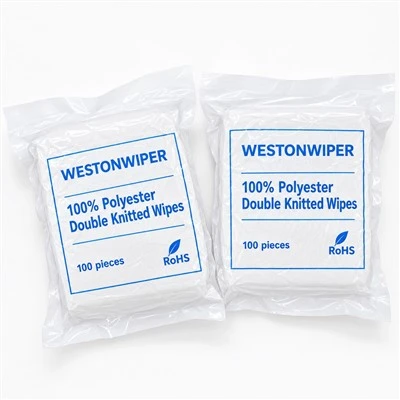
For critical semiconductor and optics applications, 100% polyester knit wipes with laser-cut or sealed edges are often considered when low particle, low fiber and low extractable performance are required. For less critical tasks, poly-cellulose wipes may offer a practical balance of absorbency and cost.
Where Should Weston Wiper Products Be Used?
Weston Wiper cleanroom consumables can support low-residue cleaning programs across semiconductor, electronics, optics and precision-manufacturing environments.
For controlled surface cleaning
Laser Cut Cleanroom Wipes are suitable for controlled cleaning of equipment exteriors, workstations, tool surfaces and other approved non-critical areas. Laser-cut edge construction is designed to support low-lint performance, which is important in semiconductor and optics applications.
These wipes can be used for:
- Equipment surface wipe-downs
- Workstation and bench cleaning
- Tool exterior maintenance
- Reticle pod and carrier exterior cleaning, where approved
- IPA or DI-water-based cleaning tasks, subject to compatibility verification
For precision and confined-area cleaning
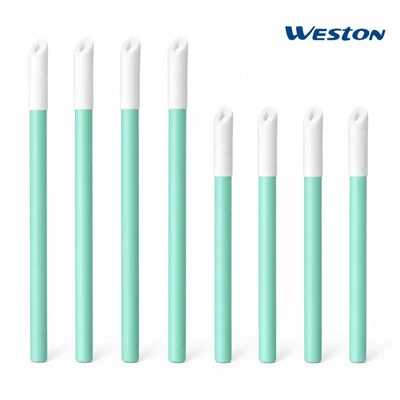
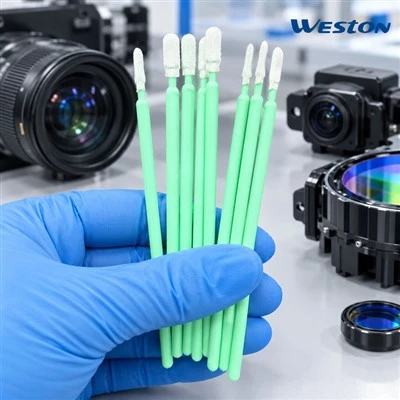
A Foam Cleanroom Swab is useful when a standard wipe cannot safely reach the area that needs cleaning. Foam-tip swabs are commonly used for controlled cleaning around sensors, connectors, slots, small components and precision equipment interfaces.
They can support:
- Sensor and connector cleaning
- Narrow-gap and recessed-area cleaning
- Precision equipment maintenance
- Controlled solvent application
- Cleaning around inspection and test equipment
As with wipes, swab selection should consider NVR, ionic extractables, tip material, solvent compatibility and the sensitivity of the surface being cleaned.
What Mistakes Should You Avoid?
Assuming "lint-free" means low residue
A wipe can be low-lint but still release NVR or ions. Particle performance, NVR and ionic extractables are separate characteristics.
Comparing test results without checking conditions
Always compare NVR and ionic data using the same extraction solvent, test method, wipe size and reporting unit.
Choosing only by absorbency
High absorbency is useful for spill control and wet cleaning, but it should not come at the expense of residue control in critical applications.
Ignoring chemical compatibility
A wipe that performs well with DI water may not be suitable for IPA, acetone or another process chemistry. Compatibility should be confirmed before use.
Using one wipe specification everywhere
A gowning area, general maintenance zone and wafer-adjacent tool area have different risk levels. Use a tiered selection approach rather than one universal wipe specification.
FAQ
What is a good NVR level for a cleanroom wipe?
There is no universal "good" NVR level. The acceptable value depends on cleanroom class, process sensitivity, wipe size, extraction solvent and internal quality requirements. Compare products using the same test method and reporting basis.
Which ions matter most in semiconductor applications?
Sodium, potassium, chloride and sulfate are commonly monitored because they may contribute to corrosion, electrical reliability or contamination-transfer concerns.
Are polyester wipes always low-NVR?
Not necessarily. Polyester wipes are often selected for critical applications because they can offer low particle and low extractable performance, but actual NVR and ion results depend on material, manufacturing, laundering, edge treatment and lot control.
Can I use the same wipe for DI water and IPA cleaning?
Only if the wipe is compatible with both cleaning chemistries. Check the supplier's technical data and validate the wipe under your actual cleaning conditions.
Do low-NVR wipes improve yield?
They can support contamination-control programs, but yield depends on many process variables. Avoid claiming that a wipe alone will improve yield; instead, evaluate it as part of a controlled cleaning and qualification process.
Low-NVR and low-ionic cleanroom wipes matter because semiconductor manufacturing is sensitive to what remains after cleaning-not only to what is visibly removed.
Weston Wiper provides Cleanroom Wipes and Cleanroom Stick Mats to support controlled cleaning in semiconductor and precision-manufacturing environments. Product selection should always be validated against the specific cleanroom class, cleaning chemistry, surface sensitivity and process SOP.