Protecting Pattern Fidelity from Storage to Exposure
Reticles and photomasks are among the most valuable and contamination-sensitive components in semiconductor photolithography. A particle, fiber, chemical residue or airborne molecular contaminant that reaches the wrong surface can affect optical transmission, pattern fidelity and, ultimately, wafer-level yield.
Unlike general equipment cleaning, reticle contamination prevention is a lifecycle discipline. It begins in the mask shop, continues through transport and storage, extends into reticle handling and scanner loading, and does not end until the mask has been inspected, requalified and returned to a controlled environment.
This guide outlines practical contamination-prevention practices for reticle and photomask environments. It is intended for photolithography engineers, mask-shop teams, contamination-control engineers and quality personnel. All procedures should be validated against the specific mask design, pellicle type, scanner platform, applicable SEMI standards and internal fab SOPs.

Why Reticle Contamination Control Matters
A reticle or photomask carries the pattern that is repeatedly transferred onto wafers during photolithography. Because one mask may be used across many exposure cycles and wafer lots, contamination on or near the reticle can have a disproportionate impact compared with contamination on a single wafer.
Contamination may not always be visible. Particles, fibers, ionic residues, organic films and airborne molecular contamination can all affect lithography performance in different ways. In advanced DUV and EUV processes, residual chemicals and environmental contaminants may also interact under exposure conditions and contribute to progressive haze formation.
The goal is therefore not simply to "keep the reticle clean." It is to maintain a controlled microenvironment around the reticle throughout its lifecycle, while avoiding any cleaning or handling practice that could introduce new contamination or damage.
Understanding Reticles and Photomasks
A photomask, often called a reticle in wafer-fab environments, is a patterned quartz substrate used to transfer circuit geometries onto a photoresist-coated wafer. The patterned surface may include chrome or other absorber layers, anti-reflective coatings, phase-shift structures and alignment features.
Some reticles are fitted with a pellicle: a thin transparent membrane mounted above the patterned surface. Its purpose is to keep particles away from the critical pattern plane and outside the exposure focal range. However, a pellicle is itself delicate and requires careful handling.
Different mask types have different sensitivities:
- Binary masks are generally more robust but still sensitive to particles, residues and handling damage.
- Phase-shift masks may include additional layers or structures that require stricter chemical and mechanical control.
- EUV masks often require more stringent handling, storage and environmental controls because of their value and exposure conditions.
- Pelliclized masks require special caution around the membrane, frame and adhesive areas.
For this reason, a single universal cleaning method is rarely appropriate. The correct approach depends on mask construction, coating stack, pellicle configuration, exposure wavelength and fab-specific risk assessment.
Main Contamination Risks
Reticle contamination can come from the surrounding air, handling tools, carriers, operators, cleaning materials and even the mask's own storage environment. The most important risks include:
|
Contamination Type |
Common Source |
Potential Impact |
|
Particles |
Ambient air, carriers, tools, operators, improper packaging |
Printable defects, light scattering, pattern distortion |
|
Fibers |
Unsuitable wipes, garments or packaging |
Repeatable defects and inspection interference |
|
Organic residues |
Outgassing materials, fingerprints, incompatible chemicals |
Haze formation and optical transmission changes |
|
Ionic contamination |
Cleaning chemicals, water quality, handling materials |
Chemical reactions, residue formation, corrosion risk |
|
AMC |
Ammonia, amines, VOCs and other airborne molecules |
Photoresist interaction, haze risk, CD variation |
|
Haze |
Residual chemicals, humidity and exposure-related reactions |
Light scattering, CD shift and progressive defects |
|
Mechanical damage |
Poor handling, incorrect carrier seating, edge contact |
Permanent pattern, coating or substrate damage |
Haze is particularly important in advanced lithography. Residual sulfate, ammonium and organic contaminants can undergo photochemical reactions under DUV or EUV exposure, leading to crystal growth and progressive haze defectivity. Controlling humidity, AMC and material outgassing is therefore as important as controlling visible particles.
Contamination Prevention Across the Reticle Lifecycle
A robust prevention program should follow the reticle through every stage of its use:
Mask Shop → Transport → Fab Storage → Handling → Scanner Loading → Exposure → Inspection → Return or Requalification
Mask Shop and Incoming Quality
Contamination prevention begins before the reticle enters the fab. Mask shops should define release criteria for particle adders, visual defects, haze indicators and packaging integrity.
Incoming inspection should document:
- Reticle identification and version
- Inspection date and results
- Pellicle condition, where applicable
- Carrier or pod condition
- Cleaning or repair history
- Any deviation or quarantine status
Packaging and carriers should be cleanroom-compatible, low-particle and low-outgassing. A reticle should not be placed into a carrier that has not been qualified for particle, moisture and chemical-contamination control.
Transport and Storage
Transport and storage are often overlooked contamination points. When a reticle leaves a controlled storage environment, it may be exposed to changes in humidity, airborne molecules and particle ingress.
Best practices include:
- Use qualified reticle pods or carriers designed for the specific mask type.
- Keep reticles sealed when not actively in use.
- Minimize time outside purged storage or controlled mini-environments.
- Avoid glass-to-glass, glass-to-metal or uncontrolled surface contact.
- Store carriers in approved stockers with appropriate environmental controls.
- Where required, use clean dry air or nitrogen purge to maintain a dry, controlled microenvironment.
Reticle pods should limit ambient entrainment and help control moisture and AMC. In advanced applications, continuous purge and low-permeability carrier materials can help maintain a drier, cleaner microenvironment during transport and storage.
Handling and Transfer
Reticle handling should occur only in approved laminar-flow, mini-environment or other controlled conditions. Operators should avoid unnecessary open-air exposure and should never place hands, tools or unapproved materials upstream of an exposed reticle in laminar flow.
Recommended practices include:
- Use dedicated, ESD-safe mechanical handlers.
- Avoid generic tweezers, unprotected hand contact or improvised tools.
- Maintain the correct reticle orientation during transfer.
- Use smooth, level transfer paths to reduce vibration and particle mobilization.
- Inspect carriers and pods before loading.
- Follow the scanner manufacturer's loading procedure and fab-specific SOP.
High-value reticles require protection not only from particles but also from electric fields and handling damage. Dedicated reticle handlers and compatible SMIF pod interfaces help reduce these risks.
Scanner Loading and Exposure
Before loading, confirm that the carrier, pod and scanner load port are compatible. Avoid forcing a carrier into a mismatched interface, and do not bypass inspection steps to save time.
During loading and exposure:
- Minimize open-air dwell time.
- Avoid unnecessary door openings or repeated carrier transfers.
- Follow controlled pressure-transition procedures where applicable.
- Keep the area around the load port free from unapproved materials.
- Ensure operators follow glove, garment and ESD requirements.
The reticle should spend as little time as possible outside its qualified storage or purge environment. Longer transit times increase the opportunity for moisture and airborne contaminants to enter the carrier microenvironment.
Inspection and Requalification
Inspection should not be treated as a one-time event. Fabs commonly use exposure count, elapsed time, process criticality, observed defects or preventive-maintenance schedules to determine when a reticle should be inspected.
Inspection records should include:
- Particle adders or defect mapping
- Haze or transmission indicators, where applicable
- Pellicle condition and frame integrity
- Carrier and pod condition
- Exposure count and storage duration
- Cleaning, repair or requalification history
If a reticle shows unexplained particle growth, haze indicators, pellicle damage or abnormal printed results, it should be quarantined until the cause is understood.
Cleaning Boundaries: What Should and Should Not Be Cleaned
One of the most important principles in reticle contamination control is knowing where routine cleanroom cleaning ends and specialized mask cleaning begins.
Suitable for routine fab-level control
- External surfaces of reticle pods and carriers
- Non-patterned exterior areas, where explicitly approved by the mask owner
- Reticle-storage and transfer workstations
- Load-port and handling-equipment exterior surfaces
- General housekeeping around reticle-storage and inspection zones
Usually requires qualified mask-cleaning processes
- Direct cleaning of patterned chrome or absorber surfaces
- Cleaning of pellicle membranes
- Haze removal or chemical-residue removal
- Advanced wet cleaning, megasonic cleaning, laser cleaning or cryogenic aerosol cleaning
- Any process that could alter CD, optical transmission, coatings or mask geometry
Routine cleanroom consumables can support the environment around a reticle, but they should not be assumed to be suitable for direct contact with a patterned mask surface. Direct reticle cleaning requires specialized chemistry, process control and verification.

Recommended Cleanroom Consumables
Cleanroom consumables play a supporting role in reticle contamination prevention. They help maintain clean carriers, workstations, transfer areas and equipment surfaces without introducing fibers, particles or excessive chemical residue.
For reticle pod exteriors, transfer workstations and non-critical handling surfaces, Laser Cut Cleanroom Wipes can support controlled cleaning with clean, consistent edges and low-lint performance. Their laser-cut edge construction is intended to help reduce fiber release compared with conventionally cut wiping materials.
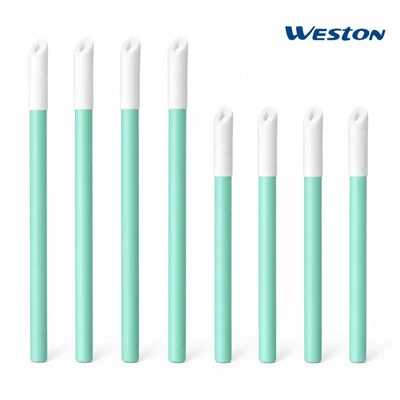
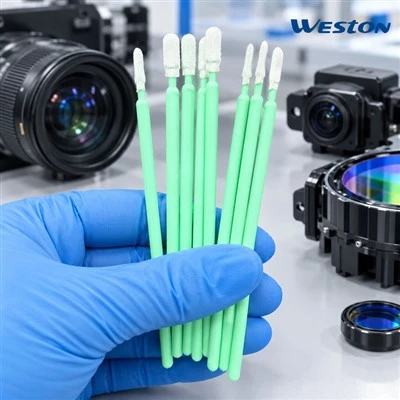
For narrow gaps, sensor housings, inspection equipment, tool interfaces and other confined areas, a Foam Cleanroom Swab can provide controlled access where a standard wipe cannot safely reach. Foam-tip swabs are commonly used for controlled solvent delivery and precision cleaning around equipment surfaces, provided the swab material and chemistry are approved for the application.
|
Application |
Recommended Product |
Purpose |
|
Reticle pod and carrier exterior cleaning |
Laser Cut Cleanroom Wipes |
Low-lint cleaning of external carrier and pod surfaces |
|
Reticle storage and transfer workstations |
Laser Cut Cleanroom Wipes |
Maintain clean work surfaces in handling zones |
|
Narrow gaps and equipment interfaces |
Foam Cleanroom Swab |
Controlled access to confined or precision areas |
|
Operator protection |
Cleanroom garments and gloves |
Reduce operator-generated particle contamination |
|
Entry and material-transfer control |
Sticky rollers and sticky mats |
Reduce particle transfer into reticle-handling zones |
|
ESD-sensitive handling areas |
ESD-aware gloves and consumables |
Support static-control practices |
These products should be used according to the fab's approved cleaning chemistry and SOP. They are not a substitute for qualified reticle-cleaning processes.
AMC and Haze Prevention
Airborne molecular contamination is a major concern in photolithography because it is not always visible and can interact with photoresist chemistry or reticle surfaces.
Relevant AMC categories include:
Ammonia and amines: Can interact with chemically amplified DUV photoresists and affect lithographic performance.
Sulfur-containing compounds: May contribute to sulfate-related haze formation under certain exposure conditions.
VOCs and siloxanes: Can originate from materials, packaging or surrounding equipment and may contribute to organic contamination or haze.
Moisture: Can influence chemical reactions and haze growth, particularly when combined with residual contaminants.
Practical prevention measures include:
Use low-outgassing carriers, pods and packaging materials.
Minimize reticle time outside purged storage.
Use controlled purge systems where required.
Avoid unapproved chemicals, adhesives, labels or packaging near reticle storage areas.
Maintain fab-level AMC monitoring and filtration programs.
Follow humidity-control requirements defined by the fab and scanner manufacturer.
AMC control is not solved by wipes alone. It requires a combination of air filtration, material selection, storage design, logistics control and ongoing monitoring.
Practical Checklist for Reticle Contamination Prevention
Use this checklist as a starting point for internal SOP development:
Use approved, low-outgassing reticle carriers and pods.
Keep reticles sealed when not in use.
Transfer reticles only in approved laminar-flow or mini-environment areas.
Use dedicated ESD-safe handling tools.
Maintain correct orientation and avoid unnecessary tilt or vibration.
Do not allow unapproved wipes, gloves or packaging near exposed reticles.
Inspect carriers and pods before reticle loading.
Track exposure count, storage time, inspection results and cleaning history.
Quarantine suspect masks immediately.
Leave patterned-surface and pellicle cleaning to qualified mask-cleaning processes.
Use Laser Cut Cleanroom Wipes only on approved external or non-critical surfaces.
Use a Foam Cleanroom Swab only where precision access is required and the material is compatible with the cleaning chemistry.
Common Mistakes to Avoid
- Using general-purpose wipes near reticle-handling areas.
- Treating all reticle contamination as a simple wiping problem.
- Cleaning pellicles or patterned surfaces without a qualified process.
- Leaving reticles exposed to ambient fab air for extended periods.
- Ignoring carrier outgassing and AMC exposure.
- Failing to document inspection, transport and cleaning history.
- Assuming that a clean-looking reticle is contamination-free.
- Using excessive liquid when cleaning near sensitive equipment.
- Reusing contaminated wipe surfaces or swabs.
FAQ
Q1: Can cleanroom wipes be used directly on a reticle patterned surface?
Generally, no. Direct cleaning of patterned reticle surfaces should follow a qualified mask-cleaning process. Cleanroom wipes are better suited to external carrier surfaces, workstations and non-critical handling areas.
Q2: What causes haze on photomasks?
Haze can result from interactions among residual chemicals, airborne contaminants, moisture and DUV/EUV exposure. Organic outgassing, sulfate and ammonium-related contamination are important contributors.
Q3: How can fabs reduce AMC exposure around reticles?
Use low-outgassing carriers, sealed storage, purged environments where applicable, controlled air filtration and monitoring, and approved low-contamination consumables.
Q4: What is the role of a pellicle?
A pellicle is a thin transparent membrane that helps keep particles away from the patterned mask surface and outside the exposure focal plane.
Q5: When should a reticle be quarantined?
When it shows unexplained particle adders, haze indicators, handling damage, pellicle concerns or an unexplained change in printed results.
Q6: Can a foam swab be used on a reticle?
A foam swab should not be used directly on a patterned reticle surface or pellicle unless specifically approved by a qualified mask-cleaning process. It is more appropriate for controlled cleaning of surrounding equipment, narrow gaps and non-critical surfaces.
Conclusion
Reticle and photomask contamination prevention is not a single cleaning step. It is a coordinated program covering mask-shop release, transport, storage, handling, scanner loading, exposure, inspection and requalification.
The most effective programs combine controlled storage, careful handling, low-outgassing carriers, disciplined inspection and appropriate cleanroom consumables around-not directly on-the mask's critical surfaces. By treating the reticle environment as a controlled system, fabs can reduce avoidable contamination risks while protecting pattern fidelity and process stability.
Need support selecting cleanroom consumables for your photolithography or reticle-handling area?
Contact the Weston Wiper technical team for product recommendations, samples and application support.