What Causes Static Electricity During Cleanroom Wiping?
Static charge during cleanroom wiping comes mainly from contact and separation between the wiper and other materials, such as its packaging and the surface being wiped. How much builds up depends on the materials involved, humidity, wiping speed and contact pressure. The charge may remain on the wiper, on the surface being wiped, or both, and each case matters for different reasons.
Why Contact and Separation Create Charge
When two dissimilar insulating materials rub together and are then pulled apart, each can leave the contact carrying an electrical charge. This is triboelectric charging, the same effect behind the small shock from a doorknob after walking across carpet.
In electronics and semiconductor work, an uncontrolled electrostatic discharge (ESD) can damage sensitive integrated circuits, and patent literature on cleanroom static control also describes charged surfaces attracting dust that ends up on products. Those two concerns, discharge and particle attraction, are why static matters even in a room designed mainly to control particles.
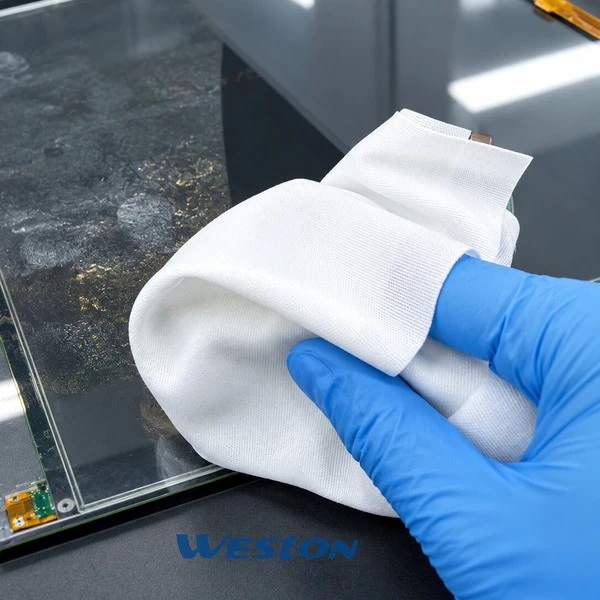
Following One Wipe: Where Charge Can Appear
It helps to stop picturing a wipe as a single event. It is a sequence of steps, and each step offers a different opportunity for charge to form. The sequence below is our way of organizing the published mechanisms; it is a reasoning aid, not a set of measurements.
1. Taking the Wiper Out of Its Bag
Many cleanroom wipers are knitted from polyester or other synthetic fibers and packed in plastic bags. Pulling a dry wiper out of a plastic bag moves one insulating surface against another, a standard setup for triboelectric charging. A charged wiper carried close to an unprotected device is the kind of situation ESD control programs are built to avoid.
2. Folding and Handling
Folding presses fabric against fabric, and every unfolding is another separation. Hands add one more material pair: the glove against the wiper. Many operators wear knit gloves with a dotted grip surface, such as Dotted Anti-static Gloves, and the glove–wiper pair is worth including when you think about where charge comes from. Whether a particular glove lowers charging depends on its construction and on test data rather than on its name. The ESD Association's gloves working group has been working on test methods for triboelectric charging of gloves and finger cots, and a separate standard test method exists for measuring the electrical resistance of gloves and finger cots. Resistance and charging are different properties, a point we return to below.
3. Wetting the Wiper
Dampening a wiper with deionized water, or with a deionized water and isopropyl alcohol (IPA) mixture, has been reported to shift its electrical behavior from insulative toward dissipative, and pre-wetted wipers avoid the dry bag-removal step altogether. That is a useful observation, but it is not a guarantee. The amount of liquid, the solvent, and how long the wiper has been out of its package all change what "wet" means, and we did not find published measurements that follow charge through the drying phase. We therefore treat "wetting solves it" as a claim to test, not an assumption.
4. The Stroke and the Lift-Off
Because charge separation happens when contact ends, a wiping motion is better pictured as many small contact-and-separation events than as one long rub. Speed, pressure and the materials involved all feed into how much charge each event leaves behind.
5. After the Wipe
What the wiped surface is made of largely decides what happens to any charge left behind. Patent background text on antistatic wipers notes that wiping plastic, glass and other insulating surfaces can leave a charge on the surface that re-attracts dust and dirt, and that an insulator, by definition, cannot be grounded.
Four Variables to Record, Not Guess
A widely used ESD supplier Q&A discusses four factors that affect static generation:
Materials: Where the wiper and the surface it touches sit relative to each other in the triboelectric series.
Humidity: Charge generation is generally described as more efficient at low relative humidity, and many cleanrooms are run dry.
Speed: How fast the wiper moves across the surface.
Contact pressure: How hard it is pressed.
Room-level conditions add to this. An ESD specialist's article points out that objects are wiped down before entering a cleanroom, that low humidity raises charge generation, and that ions are attracted to HEPA filter media and removed from incoming air, which limits one of the ways charge is normally neutralized.
Three Questions, Not One
"Does this wiper cause static?" bundles together three different questions:
A. Does the wiper charge itself?
B. Does the wiper leave charge on the surface it wipes?
C. Can a charged wiper or surface cause a discharge, or a field-induced event, near a sensitive item?
The answers depend on what is being wiped. The table below applies general ESD principles; it is conceptual guidance, not test data.
|
Wiped surface |
Charge-related question |
What to check |
|
Grounded conductive surface |
Charge on the target can drain through its ground path, but the wiper's own charge (A) and any discharge when it moves to other items (C) still matter. |
Wiper charge; verified grounding |
|
Isolated (ungrounded) conductor |
Can collect charge and release it suddenly. |
Grounding path; discharge behavior |
|
Insulating surface such as plastic, glass or acrylic |
Cannot be grounded, so charge left behind (B) may persist. |
Field after wiping; neutralization options |
|
Any surface near an ESD-sensitive item |
A charged wiper or surface can create a field at the item (C). |
Distance; field readings |
For process-required insulators near ESD-sensitive items, ESD program guidance referenced by equipment suppliers calls for measuring the field and, where it is above the program's limits, separating the items or using ionization or other charge-mitigating techniques.
What Surface Resistance Does-and Doesn't-Tell You
Wiper datasheets commonly report a surface resistance, often in the range of 10⁸ to 10¹¹ ohms, and sometimes a maximum tribo-charge voltage. These numbers come from different kinds of tests.
ANSI/ESD STM11.11 describes how to measure the surface resistance of planar materials, and it applies the measurement without regard to the material's mechanism of conduction. It is a resistance measurement. Triboelectric charge accumulation is covered by a separate ESD Association document, ESD ADV11.2. IEST-RP-CC004.3, a recommended practice for evaluating wiping materials, includes its own section on static testing.
In practical terms, surface resistance describes how readily charge can move through or across the wiper surface. It does not by itself say how much charge is generated at the interface, and the patent background cited above argues that a wiper's resistivity is not directly related to reducing charge on an insulating surface that cannot be grounded. Treat resistance as one input, not as an answer to all three questions above.
Charge is also unlikely to be spread evenly. In NIST work on mapping charge on wipe cloths, researchers found that some wipe materials do not charge extensively while others accumulate charge through contact, and that charge domains are not uniform. That study concerned wipe sampling rather than cleanroom wiping, so it should not be applied directly, but it is a reminder that a single-point reading may not describe the whole wiper.
Reading a Wiper's Static Data: Six Questions
Before comparing one datasheet number with another, ask:
What were the relative humidity and temperature during the test?
What was the wiper rubbed against, and was that material the same in both tests?
What speed, pressure and number of strokes were used?
Was the wiper tested dry or wet, and how was it conditioned beforehand?
Which face of the wiper, and which location on it, was measured?
Which standard or method was used, and is the full report available?
These are reasonable questions to put to any ESD Cleanroom Wipes manufacturer before comparing numbers. Two figures measured under different conditions are not directly comparable, and a figure with no stated conditions is hard to interpret at all.
The Clean–Charge–Re-attract Loop
Wiping aims to remove particles. If the wipe also leaves charge on an insulating surface, that charge can pull particles back, and cleanroom static-control patents describe dust deposition driven by static as a cause of defective products. Whether this happens in a given process depends on the materials, the humidity and the wiping technique, so the useful step is to measure both outcomes after wiping: particle level and electrostatic field. Looking at only one can hide a trade-off.
When Solvents Are Involved
Pre-saturated IPA wipers are used for convenience and reproducible wetting, but they still carry the health and safety concerns of volatile solvents, including flammability and personnel exposure. In cleanrooms that handle flammable substances, static electricity is also treated as an ignition concern. If flammable solvents are part of your wiping process, follow the safety data sheet and your site's safety assessment, and involve your safety and ESD coordinators in decisions about wiper type and handling.
A Practical Checklist for Process Owners
Record relative humidity, wiper type, dry or wet state, solvent, and the material being wiped.
Measure the electrostatic field near the wiped surface before and after wiping with a field meter, at a consistent distance.
Change one variable at a time, such as speed, pressure, wiper type or wetting level, and record the result.
Check the grounding path for conductive items before assuming charge can drain.
Where an insulating surface is required near sensitive items, discuss separation or neutralization with your ESD coordinator.
Keep the readings together with their conditions so that later comparisons are meaningful.
Frequently Asked Questions
Does Wetting a Cleanroom Wiper Stop Static?
Wetting with deionized water or a water and IPA mixture has been reported to change a wiper's electrical behavior from insulative toward dissipative. It is not a guarantee. The solvent, the wetness level, evaporation and the surface being wiped can all change the outcome, so verify it for your own process.
Is a Low-Resistance Wiper the Same as a Low-Charging Wiper?
No. Surface resistance and triboelectric charge accumulation are measured by different methods. Resistance says little about how much charge is generated at the contact interface or what remains on an insulating surface.
Why Does Static Seem Worse in Dry Cleanrooms?
Static charge generation is generally described as more efficient at low relative humidity, and many cleanrooms are kept dry.
How Can I Check Charge After Wiping?
An electrostatic field meter is one common tool. Measure at a consistent distance, record humidity and the materials involved, and follow the limits and procedures in your facility's ESD control program.
Can Static From Wiping Attract Particles Back?
Patent background text describes this for insulating surfaces. How much it matters depends on your materials, humidity and technique, so measure rather than assume.