Why Should Laser Optics Be Handled with Powder-Free Gloves?
Laser optics should be handled with powder-free gloves because bare hands transfer oils, salts, and fingerprints, while powdered gloves can release particles that contaminate delicate coated surfaces. In high-power laser systems, even microscopic contamination can increase scattering, reduce transmission or reflectivity, create absorption hotspots, and eventually damage an optic or shorten its service life.
For manufacturers and cleanroom operators, powder-free gloves are therefore not an optional comfort item. They are a basic contamination-control barrier that protects optical coatings, beam quality, and downstream process yield.
What Happens When Laser Optics Become Contaminated?
Fingerprints and Skin Oils Damage Coatings
Human skin constantly releases sebum, sweat, salts, and skin flakes. When these substances contact a lens, mirror, window, or filter, they can leave residues that are difficult to remove completely-even after brief contact.
On coated laser optics, these residues may cause:
- Increased surface scattering
- Reduced transmission or reflectivity
- Localized absorption under laser irradiation
- Coating degradation over time
- Higher cleaning frequency and greater risk of accidental scratching
This is why optical-handling guidance consistently recommends powder-free gloves or finger cots whenever optics are unpacked, inspected, installed, or cleaned.
Small Particles Can Cause Laser-Induced Damage
Dust, fibers, glove powder, and dried cleaning residues can absorb laser energy. At high power density, a small contaminant may become a localized heat source, potentially damaging an anti-reflection coating, high-reflection coating, or substrate.
The problem is not only visible dirt. Particles too small to see can still affect optical performance, especially in precision laser cutting, marking, lithography, sensing, and scientific laser systems.
Contamination Reduces Beam Quality and Process Stability
A contaminated optic may scatter light, introduce unwanted absorption, or change the effective optical path. The result can be unstable output power, poor focus, beam distortion, reduced cutting or marking quality, and more frequent maintenance.
In production environments, this translates into avoidable downtime, scrap, rework, and higher cost per finished part.
Why Powder-Free Gloves Are the Safer Choice
Powdered Gloves Introduce an Avoidable Contaminant
Powdered gloves historically used powder to make donning easier. However, that powder can transfer to surfaces, become airborne, and settle on sensitive components. For laser optics, this creates a direct conflict with the goal of low-particle handling.
Powder-free gloves reduce this risk by eliminating glove powder as a contamination source. They are especially appropriate for cleanrooms, optical assembly areas, and any process where low particulate release matters.
Gloves Must Also Be Compatible with Cleaning Solvents
Laser optics are often cleaned with high-purity solvents such as isopropanol (IPA), acetone, methanol, or ethanol-depending on the optic, coating, and manufacturer instructions.
A suitable glove should therefore be:
- Powder-free
- Low-lint and low-particle
- Compatible with the solvents used in the process
- Free from coatings or additives that could transfer to optics
- Changed promptly if contaminated, torn, or exposed to aggressive chemicals
Using solvent-resistant, powder-free gloves helps prevent glove material from degrading and transferring contaminants back onto the optical surface.
Nitrile, Latex, and Finger Cots Serve Different Needs
|
Option |
Best use |
Key consideration |
|
Powder-free nitrile gloves |
General cleanroom handling and solvent-prone tasks |
Check chemical compatibility, especially with acetone |
|
Powder-free latex gloves |
Tasks requiring high tactile sensitivity |
Confirm latex compatibility with site policy and allergy controls |
|
Finger cots |
Precise, small-part handling |
Protects fingertips but offers less full-hand contamination control |
For laser optics, the priority is not simply "a glove." It is a clean, powder-free barrier that prevents direct skin contact while minimizing particle and residue transfer.
How Should Laser Optics Be Handled?
Touch Only the Edge-Never the Optical Surface
The safest practice is to hold an optic by its edge, bevel, mount, or designated non-optical area. Never touch the coated face, transmission surface, or reflective surface with gloved or bare fingers.
Even a gloved fingertip can leave residue or apply pressure that risks damaging a delicate coating. Handling should be slow, controlled, and limited to the minimum necessary.
Use a Clean, Controlled Work Area
Prepare a clean, smooth, oil-free work surface before removing an optic from its packaging. Avoid working near open containers, cardboard, packaging foam, or other particle-generating materials.
Whenever possible, unpack and inspect optics in a cleanroom, laminar-flow bench, or other controlled environment. Return unused optics to their protective packaging promptly.
Change Gloves at the Right Time
Gloves should be replaced when they are:
- Visibly soiled
- Torn or punctured
- Exposed to solvent
- Used after handling packaging, tools, or non-cleanroom surfaces
- Suspected of transferring contamination
A clean glove is only effective while it remains clean. Reusing contaminated gloves can defeat the purpose of wearing them.
What Cleanroom Supplies Support Safe Optical Handling?
Use Low-Lint, Sealed-Edge Wipes
Gloves prevent contamination from hands, but they do not solve every cleaning risk. Wipes must also be selected carefully.
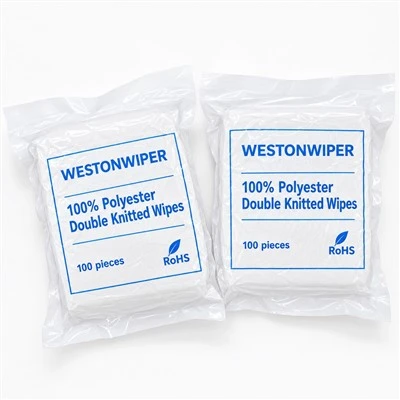
For sensitive optical and display applications, sealed edge cleanroom wipes manufacturer solutions are valuable because sealed or laser-cut edges help reduce fiber release compared with conventionally cut wipes. Lower linting reduces the chance of fibers remaining on an optic or being dragged across a coating during cleaning.
WestonWiper supplies laser-cut cleanroom wipes in common 4, 6, 9, and 12 inch sizes, with customizable weights from 80 to 250 gsm and optional pre-wetted formats.
Use Optical Swabs for Tight or Curved Areas
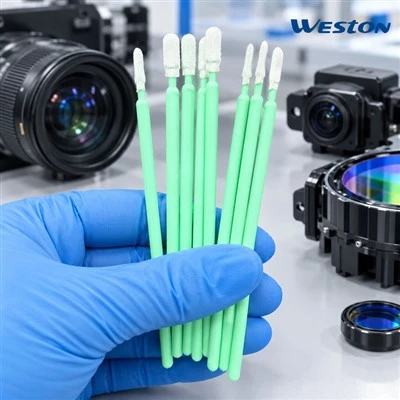
Wipes are effective for flat surfaces and larger components, but swabs are often better for lens barrels, narrow recesses, optical couplers, sensor windows, and precision corners.
A fresh swab should be used for each cleaning pass. Reusing a swab can drag particles across the surface and increase the risk of scratching.
Match Wipes to the Application
For display and electronics-adjacent cleaning tasks, LCD Panel Cleaning Wipes should be low-lint, absorbent, and compatible with the cleaning solvent or pre-wet solution used in the process. They are particularly useful for removing fingerprints, dust, and light residues from panel surfaces before assembly, inspection, or packaging.
The same principle applies to laser optics: choose a wipe that is clean, soft enough for the surface, and appropriate for the solvent system. Avoid paper towels, facial tissue, and reused cloths, which can shed fibers or scratch coatings.
Common Mistakes to Avoid
"I'll Only Touch It for a Second"
This is one of the most common causes of optical contamination. Fingerprint residue can remain even after very short contact and may not be fully removable without repeated cleaning.
"Any Lab Glove Will Work"
Ordinary laboratory gloves may contain powder, release particles, or have poor compatibility with IPA, acetone, or other cleaning solvents. For optics, select gloves specifically intended for cleanroom or precision handling.
"Frequent Cleaning Is Always Better"
Cleaning itself carries risk. Unnecessary wiping can introduce scratches, fibers, or solvent residue. Inspect the optic first and clean only when contamination is present or required by the process.
"More Solvent Means a Better Clean"
Excess solvent can leave streaks, spread contamination, or interact poorly with certain coatings. Use only cleaning agents approved for the specific optic and follow the manufacturer's cleaning procedure.
A Practical Laser Optics Handling SOP
A simple standard operating procedure should include:
- Work in a clean, controlled area with a smooth, particle-free surface.
- Wear clean, powder-free gloves or finger cots.
- Inspect the optic before touching it.
- Hold the component only by its edge or non-optical area.
- Remove loose particles with clean, dry nitrogen or an approved blower-never with a dry cloth.
- Use a fresh, low-lint wipe or swab with an approved solvent.
- Wipe gently in one controlled direction or follow the optic manufacturer's recommended motion.
- Discard the wipe or swab after use.
- Return the optic to clean packaging or install it immediately.
- Record any contamination, damage, or repeated cleaning events.
Key Takeaway
Powder-free gloves protect laser optics by preventing skin oils, fingerprints, glove powder, and particles from reaching sensitive coated surfaces. When paired with low-lint wipes, appropriate swabs, approved solvents, and disciplined handling procedures, they help preserve optical performance, reduce laser-induced damage risk, and extend component life.
For cleanroom programs that handle laser optics, displays, sensors, or precision electronics, WestonWiper provides powder-free cleanroom gloves, laser-cut cleanroom wipes, IPA pre-saturated wipes, and optical cleaning swabs to support a complete contamination-control workflow.